

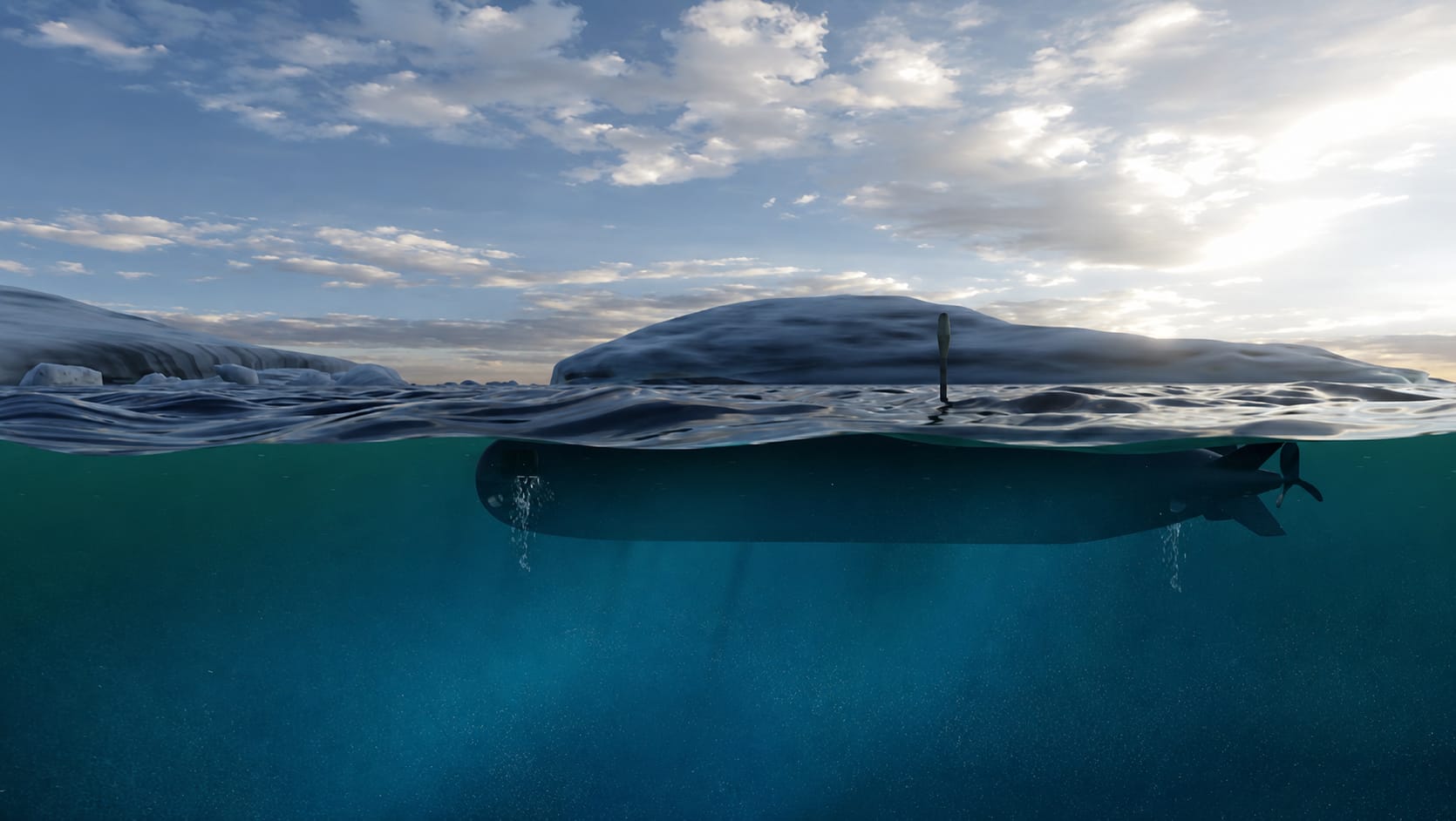
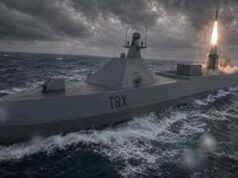
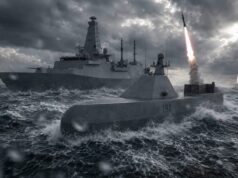
BAE Systems and Thales have given journalists at the Combined Naval Event in Farnborough an update on the Herne extra-large autonomous underwater vehicle and the new ISR mast being developed to support it, with the platform already having been at sea and a demonstration programme with international navies planned for 2027.
Emma Coughlin, Underwater Battlespace Business Development Manager at BAE Systems, said the current Herne should not be thought of as a continuation of the 2024 prototype. “This is Herne, this is the design gone through certification and military assurance, and working with payload providers that are going to support that as well. We’ve designed and assured this to be demonstrated and then available to use in operations, rather than a prototype, which the earlier version was.”
Key design changes since the prototype include a shift to a modular framework and innovations in buoyancy design to maximise payload space and improve access to payload bays. Coughlin said the team had worked through concept of operations before finalising the design, approaching the programme from a capability perspective rather than a vehicle perspective.
“We see it as a military capability that has to be integrated with the right sensing, the right payloads to deliver whatever effect it is that the end user customer wants to achieve. This is going to be a global capability, there are going to be a lot of different customers and a lot of different leads, so what we did was really consider the con ops. How are people going to use an XLAUV to get that maritime advantage, and what benefits do we bring?”
That process of working with navies to understand operational requirements directly shaped the decision to partner with Thales. One area of clear demand that emerged was surface ISR, with navies wanting not just autonomous underwater capability but the ability to sense and deliver effects at the surface as well. “We did identify a number of different navies that actually don’t want that capability as a standalone — they want to do surface ISR, they want to be able to deliver both sense and deliver an effect using ISR, and so the ISR mast was a natural fit.”
Tommy Cowan, Sea Business Sector Director at Thales, said the mast was being developed using the company’s own funding, drawing on over a century of electronics design heritage from its Glasgow facility. He was clear that this was not an existing product being offered to a new programme but a purpose-built development for next-generation uncrewed platforms. “I would call it the next generation of technology for next generation platforms. We’re really working on having the ability for that ISR mast to be agnostic to platforms, so scalable to other platforms as well.”
“The flexibility that the ISR mast offers around being able to offer a number of payloads, including the electronic warfare, communication and navigation systems, really gives us the opportunity to deliver real-time intelligent data to maximise the combat mission,” Cowan said.
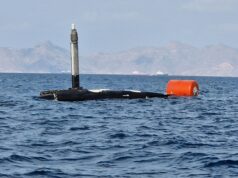
The early version of the mast will focus on visual and thermal sensing, with the modular architecture subsequently expanding to include communications, electronic warfare, and navigation payloads. It is described as a low-mass solution, designed to minimise above-water exposure during operations in contested waters where counter-detection is a direct threat to mission success.
Cowan said Thales was investing its own resources in the development because of the scale of the opportunity the hybrid navy represented. “We hear the ambition of the Royal Navy for the hybrid navy. We’re using our own funding to develop this concept. We’re working in partnership with BAE Systems, which we’ve done for over 60 years, and we’re really excited about the opportunity.” He pointed to remarks made at CNE by Scott Jameson on the flexibility requirements of the hybrid navy as directly aligning with what the Thales mast was designed to deliver.
Coughlin said the 2027 activity would be a demonstration programme rather than a formal trial, with the team working alongside navies to understand use cases and pain points in real conditions. “It’s very much demonstrating different capabilities, working with global navies to understand what the pain points are, how they want to use it, and being able to reflect back how we can support them on that.” She said ISR was a central part of that demonstration, with the combined Herne and mast capability intended to show what the system can do in practice rather than in a controlled setting.
Asked about international interest, Coughlin confirmed the team had engaged with navies from multiple regions and said the capability-led rather than vehicle-led approach had been well received. “You get the ability to use more classified capabilities that individual militaries may have, but you also get the ability to use open capabilities and switch them depending on what they need to do, whether it’s visual, electro-optical infrared, electronic support measures, and so on.”
Herne is currently progressing through a certification process with Lloyd’s Register, positioning it to become the first XLAUV certified under the organisation’s Unmanned Marine Systems Code, as the UK Defence Journal reported previously.



I’ve gained $17,240 only within four weeks by comfortably working part-time from home. Immediately when I had lost my last business, I was very troubled and thankfully I’ve located this project now in this way I’m in a position to receive thousand USD directly from home. Each individual certainly can do this easy work & make more greenbacks online by visiting
following website—.,.,.,.,.—>>> JobatHome1.Com
George if you have a message spam filter please put JobatHome1.com on it.
Keep the french out of it.