

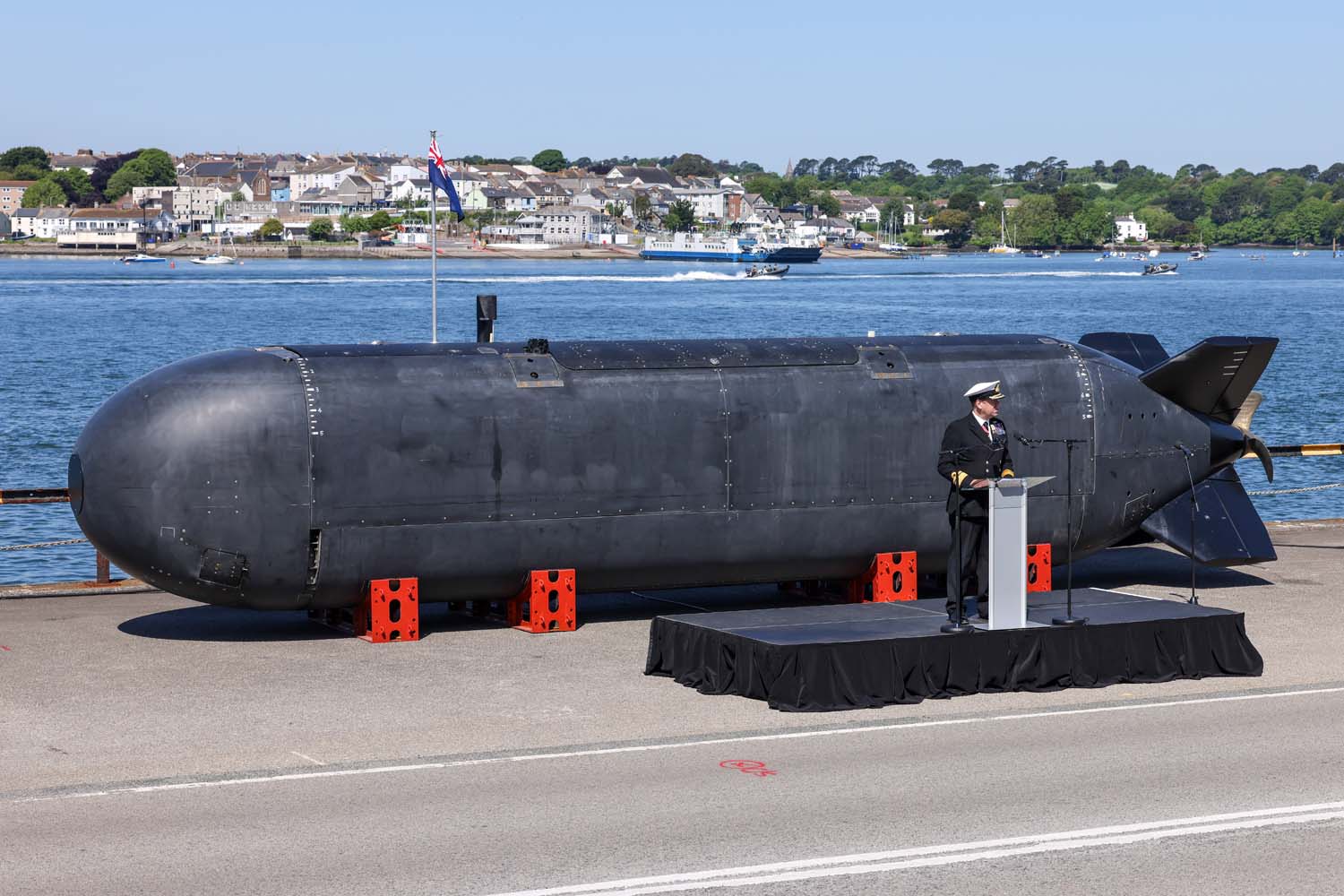
The Submarine Delivery Agency has awarded a £6.7 million contract to Plymouth-based small and medium enterprise M Subs to undertake trials and evaluation of the CETUS extra-large uncrewed underwater vehicle, the SDA stated in a contract details notice published on 25 June.
The agreement, valued at GBP 6.68bn, runs from 24 June 2026 to 1 May 2028 and covers a period of trials and evaluation using the CETUS vessel that M Subs has developed for the Royal Navy. According to the contract notice, the trials are required to de-risk underwater autonomy and to demonstrate the military utility of the platform through payload testing, with the work conducted by M Subs at the company’s Plymouth premises and on associated sea ranges.
The vessel itself was formally named XV Excalibur at a ceremony at HM Naval Base Devonport in May 2025, with the unveiling taking place in front of around 200 guests including Rear Admiral James Parkin, then Navy Director Develop, and representatives from the AUKUS partner nations. The 12-metre experimental craft, displacing 19 tonnes and measuring around two metres across, was at the time of its unveiling described by the Royal Navy as the largest uncrewed underwater vessel the service had trialled to date. The name draws on both the Arthurian legend and an experimental high-speed submarine that the Royal Navy trialled in the 1950s and 1960s.
Officially classified as an extra-large uncrewed underwater vessel, or XLUUV, Excalibur sits within the Royal Navy’s Fleet Experimentation Squadron under the Disruptive Capabilities and Technologies Office, alongside the surface experimentation vessel XV Patrick Blackett. The squadron is intended to serve as a testbed for leading-edge maritime technology, with the work conducted by Excalibur exploiting both the inherent intelligence, surveillance and reconnaissance and stealth advantages of an XLUUV and its capacity to carry bespoke payloads.
According to the Royal Navy, the vessel will not perform operational duties, with its role instead being to shape future concepts for the use of uncrewed undersea systems in a mixed force structure.
The contract has been awarded directly to M Subs without competition under the qualifying defence contract provisions of the Procurement Act 2023. The Submarine Delivery Agency justified the direct award on the basis that M Subs, as the sole designer and manufacturer of CETUS, holds all the technical and proprietary knowledge of the vessel’s form and function, and is uniquely positioned to safely operate the vessel during the execution of trials. According to the SDA, while there are alternative commercial operators of autonomous underwater vehicles in the United Kingdom market, none currently hold the necessary system knowledge to operate this particular vessel appropriately, and the use of an alternative supplier would risk delay, increased cost or higher system risks while that knowledge was acquired.
The initial work under the contract is a repeat of S201 trials previously carried out by M Subs on a smaller extra-large autonomous underwater vehicle within Project Manta, which the company delivered for the Defence and Security Accelerator under an Open Call competitive contracting route. The SDA said that knowledge of those earlier trials gives M Subs a practical advantage in allowing the activities to be repeated consistently and efficiently on the larger Excalibur platform, with the work expected to inform the wider effort to bring extra-large autonomous underwater vehicles into operational use with the Royal Navy.
At the May 2025 naming ceremony, Commodore Marcus Rose, deputy director of the Underwater Battlespace Capability, described the unveiling as a significant milestone for the Royal Navy and said the upcoming sea trials would allow the service to rapidly develop its understanding of operating uncrewed vessels of this size underwater. “The lessons learnt from this exciting programme will build on our experience from existing programmes, such as the Mine Hunting Capability programme, to inform more extensive use of these technologies in a mixed force of crewed and uncrewed systems,” he said, as quoted by the Royal Navy.
“Successful delivery of this programme is testament to what can be achieved in collaboration with our industrial partners.”
The notice also indicates that the SDA intends to broaden competition once the initial trials have been completed, with the contracting authority noting that there will be greater scope to compete the longer term operation of the system once it is better understood by all parties. Separately, the SDA said it intends to competitively seek different payloads from the open market in the coming years, allowing a broad range of suppliers to participate in advancing the military capability of the wider project.


I think the contract figure in the first sentence needs altering George.
Fascinating subject with so many opportunities. Id love to hear that a weaponised option is now available. Id also be interested in how fast they can be produced.
First sentence looks good to me for an SME. It’s the £bn figure that makes it look like a replacement for the entire Astute programme.
Sorry, that should read first sentence of para two.
I’ve told them a Billion times not to exaggerate.
Perhaps they’re testing it once for each ship in the thousand ship navy?
😁
Probably not 😡😡
thousand ship navy? chinese?
Again this is the type of stuff that can be left in place or patrol with the required sensors leaving more expensive and manpower intensive equipment to do other jobs. Like using drones to escort surface vessels it’s a no brainer
One minor problem, It’s not very fast.
Nor is. My car but I still have to use it
It was more an answer to Brom’s use of it as an escort for surface vessels. I doubt your car Is slower than 4 knots !
Or Is It 🤔😂
I was referring to surface drones for escorts 😉
Which ones ?
Hell we could do it with the Ukraine ones but the type 92 or 93 they’re proposing
Oh.
I didn’t know that Ukraine had such Escort Drones.
BTW, What do they escort ?
Nor are SSKs, I guess you could consider both more like mobile minefields/area denial? Or perhaps I am letting my amateur knowledge show
Not really.
Top speed of this Sub is 4 knots.
About the same as a speeding Sea Cucumber.
It will let the enemy come to it, I guess?
If its that slow it could get scooped up or snarled in fishing nets by large fishing biats / trawlers.
Operate in pairs of more around our undersea cables. Turn these out at the fastest rate possible
What puts them in place? if it is a surface ship it can be detected.
If it’s the underwater jobbies they can be deployed miles from danger or even from port. Once underwater they’re like any other submarine I would imagine
At 5kt speed they need hour or days to deploy.
Australia’s Ghost Shark XLUV (similar size with sensor, sonar bouy and ‘strike’ weapons) has entered production with first vessel rolled off production line in October 2025 and introduction into service in 2026. in April 2026 the RAN established a dedicated Maritime Autonomous Systems Unit (MASU) to operate its autonomous fleet alongside crewed vessels.
RAN is coy about production numbers but public statements refer to ‘dozens’ ( most likely around 30) of Ghost Sharks to be delivered.
The RAN is also bringing a smaller long range LUV the Speartooth into service. it will be lower cost and more attributable than Ghost Shark and likely to be acquired in greater numbers the Speartooth has already been exported to the USN (11 vessels).
The RAN currently operates a fleet of 15 (40 more on order) of Bluebottle autonomous surface ISR vessels – in service since 2013. The unique system is powered by solar panels and wind via a rigid sail and effectively has unlimited range and can stay at sea for months on end with reported ‘range’ up to 30,000 nautical miles or 55,000 kilometers.
Might be some operational lessons that can be shared with the Royal Navy
‘Shaping future concepts’.
I don’t think this size category of XLUUV is ready for mass investment yet. The low speed and inability to communicate effectively from underwater make them pretty useless against enemy ships or submarines except by patrolling chokepoints as a surveillance tool and even then they can’t do anything to prevent passage.
XLUUVs have their uses. 4 knots is plenty for covert survey of underwater infrastructure or coastal ISR, and there’s an opportunity to use them for X-craft style harbour attacks. But until somebody builds a UUV capable of competing with SSKs for range AND speed, or solves the comms issue, they have only niche applications.
I thought that WAS what they were being procured for, surveillance.
It is one of the “issues” I have with this whole Drone business, sea wise. It all seems benign so far, no firepower. The 7 Rattler Pacific RHIBs at least have a GPMG I think!
Ah but If you look at this Drone, It’s designed like a Suppository to attack the rear of the enemy.