

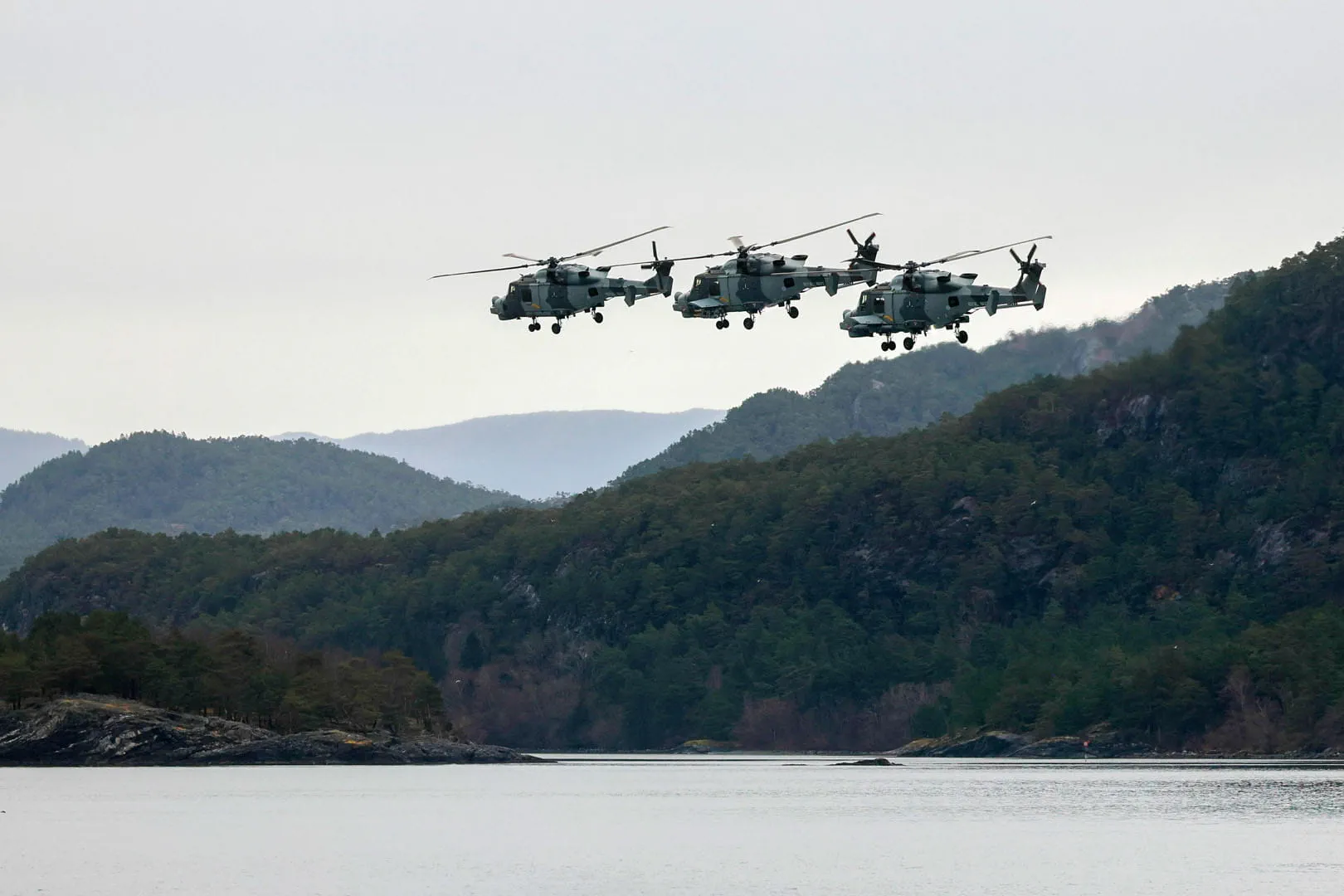
The Defence Investment Plan sets out an autonomous replacement for the Royal Navy’s Wildcat maritime helicopters and increasingly autonomous rotorcraft flying from frigates and destroyers, as the Fleet Air Arm shifts towards uncrewed flight.
The Royal Navy’s Wildcat maritime helicopters are to be replaced by autonomous aircraft, with the Defence Investment Plan setting out a future in which increasingly autonomous rotorcraft fly from the fleet’s frigates and destroyers, the plan said.
The plan listed among its commitments “an autonomous replacement for Wildcat maritime helicopters,” and described a Hybrid Carrier Air Wing flanked by increasingly autonomous rotorcraft operating off escort vessels, a signal that the small crewed helicopters now flown from the back of warships will in time give way to uncrewed machines doing the same jobs.
The Wildcat in this maritime role, the HMA2 version flown by the Fleet Air Arm, is a different aircraft from the Army’s battlefield reconnaissance Wildcat that the plan retires from 2027, and it operates from the flight decks of the Royal Navy’s frigates and destroyers in the anti-surface and reconnaissance role and in support of anti-submarine operations, armed with Martlet and Sea Venom missiles and acting as the eyes of a warship far beyond its own horizon. Replacing it with autonomous systems would extend a pattern the Navy is applying right across its aviation, in which uncrewed platforms take on roles once reserved for crewed aircraft.
The Royal Navy has already been preparing the ground for this, having run trials of uncrewed rotorcraft as technology demonstrators, including work with industry on a crewless helicopter able to carry sensors and weapons for the anti-submarine task, and an uncrewed aircraft flying from an escort carries obvious attractions, since it can stay airborne longer than a crewed helicopter, costs less to operate and risks no aircrew when it is sent into danger.
The shift is not without its difficulties, because a crewed maritime helicopter brings a skilled crew, a heavy and varied weapons load and the judgement to operate in the unforgiving conditions of the open ocean, and replacing all of that will depend on uncrewed rotorcraft maturing to the point where they can match it, taking off from and landing on a small, moving deck in poor weather and carrying enough capability to earn the space they occupy.
No date has been attached to the Wildcat’s departure from the sea in the way one has for the Army’s version.




Not sure I would be keen to do a troop transfer or a boarding operation in a “drone”.
Hate to say this put do humans have any future in the military.
Don’t they have a role in rescue and medevac as well or inserting SF?
RN Wildcat Force have a MCT Flight. Think used for sniper overwatch like with ops the other week with the tanker.
Shortly, no longer possible with this asset.
Can Snipers sit inside a Drone?
Exactly DM – refer my earlier reply to your on the retirement of the ACC helos. Begs the question though, which drone has been selected as the replacement – does it even exist? I hope the MOD realise 2027 is next year, so good luck to them with this procurement plan!
Keen to see it will be a one for one replacement?
AAC is as soon as next year, FAA longer.
After all the song and dance made over Wildcat carrying so many LMM.
Fleet Air Arm Wildcat number 28. AAC 34, so there’s your ballpark.
I predict 30 to 50 for both and “world leading.”
Once the Wildcat go, how is the RN going to deliver Sea Venom? To me, scrapping Wildcat is a panic cut dressed up as being cool & hip.
Well by my understanding, FAA Wildcat isn’t going yet, so you’d assume the Drone replacement for it.
It’s the soft power and various other roles a manned light utility heli does that are of greater concern, the RN isn’t about to drop Sea Venom Martlet capability.
Drones might be able to carry Ses Venom or maybe it can be used in ashm capacity for OPV/other patrol boats.
More rewritten sound bites to disguise the word CUT
From a drone 🤦🏻♂️
So we are scrapping a capability that works now, for a drone that may or may not be ordered, may or may not work, may or may not be jammed.
Wrong. Maybe you should read the article?
We are at some point in the future, sometime between 2030 and 2035 (ie not “now”) going to replace the Wildcats with drones rather than another manned helicopter.
Or did you think the Wildcats would last as long as B52s?
Drones work. SpaceX has had autonomous drones reentering from space and landing on barge in the middle of an ocean for years.
Re: ‘jamming’, lookup the meaning of ‘autonomous’.
Dork. As usual.
Twat, since birth.
nice DM – liking the “world leading” analysis 😂
What an utter waste of bloody money they were mate!
They have only just reached full operational status too fast!!!
I can understand getting rid of the chocolate teapot Army Wildcats, but the Navy examples were extremely useful assets.
Are we really going to fire missiles and guns from drones???
Will drones be inserting/ recovering SF and transferring personnel between frigates?
I guess the small Merlin fleet will be working even harder, with manned aviation the sole role of the QE Class. Ah well, same old shit, different day.
We’ll have to. As Drones are progressing beyond ISTAR only assets.
There was that Jackal that was being hyped with RAF roundels on years back, something along those lines no doubt.
The combat side can be replicated, the other varied tasks not so much.
Yes, bug juicy cut to add to the never ending list.
Still the apologists will find some justification I’m sure.
We’ve been firing missiles from drones for years – or have you not heard of Afghanistan, Iraq, Syria?
You do understand there’s a ‘substantial’ difference between a Reaper, meandering around in a lazy figure of 8, in safe airspace, dropping paveways and firing hellfire missiles at leasure and a rotor equipped VTL drone, ,that will have to operate in all sea states and actually be fired at by unfriendly enemies don’t you Spock??
Do you understand its a totally different issue, requiring a radically different solution.
You do understand that man has landed on the moon right?
Half man Half Vulcan… or so I heard.
lol. Wish he would bugger off into space. One way….
And preparing for a grumpy reply from Mr Spock in 3,2,1.
🥱🥱🥱🥱🥱🥱
I’ve politely mentioned this before Spock, I’m not remotely interested in your opinion of my comments.
You have little insight to offer.
Now off you pop to irritate someone else.
And yet you always comment when I respond to your latest stupidity… so it’s obvious you’re telling porkies there 🤷🏻♂️
In the vernacular of a current sporting event, that would be classed as an ‘own goal’ 😏
Sadly, I cant block you, off you go lad…
Sadly I can’t have you sectioned for being so stupid.
Off you go grandpa…
Given their use for moving people, I could imagine these being optionally piloted, either remotely from the ship itself or from the helicopter itself.
You lose the advantages in endurance and simplicity with optional crewing, but still gain the disadvantages of additional development and Comms vulnerability.
A maritime ISTAR/air defence/attack UAV would make a lot of sense but would need to be complemented by a transport, command and utility helicopter. Like a flying CCV and its escorts.
It won’t be optionally manned. Get helicopters through flight safety is expensive and also adds to the running costs. The whole point is to save money.
Yet another defence cut dressed up as being hip & trendy.
Yup. Its all smoke and mirrors. Just buzzwords
I have always been a futurist and pushing for new ideas and technology but I can’t help but think this may prove more optimism over realism at play here. In theory great but in practice I fear it will not be flexible, effective or reliable in practice as desired for all the roles expected of it in a conflict. A shared future with such drones is great, absolutely the right decision, but at this stage in drone and autonomous technology this seems like buying into the misguided predictions (some might say bs) of a Musk portraying himself as an engineer again, claiming manned flight as obsolete and selling self serving alternatives. He did after all try to kill off the manned fighter altogether and to be honest that just might be an easier vision to achieve in reality than this. Always a warning to me when those making decisions are suspicious of new tech for years then suddenly can’t get enough of it. Are they truly knowledgeable enough to judge or do they just see the accountants savings on manpower and risk removal and all the long term costs and get all heady about taking them out of the equation altogether. Vision is great but has to be through sharp lenses, not deep pink tinted ones, time will tell which this is.
Its cuts dressed up with PR buzzwords. Nothing more.
You just don’t understand it all Ron. Its not 1980 anymore
Yet despite his neo-fascist tendencies, recreational drug-use, overly optimistic timelines, and financial trickery, SpaceX has produced an autonomous reusable rocket that can land from space onto an autonomous landing-pad in the middle of the ocean.
A rocket that has repeated the feat hundreds of times now.
The issue is backing the right company (eg Space X v Blue Origin) for this technology, rather than whether the technology is achievable.
Space x landing some drone helicopter on something at sea is not really the same thing as a drone helicopter that will be expected to go into combat where every man and his dog will be trying to jam its signal I don’t think anyone is saying it’s not possible to have a drone helicopter people are mostly concerned that this is being pushed because the government thinks it will save money I’m also of the view in thinking this just an attempt to save money I’m willing to bet there will be lots of compromises in it and it won’t do as much as a manned one is capable of but they will dress it up as a success however I hope I’m wrong
Yet another dinosaur that wants to live in the past.
Wonder how the Royals will fast rope onto ships
Using Commando Force Merlin. The only Wildcat of the CHF are 847 NAS, and they’re Army examples pooled with 1 AAC.
Oooops. They’re gone too.
I spent Monday on Mounts Bay, that’s alongside in Falmouth and Tuesday catching up with some old chums at RNAS Culdrose. After the friendlies about how old we are getting and what silly things do we do now to pay the bills now, the talk was all about the newly christened DIP(-shit) plan both from old soaps and present company training. People were shaking their heads in disbelief. No one said they would fast rope from one or be able to order men onboard unless there was some sort of huge improvement in capability of autonomous platforms. One pilot said that the much-hailed Proteus flights down at Predannack are far from satisfactory. They flew a manned Wildcat against Proteus in the ongoing tests and no one was impressed apart from the Andrews with hoops. The person a group of us spoke to laughed when we brought it up. The comment was, I hope for our sake the weather is always going to be calm and sunny 24 hours a day if we are binning the current solution. Apparently, it doesn’t like the weather and the issue has been worked on for a few years without success. Who would have thought? Imagine the poor thing in the Falklands?
Hi mate.
Proteus is the example people use, it looks the part, but is it, as you say real world conditions.
Also, I’ve now learnt it was only ever a demonstrator for the software and other tech ( a good long post by Magenta here ) so we are not about to actually buy it!
They keep grandstanding it though, it has its own page in the Dip****.
Back in 2005, the MoD Perm Sec said UK was short 28% of helicopter lift. We had over 520 helos then. Now we are down to what 220 ish & yet we think we can cut more helos. This decision will come apart at the first sound of gunfire.
You do know it’s 2026?… 🤷🏻♂️🤦🏻♂️
You do realise we cannot beam down Star Trek style, so may need helicopters to get about.
You do realise we used to get about BEFORE helicopters existed? You must remember, you’d have been alive back then.
Troops coming down with WW1 trenchfoot in the 1982 Falklands conflict as we lacked enough transport helicopters in theatre. Snatch LandRovers being blown up as we lacked enough helicopters in Afghanistan.
Look at the other nations buying MH-6 Littlebird, or H-145, or AW-139, amongst others. They can see the need.
So you’re one of those people that thinks a helicopter is a helicopter, and is unable to understand that different helicopters are designed for different uses. That’s why you’re making such stupid comparisons 🤷🏻♂️
So Canada has 72 Bell 412. The French army is buying 80 H160M, the French Navy 55 H160M. The German army will have over 100 H145. Japan will have over 135 Bell 412EPX. The United States Army will have over 120 MH-6 little birds, the US Marines have 131 UH-1Y. Are these countries stupid to have these small to medium helicopters?
Hi M8,
I’m just beginning to look at this whole DIP as a fudged effort to get anything out there before next Tuesday. It’s just completely flawed from the start because the entire funding plan doesn’t meet our NATO commitment, that has forced rushed decisions many of which are just plain daft.
Yes Drones have a future and yes they will increase lethality, but in this particular case it’s too far and too soon and that statement can be backed !
The mighty and hugely well funded USN has ditched its UAV Helicopters and that was after spending a fortune getting them into service. IMHO where drones are useful is as a force multiplier for Wildcats or Merlins fielding extra sonar buoys or Torpedos, but it’s what they can’t do is the issue SAR, Casevac or even carrying SF for boarding ships.
It’s like Drones for everything but has anyone thought about who is going to control them ?
I actually think this will all implode next week at the NATO summit and then it will go back to where it needed to be a grown up conversation about delivering what we are obligated to rather than crossing our fingers and hoping no one notices we have blatantly lied to NATO.
Last night I got fed up reading lots of dross and concentrated on the money plan as that is what also has to be delivered next week.
It doesn’t meet any of the criteria set down by NATO and what we pledged to deliver.
The funding provided gets us to 2.72% by 2030 not the 3.0% Target then the funding has to be massively backloaded to get to 3.5% by 2035.
Of the 4 spending plans Navy, Land, Air and Munitions all of the except the Army are low for 27/30 and then climb through the roof for 30/35 (the Army’s drops from £41.4 Billion to £36 Billion), the increase for that period is over £50 Billion.
It’s everything we were told not to do ! It’s supposed to be an annual incremental increase from last year to 2035 which isn’t a hockey stick and guess what ? That’s exactly what they have announced.
If I were Burnham I’d either get ready to redo it or not put his nomination papers in !
Hi mate.
Yes, i read your explanation of this elsewhere on the site.
I’ve never trusted this government and nothing has changed my mind.
On Wildcat, no date set.
I see both sides.
A Drone could do the fighty side but it’s the other tasks that concern me.
Worst for me is the AAC Wildcat cut, they could be updated as CUAS assets back from the front line while being used as light utility.
Instead, just thrown away.
It’s full of holes and just plain lies it’s like the £63 million to be spent on the DNE “over the next 4 years” it’s garbage that’s the total for the DNE for a decade and started 6 years ago.
I wouldn’t take this as the last word on the DIP, it’s not done yet by any means.
Another thing about the money. If UK defence had stayed at 2.7% gdp, I would have been happy, but so many other things have been pushed into the defence budget over the last decade, that you need at least 2.95% spending to get 2.7% real defence spending.
Proteus wasn’t always supposed to be a software demonstrator. Not from the Navy’s side nor Leonardo’s. Demonstrator yes, software no. Somebody is rewriting history. That’s what it became, as publicly acknowledged by Leonardo on announcement at DSEI last year, when they admitted the physical design was deliberately not fit for purpose, and that its autonomy performance in virtual simulations was all that mattered. It was the third major iteration of the joint RWUAS programme and autonomy wasn’t even a thing when the programme started. How it was allowed to mutate to a software autonomy programme, I don’t know, but nobody told the public this was going on and I suspect a lot of relevant people in the Navy weren’t told either. I followed it closely, including chats with the Leonardo sales people at various shows over the years and while I knew they’d made compromises in the physical design to keep it in budget, DESI was the first time I’d heard how far they’d skewed the budget towards in-silico autonomy.
Remember the early tandem-rotor and embedded-fan teaser designs? It was clear the initial brief was to get a good clean-sheet physical design, which was abandoned after a year or so to create yet another manned-helicopter conversion — something they’d done with the Solo in an earlier iteration. Maybe Leonardo ran out of money or weren’t given enough in the first place, and they concentrated on the autonomy instead of what was actually useful to the Navy. I don’t know if Leonardo will get a fourth bite of the cherry. It’s not in a specific budget that I can find, although there’s general drone-directed budget. The £60m MOD put in the last time has not delivered what was billed, and unless eyes are very firmly kept on a single prize of particular capabilities, such as an ASW-capable drone, it might well deliver something not fit for purpose next time too. Drones, autonomous or not, are not an end in themselves. They have to transform or at least enhance the way the military does its job, or the money has been wasted.
All may not be lost. Amongst the in-silico boasting at DSEI, Leonardo claimed that their software was suitable for any sized rotary including the AW101. So perhaps someone will ask, why don’t we give ourselves the option to replace the Wildcats with autonomous Wildcats? I’m not saying I believe the hype, and I know it won’t be simple, but there are some spare Wildcats from the end of the year, some general drone budget and autonomy software that the manufacturer claims will work. Just saying.
Thanks.
I know the FAAs Wildcats are not gone for quite a while, just wondering what was out there to replace them.
Maybe nothing, and they’ll remain as common sense prevails, or the cuts saving cannot be realised.
I wish Parliament was Unmanned.
Might be WFH with Burnham and robots in Parliament
Well technically wouldn’t an ai model by say Cosine certainly theoretically be capable of doing a better job than politicians, judges, lawyers, teachers and of course defence analysts. Strangely I doubt any of those will be given up to this technology because it is no doubt deemed the human element (by those likely to lose their roles) is vital in those scenarios. Perhaps we should ask those on the frontline what they think in that regard, one might hope they are at least in the loop, rather than things decided from above based on less than operational considerations. We have seen too many decisions based on what works fine in peacetime less so in wartime. Assuming that we won’t need to fight a war and it all being essentially for show is a luxury we no longer can afford.
I think it is, they are barley human.
Is this a joke? Wildcats are virtually brandnew I recall the crews being interviewed when they were introduced. I personally doubt the Army’s OSD will stick, and at least 25% will be retained for a long time yet. Autonomous systems do make sense, and the objectives are right for the future; however, the transition is bound to be a roller-coaster ride with many setbacks.
Err, yes!
announce that cabinet ministers wont have their chauffeured cars anymore they will all be driverless cars
Yes, those nice Chinese ones that self ignite.
The Chinese only build electric ones now, not ones powered by explosive fossil fuels.
No they don’t.
They build both electric and ICE using power from over 3000 Coal fired Power Stations and other renewables.🤦♂️🤦♀️🤡🤡🤡🤡🤡.
What do you call a Female Clown ?
Mate, thanks that had me rolling!
Good luck with putting out a fire in a lithium ion battery.
Funny, I’ve had countless lithium ion batteries, never had one catch fire.
You’re clearly doing something wrong.
You tube has numbers beyond count of videos of electric vehicles on fire.
“Freedom of Information (FOI) request revealed that in 2019 the London Fire Brigade dealt with just 54 electric vehicle fires compared to 1,898 petrol and diesel fires.”
And the fire service had records showing petrol cars catch on fire more frequently than electric.
But why believe facts when you can watch YouTube videos endorsing your antiquated prejudices?
Yes, but you can put out fires in Petrol cars. I have watched the Paris fire brigade do it to a row of cars after a riot, but the one electric car kept re igniting, no matter how many times they thought they had put it out.
Ah yes, when you can’t win with facts or statistics, use a personal anecdote…
According to your logic we should ban chip pans then, because you can’t put them out with water either. As anyone who has done a fire safety course knows, you use different extinguishers depending upon the type of fire. Use the wrong extinguisher and it won’t work or possibly make things worse.
Personally I don’t believe the Paris fire-brigade are as incompetent as you claim.
The transition to F-35B’s was going to be a roller coaster so clearly they kept back a couple of squadrons from Joint Force Harrier to cover…Oh, of course they didn’t. They didn’t even keep a flight going to do fixed wing flight trials with. All of this is just more cuts disguised as progress that never arrives or can’t do the job when it does arrive ten years late.
The same is happening with two T23s they are being shown early doors, leaving even less surface support, and all before the T26 and T31s show their faces. It all makes eminent sense.
Got to pay for the dinghy peoples new houses and the 900,000 yoofs who all have ADHD and autism.
Every one of your comments in this thread reads like it is straight off a Facebook page set up by Russia to con boomers.
is it just me or am I seeing drastic reductions in various equipment for the powerpoint promises of unproven tech?
Of course.
Cuts happen quickly.
Replacements may or may not even survive.
( small print riiiight at the wnd of the DIP.)
It’s basically a vague list of things that survived the chop, and a list of things that didn’t.
Hollowed out forces, anyone?
I would suggest great insight to you both. You can offer all manner of exotic new untested tech as cover for getting rid of existing tech, if firstly you won’t be around to take the can or worse still if you don’t have any clear intention or timeline to introduce that replacement tech. After all fitted for not with us an essential part of British planning so this is just taking it to the next level. Proton torpedos anyone, that should excite the audience for a while.
I launched a Protein Torpedo earlier…. Had to use a stick to help It past the U-Bend though…. 😁
Ere you, I’ve told you to behave before!
Proton torpedo? Are they made by that old Yugoslav company?
What about using the photon torpedoes Picard used 😉🖖? They are about as much of a fantasy thing as what’s in parts/most of, the DIP(shit) HMG plan.
Yes you are, The money is not there either, an industry source told me that the MOD has to find £10 billion in savings in order to get the ball rolling.
Frankly DIP is the biggest long con in parliamentary history.
You wouldn’t get me in a drone with a view to fast-roping onto a contested deck. This automation malarkey is being seen as the golden goose to cure underfunding. There’s nothing better than working with good experienced helicopter crew when you are dealing with the need to use people. The decision to retire the Royal Navy’s Wildcat helicopters is being presented as progress. I see it as a serious mistake.
Nobody disputes that drones and autonomous systems are changing warfare. The conflict in Ukraine has demonstrated how effective they can be for surveillance, reconnaissance and strike missions. They are cheaper to operate, can reduce risk to aircrew and have become an essential part of modern military capability. They deserve investment, but they are not a replacement for experienced helicopter crews.
You would not get me into a drone with the intention of fast roping onto a hostile ship. There is a fundamental difference between using an unmanned aircraft to observe a target and inserting Royal Marines onto a contested deck in poor weather, at night or under enemy fire.
I have worked with helicopter crews in demanding operational environments. There is no substitute for experienced pilots and observers making split-second decisions based on what they see around them. Human beings recognise subtle movement, changes in behaviour and emerging threats instinctively. Our eyes process depth, movement, contrast and fleeting visual cues that cameras often fail to capture. Anyone who has spent time relying on video systems knows they are an outstanding tool for recording and reviewing events, but they cannot match human observation and judgement in real time.
The same applies to humanitarian operations. A Wildcat or Merlin does far more than transport equipment. It rescues casualties, evacuates civilians, delivers emergency supplies and reaches communities cut off by floods, earthquakes and hurricanes. It carries frightened families to safety, secures vulnerable passengers and adapts instantly when circumstances change. A drone cannot comfort an injured child, secure a stretcher, reassure a terrified parent or improvise when the unexpected happens.
The Ministry of Defence’s Defence Investment Plan rightly places greater emphasis on autonomous systems, artificial intelligence and uncrewed platforms. Future military operations will increasingly combine crewed and uncrewed systems working together. The problem is not investing in drones. The problem is retiring proven capability before technology has demonstrated it can perform every task currently undertaken by a manned helicopter.
Capability is not measured by the purchase price of an aircraft. It is measured by what it can achieve on the worst day, in the worst weather and in the most dangerous circumstances. The Wildcat represents decades of operational knowledge, training and experience, much of it earned through sacrifice. Once that capability disappears, it cannot simply be recreated by buying another aircraft years later.
This proposal is not primarily about improving military capability. It is about reducing costs. Saving money by removing proven capability creates unnecessary operational risk. If that gamble proves wrong, the price will not simply be measured in pounds. It will be measured in reduced operational effectiveness and, ultimately, in lives.
Very well said 👏
Your last paragraph basically sums up what Healy said when he resigned!
I’ve yet to hear of Ukrainians fast roping from drones.
👏 👏 👏 👏 👏 👏 👏
I doubt you’ll get a reply from the cuts apologists on here though.
I bet you do. There is always some idiot that thinks you can defend the indefensible.
Seriously, whoever is making these ‘decisions’ (sic) need to be sacked – they are idiots of the first degree.
.
.
Drones cannot be used for SAR missions or personnel transfers, while target prosecution missions are arguably harder when personnel are not in the platform itself – cameras no matter how effective do not not replace the Mark I Eyeball – I know from experience (albeit from a couple of decades back 🙂) when I was involved in surface warship EOIS trials.
.
.
Like my post on the just as hare-brained, stupid and teeny-pinching led decision (apologies I could add more adjectives but I digress..). decision to replace the T45s with drones, this is not to say unmanned platforms do not have role to augment manned platforms, but again I must stress augment, not replace as again a drone cannot do soft-power mission, meet with local officials, conduct sporties with local teams (demonstrating soft-power capabilities of hard-power platforms).
Yep, thought of much of that.
HADR mission with ship offshore, a specialist team needs to to ashore.
Get the bloody rowing boat out….
Ship offshore, hearts and minds role, the Commander needs to go ashore to liaise with locals. How?
Back to Colombus again, get the rowing boat out….ok, a RHIB even.
So so sad.
Yes, I liken it to going into one of those Amazon stores in London where there are no bloody assistants. You end up walking around in circles in this “shop” but have no way to talk to anyone. Two scenarios for you.
After a Caribbean hurricane, we can send one of those shiny new drone ships. It can sit offshore where the locals can see it and wave for help. If they have particularly good eyesight, they might see one of the cameras being moved to look at them, from the UK. If they have a good imagination, they can even see the operator at the UK end waving back. About as much use as a chocolate fireguard!
Or one of those Wildcat replacements on a SAR for a UK F35 pilot will be conducting a sweeping pattern looking for the pilot who has sadly broken both arms and a foot. The operator using his keen X50 zoom sees the pilot, and lands 60 metres from him. Then the operator looks and waits, and waits, and waits. Meanwhile, the huge virtual arrow has been signalled to enemy ground forces that “here’s Johnny Englishman”. They race to the scene in a bid to capture the pilot. Meanwhile, the automated drone is still waiting. The operator is screaming to the downed pilot to come and jump into the rescue box built into the drone helicopter. He wonders why the idiot hasn’t raced out of the hiding spot into the helo, and then the opposition arrives. Boom!
Maybe a 9mm and cyanide pill would be preferable to HMG and senior command in such a scenario.
Saves a few bob.
So air medevac is screwed, I think Four Two have a limited ability in that? Using Wildcat from the QECs?
My other thought.
What happens if an enemy takes out the satellites or whatever data link controls the Drones?
Sensible to go for the “weakest link”?
Ha….weakest link, we know who that’s been for decades, and it’s not our superb armed forces.
you can add EW and hacking (especially with quantum computing in the works)
this needs to be implemented progressively with trial and error. tech evolves quickly and so witll tactics to counter
putting all eggs in one basket is very risky proposition
no other navy is doing anything so radical, instead they are integrating drones gradually
100%. We are not the United States and rely on them. If the MOD believe that China and Russia will not take out the satellites that provide Western militaries with SatComms, guidance, and GPS, they are fools. China and Russia have already been testing such equipment in Space. Then take terrestrial comms and guidance, which they already block and spoof over much of the Baltic, then the prospect of being able to use such platforms in the face of enemy EW is slight. That means we have to revert to MkI humans with eyes and ears. Sadly, the support and war-fighting platforms we currently rely on will be paper clips by then.
That will result in huge casualties; there’s no other likely prospect! Einstein was wrong. The Third World War will be fought with sticks and stones, not because it will go nuclear, but due to the HMG scrapping the stuff they think we don’t need that works without it!
Truth. Someone will suss out a jamming technique. Just looking at the Ivans and Ukes having to use fibre optics is a lesson. I really do think its time for lining some idiots up against a wall.
Ah, you mean like the pesky Americans who can use an SM-3 to zap a LEO recon satellite that’s snooping over their area of operations?
Oh dear oh dear. What was the point of rushing martlet and sea venom to service. As Brian blessed would say “I like not this news: bring me other news”.
Yup, basically what I said. The Navy showed off just like performing dolphins and now look what has happened.
So we bin Manned Wildcat but order new Manned Utility Helo’s ?
Looks like Brazil will have a fantastic armed forces soon.
bin Type 83 for powerpoint naval drones, while ordering even bigger manned subs and 6th gen fighter jet without any CCA
Changed is always difficult. Deployment to Iran war was slow because people the RN was fearful they had no defence for a waves of drones. Aster 15 and aster 30 can be exhausted in no time. Only takes one drone getting near the radar for the system to be out of commission for a long time
The US has a problem with missile stocks being depleted and it’s been a couple of months. The amount of expensive equipment that has been lost too. At some point is time to raise the question of are you building expensive weapons or expensive targets
We’ve now had two wars that have shown that conventional warfare is dead. A lot of the UK current capabilities is not suited to drone warfare. The threats a real now.
People may question how quickly this stuff can be built. Pretty quick but it takes new companies to do it. The UK already has a ton. Startups can quickly delivery this stuff. COTS over custom is winning the game. Supply chains that aren’t reliant on multiple single sources.
It sad to see the big stuff go but a bunch of targets all in dock because they have been hit by drones aren’t useful. About as useful as the current type 45’s.
Yes change is coming,but to do that change just to save money as has been pointed out is in fact risking lives not saving them!
Conventional war is far from dead,Ukraine is basically a WW1 battlefield in the 21st century but eventually IF they manage to break through will it be drones or boots on the ground that will win through?Iran was/is a political war thought up by a numpty in the White House who thought he could bomb a country in submission,guess how that war would have been won? Yep boots on the ground!
Building an Harop/Shaeed is quite different than building a 3000t warship drone.
Yes you a have a point, but to sacrifice everything on the alter of drones and tech that doesn’t exist and therefore not proven.
Change is the one constant in the universe but this isn’t change, Change requires you to go from something to something else. This is entropy, going from something to nothing with the hope that something else might turn up eventually that can do the same job. You say COTS is winning but where is the COTS replacement for the Wildcat? There isn’t one. Nobody has anything that you can even order let alone have it ready to start taking over next year when the army wildcats are cut.
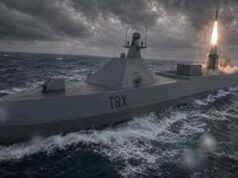
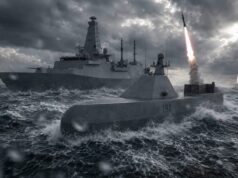
These Type-9Xs that are supposed to be coming in to add mass are not even in the water tank for testing hull forms yet. The CCS is an acronym on a powerpoint with no actual substance to it and yet real world assets are being allowed to disappear for it. You want to start up new companies to do it? Building a production like for a Drone Wildcat is, an optimistic, five year process because the machinery to do so can’t be bought off the shelf it is all built to order.
Getting the design done is three years after you open your design office to 1/3 scale prototype assuming we have the engines for them and they don’t have to be designed or redesigned for the platform.
COTS is fine if you want something like a hand launched surveillance drone. Something that will carry troops into battle, carry ordnance, engage ground forces and armour isn’t something you can pick up off the shelf. In fact the only currently viable of the shelf replacement for a wildcat is another wildcat.
The current Type 45 is pretty damn useful.
Best air-defence platform currently in service, and it’s guaranteed to be performing the role of the CCV until the new class are built.
No space nor comms for drone control, the hangar will be still necessary for a comms relay helicopter.
It’s called the Ops Room (CIC in American).
well laser guided rockets proved to be very useful vs the Shahed dronex. France used them in Qatar to great effect. Typhoon just got rockets pods certified.
also why is no money invested in buying GBAD vs various missiles?
seems like a lot of actual cuts in proven equipment for powerpoint dreams
sorry I meant LGR in UAE (not Qatar) fired from Tiger attack helicopter
The obsession with drones is extremely dangerous, seeking g to remove key assets and replace it with a far less capable, cheap alternative! Starmer reminds me of Admiral Kane in Top Gun 2 – ‘the drone ranger’
Drones…. Great just can the get people in and out? Oh sorry, no, well there we go another bonkers idea, how about the lore sensible idea spend enough money to have both, cut the civil service by 80 percent and the overseas aid completely, reduce the NHS by half and get rid of local councils, eradicate our deficit, lots of no good useless jobs and spend it on defence
So your solution is – nobody to administer state pensions, nobody to operate jails, nobody to conduct surgery, nobody to collect the rubbish, nobody to run elections…
Or to summarise in a slogan, “make Britain medieval again”…
The truth is we do NOT need all the tens of thousands of people we have now making up jobs for themselves. Removing our flags from our lampposts, creating 5 different bins for your waste, compiling a book bigger than the encylopedia brittanica for tax laws,, how many taxes – tax on fuel, roads, cars, insurance, income, housing, purchases, extra tax on alcohol, petrol, diesel, cigarettes, spirits, cigars, piipe tobacco, extra environmental csts on energy …. the list goes on and it is all because we have far too many civil servants with bugger all better to do than to ,ake more rules. Our roads arent repaired, our jails dont function, our police are a joke (and not funny), we have no armed forces , teachers pay is about the same as tesco, hospitals full of obese staff waddling at the speed of a dead slug to show each other their latest party photos because they cant be arsed to care for patients any more because they are ‘tool important’ … and if you dont believe me venture beyond the hospitals shopping mall to the wards.
We dont need to be medieval but we DO need to cut the crap down to a size we can afford and we cant afford the crap we have now
Flat-shagging conspiracy-theorist alert 🚨
I am sure… I mean my grandfather served in the BEF in France – old ww1 equipment, most of it didnt work properly, promises of new kit never fulfilled and a retreat from Dunkirk. I was at military college during the Falklands – we had to borrow back the aircraft carrier we had already sold, we didnt have the missiles or capabilites to defend our own ships properly leading to death and injury to sailors and the total loss of ships that would have been ok if it wasnt for the penny pinching short sightedness of those in charge. But of course this is only a conspiracy theory isnt it? The British army is the biggest and strongest in the world and I am tilting at windmills eh? The royal nacy has enough ships to mount a falklands campaign again doesnt it? Oh – sorry, no, not quite, and even the half dozen we have probably dont work anyway certainly wouldnt trust either of the two current carriers to make that journey but we scrapped the proven ones. ‘because we cant afford them’, then of course you have the planes – f35s, useless without permission from the USA to use them, but the USA under tru,p has already told us that Argentina should have the Falklands so what chance is there we will be able to use the f35?
Old git conspiracy-theorist alert 🚨
There, updated it for you.
DIP is not supported by the service chiefs.
Vulnerability against drones is quite simply a lack of drones: counter drone interceptors.
The lessons from Ukraine are that drones are a necessary adjunct to conventional forces and not a replacement for them.
‘…the declining effectiveness of USV attacks should provoke serious reflection in any navy currently investing too heavily in this type of platform as a weapon. Early attacks launched from Ukrainian beaches in 2022 carried an 80 to 90% probability of reaching their target, over a range of around 300 kilometres, against an opponent that had not yet developed countermeasures. Russian countermeasures have dramatically reduced success rates to about 2% for any attacks that are not conducted as complex, mass, joint operations.’
‘…what kind of navy does Ukraine need if and when a ceasefire comes? His answer challenged a comfortable assumption that has developed in some Western commentary, that the lesson of the Black Sea is simply that uncrewed systems are the future and conventional warships are obsolescent….warships can be acutely vulnerable in port and in contested littoral waters when they lack dispersal, air cover, or effective defences against cheap attritable systems…this is not new…Taranto (1940)…and Alexandria with human-guided torpedoes (1941)’
‘…the central procurement lesson of the Ukrainian campaign into a single principle, citing radar pioneer Sir Robert Watson-Watt: “The second best will do, the best comes too late.” In Ukraine, any system introduced into service is typically countered by Russia within months, rendering the pursuit of the optimal solution not merely wasteful but actively counterproductive. The gyro-stabilised quadcopter platform for Ukrainian USVs was not developed by a defence contractor; it was adapted from a commercial manufacturer of stabilised pool tables for superyachts. The solution took days.’
Navy Lookout 19 June 2026
The service chiefs are more concerned about peerages than defence. Always have been always will. They pop up on tv and complain about the decisions they made on there watch.
I find them to be infuriating.
🤡
Yup, politicised lick arses.
If this stupidity continues? Situation banjax will be complete. Will “unmanned systems” police the inevitable civil unrest/conflict that we face? Will they counter the proxy terrorism that we face? If people do not join the dots and realize the real enemies lie within? We totally are screwed.
Will not rant about politicians and Fabian scum today, it triggers too many. Of course the answers lie in ceasing to be the welfarist country of choice, and stopping illegals, both from a financial and inserted sleeper points.
Then of course the “strategic reserve” of 65 year old vets and kids with Xbox drone headsets are the answers to the Treasuries dream.
Its deliberate, end of.
🤡
FOC for wildcat with Martlet and Sea Venom was only recently declared. Much fanfare was given about a Martlet equipped Wildcat being able to shoot down drones. Is this capability to be scrapped as well?
I despair. It’s a cut – A massive cut. Not even in disguise. There are several countries about to order AW159 from LHUK, how will this affect their thinking? Where will the AAC manpower go? same place as the Puma Aircrew/Maintainers I expect. In times where recruitment and retention are so important, what kind of message does this give?? Drones my AR*E!!! I refer you to line 1. 🙁
I assumed, hoped, that 1 AAC personnel will operate whatever Drones are chosen?
Hoping a bigger type is chosen.
Maybe a turf war as well, as the small ISTAR Drones and the larger Corvus and Watchkeeper are RA assets.
When it comes to turf wars the RAF have that sewn-up! Red Arrows!!!
With respect, I humbly disagree regards the Reds. Their cost is chicken feed compared to their PR value, prestige value ( dirty word for many who want to dismantle my nation, but not for me, optics matter ) and shop window ability to get the RAF in the public eye.
I’d fully support similar things for the Army and the Royal Navy.
Further, I don’t see other nations acting in a similar way, as they get it, they get that some things are not about the cost.
The aircraft used is also a training asset, from a pool, so it’s not as if we are using Typhoon ( stupidly expensive ) or a unique type with unique logistical footprint for the purpose.
Similarly, the ceremonial stuff elsewhere about the Guards Division is also old chestnuts for me.
The Royals make a profit, the soldiers are not ceremonial troops, like some nations, but real soldiers, and if state occasions are supported by the pagentry of massed bands, horses, red uniforms and all the rest then bloody f******* splendid…..eat this, other nations watching on at our history and ability to pay on a spectacular state occasion.
Further, beneath it all is two agendas. It’s not the cost. It’s either anti monarchy at heart, or another avenue to reduce the UK from something a little different to just another republic, with all the loss of history that entails.
Luckily, it’s ignored.
But I’m a proud Monarchist who sees the value in some traditional things, not just the cost and I’m not blinded by hatred and envy of rich people either. ( see Labour and their class war. )
Wow! Think I poked the bear, didn’t mean to 🙂 Most of your sentiments above I strongly agree with, I just meant that this shambles of a government has it’s priorities wrong (IMHO)
Mate. We can laugh. And we don’t all have to always agree!
Some things “press my buttons” and I’ll defend them passionately.
We just disagree on the Reds. I smiled when I saw your comment elsewhere, but didn’t wade in.
But you mentioned the subject here on this thread to me….so the “Bear” awoke!!!!
No worries pal. Respect.
Mutual
Drones everywhere, give it 5 years and it will be robots replacing soldiers. The takeover has started, there is just no way Starmer and Reeves are flesh and blood? The last humans on earth have probably been born. Last one out please switch out the lights.
No need, Alexa will do it
You are a million miles away, mate. Take a look at the latest demonstrations if you have not been following developments. Humanoid systems, tracked robotic vehicles and wheeled autonomous platforms are being presented as the future of warfare. The sales pitch is that machines will replace soldiers. The reality on the battlefield tells a very different story.
I can make myself difficult to find by felling trees, digging trenches, creating obstacles and using the terrain to my advantage. That is exactly what soldiers have done throughout history. The problem for robotics is that battlefields are not laboratories or factory floors. They are chaotic, unpredictable and deliberately engineered to defeat technology.
If robots were ready to replace humans, Russia and Ukraine would already have emptied their trenches and forward operating bases. They have not. Both sides continue to rely on infantry because ground still has to be seized, held, searched and defended by people. No army has demonstrated that robots can replace that role.
I have seen some of the robotic systems being used in Ukraine first-hand on the ground. They have value, but they also expose the limits of current technology. Many fail once they leave prepared tracks. Uneven ground, shell craters, mud, culverts, steep slopes, fallen trees, rock outcrops and collapsed buildings regularly stop them. Electronic warfare disrupts communications and GPS. Batteries run flat. Cameras become obscured by mud, smoke or snow. Dust, rain and ice degrade sensors. A machine that performs perfectly on a demonstration range often becomes another piece of abandoned equipment after meeting the realities of combat. A human doesn’t. We just take a shower and, provided there are no injuries are relatively good to go again.
The Russia-Ukraine war provides repeated examples of this. Both armies have invested heavily in uncrewed ground vehicles to move ammunition, evacuate casualties, lay mines and deliver explosives. They have achieved successes, but they have also suffered high losses. Vehicles become immobilised in mud or cratered ground, are destroyed by artillery or first-person view drones, or are rendered useless by electronic jamming. The war has shown that autonomous and remotely controlled systems are valuable force multipliers, not replacements for soldiers. Every major offensive still depends on infantry prepared to close with the enemy and occupy terrain. Those vehicles end up needing recovery, especially if a casualty is on it.
Supporters of AI often assume that more computing power will solve these problems. It will not. Human judgement is not simply pattern recognition. A soldier understands context, intention and nuance. They recognise surrender, distinguish fear from aggression, identify civilians behaving unusually, and adapt instantly to situations they have never previously encountered. Machines remain dependent on data they have already seen. Unexpected events remain one of their greatest weaknesses. I know, I have worked with it since 2014. There’s no AGI on the horizon, especially no self-contained AGI that can be deployed in such units. You have to see the size of the data centre it takes just to get a reasoned learning model working well.
The ethical problems are even greater than the technical ones. The moment lethal decision-making is delegated to software, accountability becomes blurred. Who is responsible when an AI identifies the wrong target? The programmer? The commander? The manufacturer? The government? When I aimed, fired assessed and continued, it was me who became liable should I unlawfully kill. I would face investigation, prosecution and imprisonment. A robot cannot stand trial. It cannot feel remorse. It cannot explain why it acted. It simply executes code.
AI also suffers from bias and error. Machine learning systems inherit weaknesses from their training data and assumptions built into their models. Combat environments constantly present situations outside those assumptions. Civilian clothing, damaged infrastructure, smoke, deception, decoys and changing weather all reduce confidence in automated identification. A human can question what they see. An algorithm cannot question its own reasoning in the way an experienced person can.
War is ultimately a human activity. It is fought for political objectives, among populations and under laws that require judgement, restraint and proportionality. Compassion is not a software feature. Neither is moral courage. Soldiers sometimes choose not to fire because they recognise a child, a hostage or someone surrendering. That decision cannot be reduced to probabilities on a processor.
History should also make us cautious. One of the lessons of the Second World War is the danger of people surrendering moral responsibility by claiming they were simply following orders. That was a failure of human judgement, not automation. We should not repeat the mistake by transferring life and death decisions to machines that possess no conscience at all. Technology should assist human decision-making, never replace it.
Robotics, automation and AI unquestionably have a place in modern warfare. They are excellent for reconnaissance, logistics, bomb disposal, surveillance and reducing risk to soldiers. They can save lives when used to support human operators. They become dangerous when they are treated as substitutes for human judgement. Removing the human from lethal decision making does not make war cleaner. It makes accountability weaker, mistakes harder to explain and atrocities easier to distance from those responsible. It becomes easier to go to war. There’s a reason why the USSR/ Warsaw Pact and NATO never went to war. The consequences of it running away from the politicians and going nuclear were too much for anyone to contemplate. Up until WWI, commanders rode into battle with their troops. Wars were self-contained, regional at most. Using robots takes us back two centuries.
The battlefield in Ukraine has demonstrated that technology is transforming warfare, but it has also demonstrated something else. Despite billions invested in drones, AI and robotics, victory still depends on human beings. The soldier remains the most adaptable, resilient and accountable weapon on the battlefield, and that is unlikely to change for a very long time.
Great post.
are we saying no more manned helicopters anymore ?
I think you just bought 23 AW149.
Bought at the eleventh hour because the Chancellor was faced with the immediate closure of the Yeovil site. It wouldn’t be a good look on her CV now would it.
Watch this space,,,,,,,,,,,,,,,,,
So the Navy has spent a small fortune on getting Martlet working on the wildcat. The very missile credited fo taking down drones in the Eastern med.
Providing top cover for boarding parties and generally making a nuisance of themselves shadowing the Russians.
Can someone show me a photo of what ever it that’s going to replace Wildcat or are we going to defend ourselves with yet another capability gap?
This is the very same problem with changing the mine hunters out for single purpose autonomous systems and shows a profound lack of understanding of what a navy is for.. a drone off the back of a ship is essentially for kinetic warfare.. a small ship flight is so much more. It provides the ability to move people and kit, it provides a UK presence it is functionally important for the day to day “supporting martime functions and power” as well as a potent weapon of war.
This DIP very much reminds me of the 1957 defence white paper and seems to be making all the same assumptions and mistakes…. We decided crewed aircraft were pointless in the face of ballistic missiles and Sam’s… destroying our own world leading airo industry… or the beeching report in 1963 where in an act of self destruction we decided railways were dead.
The new does not automatically replace the old, to make that assumption is to make a massive mistake.. the wheel is still the wheel, the gun armed infantryman has been the primary figure on the battlefield for 370 years and survived every innovation that could have made them irrelevant… and as our roads clog and petrol prices rocket we all wish our towns all still connected with railways as they once did.
Yet again History repeats itself. Going for untried high tech that simply does not deliver what it says on the tin. If some recall the UK was to give up manned fighters to be replaced by missiles to defend the UK, that failed and this will too. You simply cannot do without humans in the loop. A manned Helo for example can provide so much more than any number of drones will ever do, its the Swizz Army Knife of the aviation world. Sorry the MOD has simply become a weak shadow of it’s once self and no longer worth the money wasted on it for it delivers little for it. Ashamed of what was once the best of best.
We’re moving too fast in the direction of drones.
seems like Wildcat (or equivalent replacement) is still very usefull, esp vs drones. France used Tiger with laser guided rocket pods to great effect vs iranian Shahed in UAE.
food for thought
As I understand it the DIP said maritime Wildcat replacement was an investment “through 2030-35”. In other words it’s someone else’s problem. It becomes a Navy problem if some d*****t gaps it.
This just seems a totally craze move and I would suggest it a balancing the books move
A Treasury led Defence investment plan is exactly what you’d expect it to be. Retiring sucessful platforms early with promises of magic, unproven projects tomorrow. Feckless incompetence which is baked in to fail and then they’ll blame the hapless MOD for being unable to manage procurement. If only we could teach the Treasury to defend the realm as hard as they defend their spreadsheets. This smells bad like a rotten fish.
Can’t wait to see the first man overboard winch recovery or fast roping operation from a wunder drone
Ukraine finds their helicopters are very good at shooting down drones. Who are the UK military experts that are ignoring these lessons, given that the UK is vulnerable to attack by drones and has Russian warships/ shadow fleet prowling off the coast?
Telegraph today…new Russian jet powered drones in use in Ukraine…500kph.
“Space x landing some drone helicopter on something at sea”
What a comically stupid and ignorant comment. 😂🤣😂🤣😂
SpaceX land a freaking rocket, from space, travelling at Mach 6.5, down to stationary, on a barge in the ocean. Autonomously, no humans involved.
Sometimes they do two, simultaneously.
“every man and his dog will be trying to jam its signal”
What signal? It’s autonomous 🤦🏻♂️
Do you have a signal? Is someone remotely controlling you?
“I don’t think anyone is saying it’s not possible to have a drone helicopter”
That’s because they already freaking exist. 🤦🏻♂️
“I’m also of the view in thinking”
Your prejudiced views don’t matter, it’s the facts that matter. I’m doubtful you are thinking.
Can’t understand why it took Musk so long. Thunderbird 3 was doing Space X landings 20 years ago 🙂
This is a really Bad Idea and has R-A-F written all over it. Instead let’s replace the Red Arrows with Drones shall we and be done with it then?
Just plain stupid!!!!!
‘Binning’ the Army Wildcats, simply means they are retiring them early, to save money. Who knows maybe Brazil will buy them?