

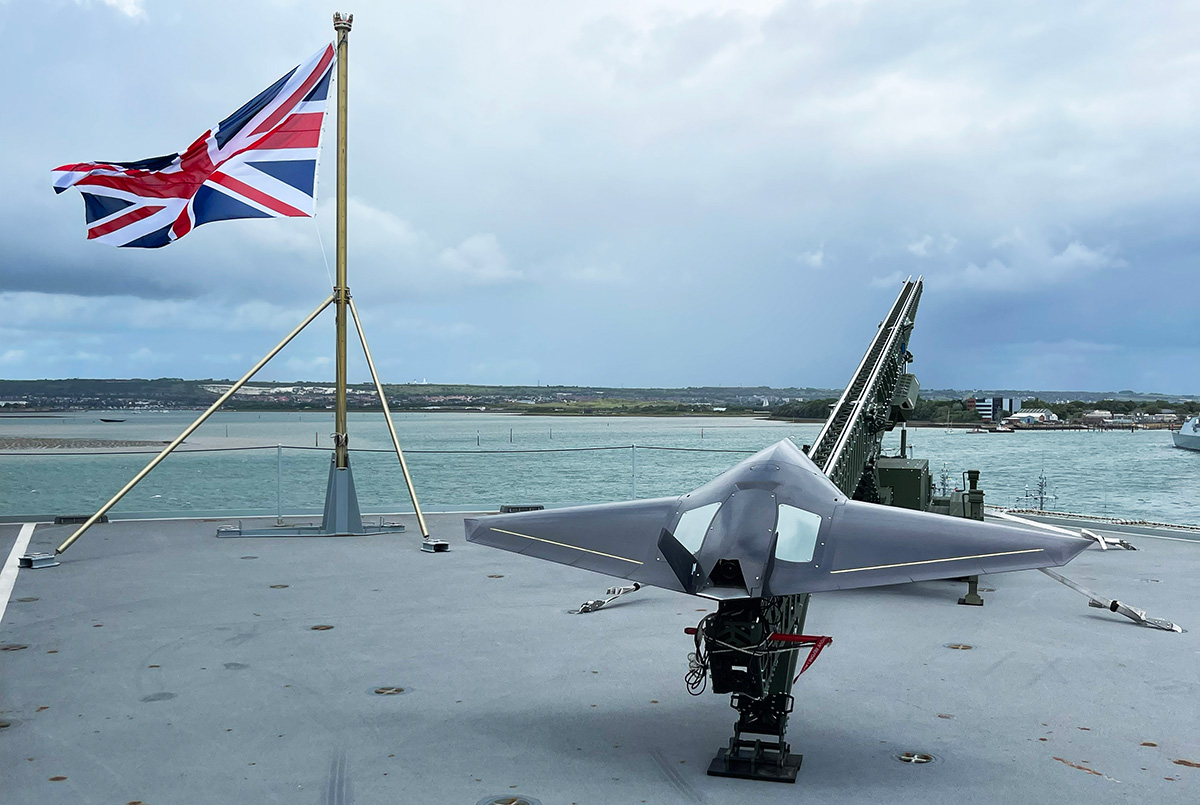
The Royal Navy has launched a strike-capable one-way effector drone from a ship at sea for the first time, firing the British-built Nyan from the experimentation vessel XV Patrick Blackett off the south coast of England, the service has announced.
The trials took place last month under Exercise Neptune Reach, with the Royal Navy, British Army and Royal Air Force working together under Project Vantage, a tri-service programme focused on accelerating the test and evaluation of maritime attack drones. Personnel from 26 Regiment Royal Artillery and 744 Naval Air Squadron worked alongside the ship’s company, launching and flying the drone while the vessel was underway.
The pre-programmed autonomous aircraft was fired from a launcher installed on the ship’s deck, capable of accelerating one-way effectors to up to 55 metres a second.
Nyan is a small uncrewed aircraft with a 2.9-metre wingspan designed to provide a precision strike capability, developed and built by Callen-Lenz, a BAE Systems company. One-way effectors of this type are flown to a target and expended on it, trading the performance of conventional cruise missiles for low cost and high production volume. According to the manufacturer, more than 1,000 units have been produced and the system is already operationally proven on land. The British Army used the same drone and launcher combination in Estonia in May during Exercise Spring Storm, employing it as part of the UK’s deep fires contribution in support of NATO allies.
Minister for Defence Readiness and Industry Luke Pollard said the trials showed the direction of travel for the fleet. “Britain is serious about the transition to a Hybrid Navy with new, powerful drones at the heart of the Royal Navy,” he said. “By bringing together Army and Navy expertise to field strike drones from a ship at sea, we are accelerating the capabilities our forces need to stay ahead of our adversaries.”
Lieutenant Commander David Burton, the Royal Navy’s Maritime One-Way Effectors capability sponsor, said the trial marked “a significant step forward in delivering Maritime One-Way Effectors at pace.” He added: “Under Project Vantage we are planning to integrate these capabilities into the Hybrid Navy, combining crewed platforms with uncrewed systems to expand reach, increase tempo and enhance lethality. Working closely with our army colleagues, this activity demonstrates how we are accelerating Atlantic Strike concepts into practical, deployable capabilities of the Fleet.”
Matt Foster, chief executive of Callen-Lenz, said: “These trials reflect strong collaboration across the services and industry, highlighting the pace at which we can deliver innovation to advance the UK’s integrated, multi-domain defence capability.”
The Royal Navy Capability team and the Air and Space Warfare Centre are now analysing the results, with the potential for further trials aboard the aircraft carrier HMS Queen Elizabeth. The work sits with the drive towards a hybrid fleet backed by the Defence Investment Plan, which commits over £5 billion to drone and autonomous systems according to the Royal Navy, including new classes of uncrewed naval vessels designed to operate alongside crewed warships.




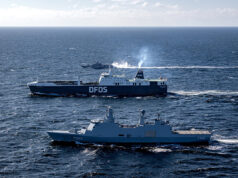



Is that a Macro Lens shot ?
But seriously, here Is your new future of Warfare…. how much will 1000 Patrick Blackett’s cost ?
🤡
🫂
A macro lens shot from inside Portsmouth harbour, no less. I certainly hope they didn’t do the launch from there.
Well spotted Young man. 👍
I hope It wasn’t aimed at the “Whale Island Zookeepers” house. 😁😁😁.
Well now you mention it, Whale Island is where the grey and red building just below the end of the launch ramp is…
The actual launch seems to have been done from within Lulworth Ranges, Portland is visible in the background of the video Navy Lookout posted.
I must go take a look at NL.
Looked a while back but It seemed rather an unfriendly place, lot’s of large Ego’s and silly Insults.
Wiki says Nyan has a range of 150km, possibly 250km.
I looked as I wondered what vessel would want to come close to land to use such a thing.
As one would think it useless against an enemy ship with missile and other air defence, judging by the numbers lost by both sides in UKR to finally hit a target.
Presumably one of the LUSVs close to shore?
Well plenty on here think warships should sail close to shore to undertake suicidal NGFS with their main gun. This allows a warship to undertake such support from a more survivable (for the ship) range from shore.
Yes, fair, much further than your usual shell.
It’s already being used in Ukraine, it’s not an RN weapon it’s an Army weapon, seems to be very handy for knocking out mid range air defence systems and its appears to be a very low RCS configuration. Such a system would have been very handy for warships fighting the Houthis in the Red Sea, if you watch the video on IBFS forces news it shows a single guy loading the ramp. Suggesting you could fire dozens of these very quickly from any RN vessels with a flight deck.
Yes, the Army has it for CABRIT.
This is the thrust of my questions, I want it deployed more widely in the Army, not a niche capability in a solitary Battlegroups assigned RA Batteries.
And the RN too.
I suspect too often this is all style over substance, like your Jet Powered Drone.
I presume they can change the payload? Ie penetrative hollow charge vs shrapnel effect? I believe the harm style missile uses blast and fragmentation to demolish radar kit. Blowing a hole in the side of a vessel is preferable to pepper potting it. Or will we ever Know??
Very much so. It has a modular payload, so you can stick in different targeting sensors, or fuel for extra range, but it all eats away at the standard 20kg warhead payload. I think Ukraine have a significantly extended range version with a very small payload.
It depends Daniele, 150km is a long way and a lot of sea to hide in.. remember if your 25 km away you are under the Horizon and hidden from ground based radar or even low flying radar.. Your not going to want to close within 150km a hostile peer shoreline.. but let’s say your supporting marines in a fight on a random bit land in the high north, it’s far better that a gun that puts you in radar horizon of the shore.
Agreed.
Really, Nyan? So someone thought naming this new drone after the Japanese onomatopoeia for a cats meow was a good idea?
Blimey, you actually knew that ? or had to look It Up ? 🤔
I grew up on 2000s internet, of course I know what it means
What’s an “Internet” ? I’m Old.
An anime binge-watching toolkit apparently.
Nyancat. Good times.
Someone gets it at least
Gen Z mate, they are all odd.
I think that predates Gen Z(ed) by quite a bit, the internet is old you know!
😳
Cat got your Tongue DM ? 😁
Don’t underestimate cats they are fiendishly good at seeing off all manner of larger more dangerous opponents. And they sleep very stealthily between times.
Is there any logical reason for us not having a land based anti ship missile system, seems ridiculous the lack of capability
Given that most of our Fleet Is In Port or dry dock, we already have that capability. 😇
🤣
I fear that’s an actual plan. I foresee HMS Warrior getting a new lease of life here not to mention Ferguson Marine built Scottish ferries.
NSM has a range of about 100km, so you’d need a lot to cover the coastline, along with military installations to house them all.
It’s makes more sense to air or ship launch so you can head towards the target first. For air we have sea venom until STRATUS arrives.
Although I wouldn’t be surprised if storm shadow could hit a ship if it wanted.
Why do you think the lack of land launchers is ridiculous?
*sorry 100nmi
Totally agree in theory air or sea launched would be ideal, but surely some form of mobile land based anti ship could be sensible, especially given the state we’re in.
It infuriates me Russian ships can sale through the channel laughing at our lack of capability.
I don’t think we’d have any problems closing the channel at a moments notice, we have air launched anti ship missiles and torpedoes. Plus our surface ships and subs.
I don’t think there’s any benefit to having land based anti ship systems in the UK, they’re probably more of a benefit for overseas deployment. But again, just use a jet or helicopter.
On the air launched anti-ship missiles, all we have is Wildcat and its Sea Venom, which would need to fly over from Culdrose. Also I believe Stingray, either air or surface launched, has no capacity to attack surface ships.
But yes getting fast jet AShMs is a much better investment than shore batteries.
Sorry exposing my layman knowledge here, but are you saying Stingray, as far as I understand our creme de la creme subsurface weapon, has no ability to target surface shipping? It’s for taking out subs only? I hope my understanding is wrong
I believe so, Stingray is optimised for deep diving and destroying submarines and so has no targeting capacity for surface vessels. It isn’t a huge warhead (45kg shaped charge) so wouldn’t do a great deal of damage anyway, and there would be hardly any use cases with a reported 8km range at which either a frigate or a helicopter would be a sitting duck.
Spearfish of course is dual-role and perfectly capable of attacking both surface vessels and submarines at longer range.
Concur.
I believe the stingray can target a surface ship…
As an aside it’s also good at attacking shipping containers and dockyard fences AKA the Argyll incident…
Didn’t we have a bunch of Tornados with Sea Eagle until that was deemed obsolete?
2 Sqns at Lossi, yes.
So the Germans could still do a Channel dash as long as they give Scotland a wide berth. Damn it, so it’s free fall bombs from the super modern F35s then I guess if they have one free from servicing.
Umm have I missed something ? Exactly what air launched anti ship missiles we have now Sea Eagle has gone – NSM/JSM sadly not !
Ah but you forget that when we built the Chunnel, we rather cunningly Installed a Plug and Chain.
One Tug and Down the drain they go.
😆
…and with plenty of time to do so, until the tug turns up.
Breakstop might fill that niche perhaps. I think it’s not for moving targets initially, but it wouldn’t surprise me to see an upgrade.
Don’t forget that the sea leave radar horizon is only about 25km.. so your land based weapons limited by that as part of the kill chain.
Ah but on a clear day It can see 50km’s.
Seriously though, I was down on the top of Portland a while back and you could see Start Point….. It has to be at least 50 Miles (miles are the old KM’s for any Gen Z viewers)
That’s an unusual set of topography you have two very high coastal points.. one at 140meters and the other at 120meters.. essentially you get a top point horizon of 90km between those two points.. but and this is important.. If you set up a surface search radar on the high point of Portland.. it would only give you a surface horizon of about 40-50 kms… a ship can hide behind that.. so if you had a 10meter high ship out at 60km between Portland and start point.. you would not see it as it’s under the horizon… just like a hidden dip in the road…. And most coastlines do not offer up 140meter high easy access high costal points.
Ha, I get that, It’s just that I can give It as an example because It came up In conversation last time I was there !
BTW, at night, I can also see Uranus ! 😁
Oh and up the top of Dunkery Beacon, you can see Penny’s Fan …… 😇
Did your phone say you were in France. Or is that only St Margaret’s Bay and more worrying I hear from a friend Broadstairs now. Let’s hope our missiles don’t suffer the same problem or we might sink Calais.
Yes, need to go back a bit first.
In the Cold War the Russian surface fleet was to sit in their Bastions, not circle the UK or NATO nations. Their sub fleet and long range naval aviation were the main weapons.
Post Cold War, no need.
Now, with Russia resurgent, again their main offense navy wise is sabotage their submarines, and missiles.
Their ships will be sat in the Bastions in the north, or stuck by geography in the Baltic and Black Sea, which NATO control the exits to.
There might be the odd ship in the wider oceans, sure, I’d give it a few days survival at most if war broke out and ENATO and the US were on our side.
I don’t see Russia as stupid enough to start WW3 with their warships lined up off Britains shores, but shadow fleet with Drones, maybe.
So why a land based ASM system?
I want more GBAD for the UK as I think there’s a greater increase in threat there, but not ASM.
Interestingly, we did have such a system once, a handful of Exocet were on Gibraltar, but not for long.
Hi Daniele
Thanks for your informed reply.
Living on the coast I’m probably too used to seeing remnants of the old coastal batteries 😂
We most certainly need an ASM for F35, though.
Sea Eagle and a F35 Buccaneer derivative would Awesome 💪
Hi Daniele, I tried having this conversation with Jim the other day, but I don’t think he got the point I was trying to make.
‘ENATO’ isn’t a military alliance, it doesn’t exist. I understand using it as shorthand in a sentence like, ‘ENATO members are investing more in defence.’
But when we start talking about ENATO going to war, it becomes much more complicated. As you know, NATO can only act collectively if all member states reach consensus. If you’re taking the US out of the equation, then you’re no longer talking about NATO.
Of course, ENATO members could choose to fight together, and many probably would, but that would be a separate coalition, nothing to do with NATO. It also wouldn’t have the integrated command structure, strategic enablers, intelligence, logistics and other capabilities that the US currently brings to the alliance.
The real question then becomes: which ENATO members would actually agree to fight, under what political circumstances, and under whose command?
We have frameworks like the JEF and the EU has a mutual defence clause, but neither means that ENATO members would automatically function as a single, politically aligned and militarily coherent bloc if the US were removed from the equation. That’s why I think treating ENATO as though it’s a real alliance can be misleading.
With some of the rhetoric coming out of the White House, I understand why some question the US’s commitment to NATO. But if our politicians are taking that possibility seriously, then they need to invest far more in closing the capability gaps that Europe currently relies on the US to fill, and ultimately build a separate European military alliance.
That may well be the direction we end up heading in, depending on future US administrations. But we’re not there today. After decades of underinvestment, Europe still relies heavily on the US for key capabilities. Calling that future alliance ‘ENATO’ today doesn’t make it a reality.
Thanks mate. That’s why I reference both separately, as without either one we’d be in trouble and have to use Paveway or Sea Venom from Wildcat, if they’re allowed to live that long.
Point being that as is, assuming NATO and the US are together, a Russian ship anywhere near is dead, regardless of our own lack of ASM Batteries or wider ASM capability.
Though it’s not very much publicised here European partnerships are moving to factor out US reliance and indeed are forming a plan to replicate vital areas over the next decade, be it satellite, launcher, communications chip or software related as well as the more obvious particular weapon and sensor platforms we have traditionally relied upon the US for. Clearly it’s not openly stated as such for obvious reasons and will take years to start to be effective but it is happening as it is in various economic areas that presently allow the US to cripple Europe should it not fall into line. I am concerned that post Brexit the UK is positioned between a rock and a hard place in these developments.
There is, of course, encouraging movement, with some ENATO members starting to take defence more seriously again. But in the UK we’re still dragging our feet somewhat, with no credible path to reaching 3.5% of GDP.
Trump got allies to agree to the figure. Now the challenge is actually getting there.
I agree that, if Europe genuinely follows through and continues increasing defence spending, things could look very different in the medium to long term.
Sorry I forget to mention that the DiP included funding for PrSM. Since it mentions we’re joining Australia in that project then it means it will be the increment 2 missile which has anti ship capability out to 500km. The later increments will go to 1000km.
So we actually have just agreed to get land based anti ship missiles 🙂
Yes, read that PRSM was included.
Low budget though, so I don’t think we’ll buy many.
Did not know it has AS capabilty???? There you go then!
Might have to keep some MLRS sat in Larkhill then rather than deployed with the ARRC.
Interesting drone, jet-powered and with no vertical surfaces.
Yes, reminds me of the various stealth designs.
There is a tiny stabiliser on either side of the jet pipe if you look closely.
The stealth shaping is quite interesting though.
Yup you’re right, looking at some better photos now.
I did wonder what it would take to remove them and the other control surfaces, and use blown-air for control to create a very stealthy drone. But, given its size and blended/flying-wing design, I doubt the extra effort would be worth it.
There was the BAE Demon which did that, but it’s so old the factsheet is of a pdf type that doesn’t load on my computer. Save it for the more survivable CCAs.
Which is why I thought of it, given the Nyan is made by a BAE subsidiary.
I’m hoping we might see it’s use in Tempest 🤞🏻
What’s a “PDF” … Is It like a Telex thing ?
Confused Old Bloke from Cambridge.
Nyan with Blown Air ?
I think It’s called a “Cat Fart” In Japan
Where’s Clunker, he’s knows his shit on these things 🤔😁
I crack myself up !
Finding further photographs it appears that when stored/shipped Nyan doesn’t have the stabilisers fitted (presumably to maximise space). Then before launch they are simply slotted into position.
Nyan cat has gone deadly.
I suppose this ticks the box of operating a jet powered drone of the carrier by the end of 2026.
Did that already with Banshee.
“Which can accompany F35.”
😳
Agree, some similar gimmick might be used. Not saying this is one, but they talk of Loyal Wingman type CCA, pie in the sky for me without the costs of adding catapult.
Attach a toe rope to one of the F-35s like you’re launching a glider.
Ah, good one. HMS Market Garden.
Maybe that’s a Bridge too far.
Awesome! The worlds biggest and most expensive drone carrier.
Ermm, the Patrick Blackett, ain’t that big. 🫡
Errmmmm….
“ The Royal Navy Capability team and the Air and Space Warfare Centre are now analysing the results, with the potential for further trials aboard the aircraft carrier HMS Queen Elizabeth.”
But it hasn’t been deployed operationally on the Queen Elizabeth carrier. I mean, strictly speaking, 1938 HMS Argus takes the crown at the moment as the largest drone carrier, with Queen Bee drones.
‘Further trials’ is the operative point here which can/will take place on any given different platform including one of the carriers. The Queen Bee is well worth remembering mind, people often forget how far back drone technology actually goes. The US and Germany both experimented with drone bombers too, and target aircraft were reasonably common.
If we are going to start producing and using cheaper (possibly less effective) drones and launching them from ships, how many would a frigate or destroyer carry and would it be militarily effective?
This is why I referenced land targets vs sea targets further up.
They lose so many in UKR so some get through.
And you’d assume a ship, unless it’s a lower level asset, would deal with these with half descent AD.
Thus land targets with little or no AD, which means getting closer to shore.
I could see the new Dutch amphibs carrying substantial numbers.
Well their ot just Dutch but I get your point. There’s not that much known about them at the mo but after 15,000 tons with a dock they should be useful ships. Images we have seen so far all show a full length flight deck specifically aimed at launching drones . The Dutch designation ATS or Amphibious Transport Ship doesn’t really do credit to the various swing role multi tasking capable concepts we have seen doesn’t really do them credit. LSA or Landing Ship Aviation IMHO is what we should designate the four UK bulls, and yes they should be able to carry and launch a large number of if Nyan drones.
Distraction maybe it’s very much a chess game I suspect and I can see Ai working out ever changing profiles for using these alongside more expensive missile types for any given scenario. This is where drone ships carrying potentially hundreds could come in very handy as could drone submersibles able to launch lesser numbers unexpectedly.
This drone will be for but not with anything that goes bang.
I assume the picture that you used there George, is a stock photo?