

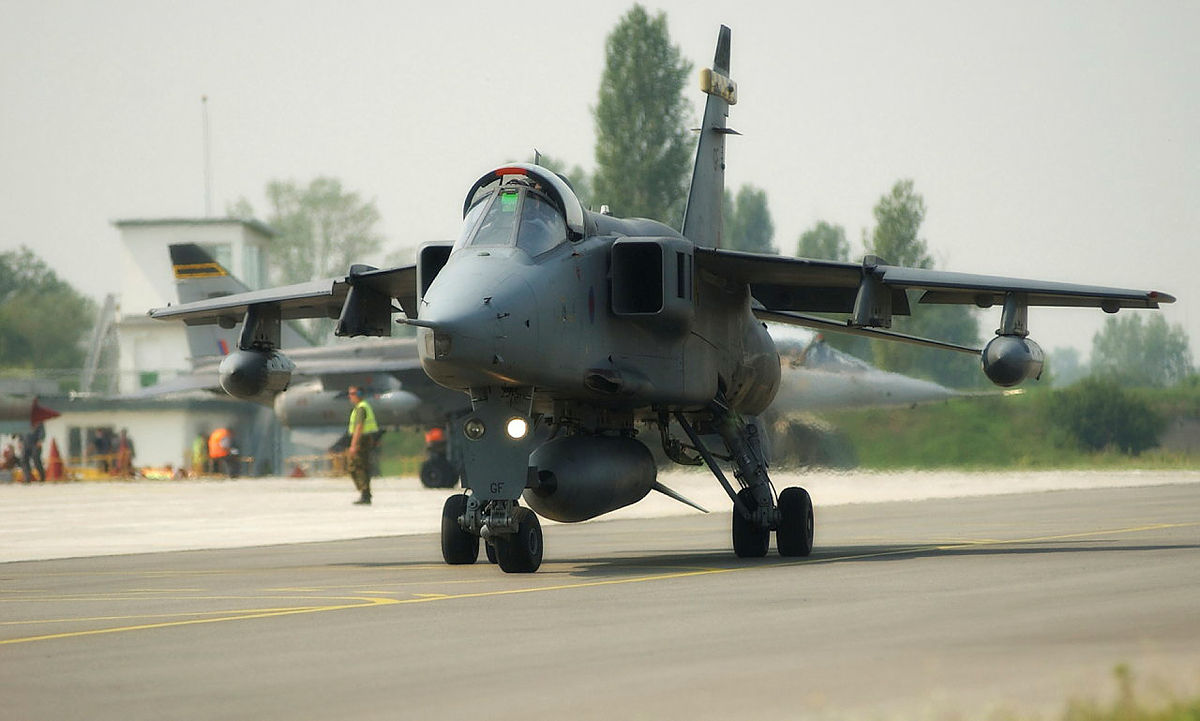
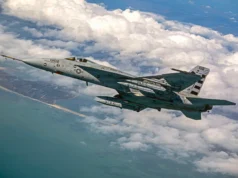
The Ministry of Defence still holds 42 SEPECAT Jaguar aircraft almost two decades after the type retired from Royal Air Force service, with nine more having been transferred to the Indian Air Force, the department has said.
The figures came in a written parliamentary answer from Minister for Defence Readiness and Industry Luke Pollard on 3 July, responding to a question from Ben Obese-Jecty, the Conservative MP for Huntingdon, who asked how many GR1 and T2 variant Jaguars the department still holds.
“A total of nine Jaguar aircraft have been transferred to the Indian Air Force. Of these, five were the GR1 variant, and four the T2 variant,” the minister said. “Of the 42 Jaguar aircraft the Ministry of Defence still holds, 13 are the GR1 variant and none are the T2 variant.” The answer does not specify the variants of the remaining 29 airframes, which the question’s scope did not cover, though the balance of the surviving fleet would be expected to comprise later marks including the upgraded GR3 series and T4 two-seaters.
The Jaguar was developed jointly by Britain and France under the SEPECAT consortium as a low-level strike and reconnaissance aircraft, entering RAF service in 1974 and flying combat operations in the 1991 Gulf War and over Iraq and the Balkans through the 1990s before its retirement in 2007, when the fleet was withdrawn earlier than planned as a savings measure. A substantial number of airframes were retained after withdrawal, most prominently at RAF Cosford, where the School of Technical Training has used Jaguars for decades as ground instructional airframes on which RAF engineering technicians learn their trade, keeping many of the jets in remarkably complete condition.
India is the last nation still flying the Jaguar, operating a fleet built largely under licence by Hindustan Aeronautics and known locally as the Shamsher. With the type long out of production and spares increasingly scarce, the Indian Air Force has turned to retired operators for support, and the transfer of British airframes provides a source of components to sustain the fleet through its final years of service, with India planning to phase the aircraft out over the coming decade.
The answer does not state the condition of the 42 retained aircraft, but we understand them to be purely used as ground instructional airframes; they’re not flight-capable.


Stripped, bent, screwed and screwed a bit more, that’s the sum total of their work! They went far too soon but that’s how the MOD functions.
Cut in Labour’s 2004 New Chapter cuts, which also claimed Tornado GR4 and F3 Squadrons, and a big chunk of the Royal Navy.
Damned Tories!
The Tories had 14 years to reverse the cuts … But instead they made many more as well as running down bases and maintenance facilities, and they continued doing this even when geostrategic changes started in earnest in 2014.
So yes damned tories
Spot on.
I comment with that sarcasm due to years of talking to people here who only highlighted Tory cuts and not what went on 97 to 2010, with selective or v short memories.
Both are as bad as the other if one wants to write down a list of cuts to compare.
And the Tories now don’t have a leg to stand on.
“Stripped, bent, screwed and screwed a bit more” – For a minute I thought you were talking about our Armed Forces! Silly me.
We should put them back on duty, same as we should get the harriers back from the yanks and put them back. You need aircraft and frankly I would trust these more than the f35 we also will need to teach people to fly it
Most of the Harriers sent to the US were for spares. The Jaguars should be offered to Ukraine.
I know, we should buy them back and put them on the carrier as, the harriers work
I suspect they are parts now. The Harrier had its day nut times move on we have F35 now.
The article says the jaguars arent flyable so Ukraine wont want them
And the tornadoes…. In war Evan a pitchfork can kill an enemy…. Oh and hercules….. It could carry stuff.
🤣
Well I sure as hell would rather take on russian ships in ships not by swimming I would rather try fighting their planes with planes than by flapping my arms, I would rather a gun with bullets than my knuckles
No Buccaneers hidden away then?
🤣
They didn’t go to soon. Great aircraft in it day. But it had long had its day by 2004. A bunch are used at RAF Cosford for Technician training.
Exactly the gulf war highlighted it’s deficiencies and I’m personally glad we aren’t considering sending highly priced and difficult to train pilots into combat zones in aircraft that simply wouldn’t survive the mission.
The French Air Force used Jaguar’s on a Bombing Mission against Kuwait Airport in GW1, from memory they all returned to Base but they all had suffered damage due to ADA.
And they still have an important job there too.
I bet there are quite a few Tornado and other types there.
The RN SOFDO had taxiable Sea Harriers too, unsure of their status.
All have a part to play and none will be resurrected, before anyone gets too excited!
The Tornado weapon pylons likely from this inventory found there way onto Ukrainian Su-24s and MiG-29s. A small part of them has lived on through this bizarre franken system and doing exactly what it was intended for.
Correct
Hi M8, If you ever want a nice day out on the Train go up to Cosford ! The RAF Museum is just amazing as a lot of the reserve collection and restore work goes on there and if you walk round the back of it the RAF bit is pretty viewable, but I have never seen a Tornado. It’s a cracking day out !
Re the Tornado I’m not sure it would be an airframe that would be suitable for instruction purposes as it’s swing wing and that’s not used anymore.
It’s a fantastic place to spend a day or more, I need to go back soon.
V Bombers, TSR2, EAP, Lancaster, Gnat Tetsi Mosquito from memory plus masses of Engines and other Interesting stuff.
The smaller Coventry Museum Is a fair shout also.
The tonkas are still used as instructional airframes. It’s more about learning the skills to do the engineering work than the intricacies of a specific airframe – repairing, say, hydraulics is repairing hydraulics, it doesn’t matter if they’re for the wings, gear, or anything else.
Assume some Tucano ended up there, and Hawks.
Before Tucano I recall 1 SoTT had Jet Provosts with the Jags and Tonkas.
The Jet provosts were use for teaching ground marshalling and the basis of flight servicings. I think they’ve been replaced for marshalling by an interactive suite, but will need to double check that.
Not been.
Only been to Duxford and Hendon.
Does St Athan still have a part to play in this, or is it long gone?
RAF No 2 School of Technical Training I understand moved to Lyneham to co locate with School of Aeronautical Engineering and the wider REME Phase 2 training footprint.
1 SOTT remains at Cosford.
At St Athan, “West Camp” remains with the SFSG, think the RAF Wales UAS is still there.
There used to be a NARO RAF crash retrieval Flight as well but lost track of those.
Was one of the RAFs biggest stations at one time.
There are a number of different airframes at Cosford used for ground instructional training. How long for is a different question. When I was instructing at Halton there were 2 hangers full of GR1s.
Must have been fun getting those there on low loaders, there’s only the grass runway at Halton for the VGS.
I knew RAF Halton had a Tornado Gate Guard but did not know about the others.
Yep, wings off.
The gate guardian at RAF Halton is a Hawker Hunter. The Tornado was on the parade ground used for passing out ceremonies for the recruits. This was removed in 2025 and replaced by a Typhoon tranche 1 which had been in storage for up to 10 years and was not burdened with too many hours.
The grass runway has over the years hosted a number of aircraft that you would think could not possibly land there. Three Vulcans and two Comets to name but a few. They never left, at least in one piece.
Thanks Big Man.
Those on a grass runway, now that’s something!
I saw one of the Vulcans in the circuit from my school in Aylesbury with a Jet Provost chase plane. We were talking about UFOs in an RE lesson when this magnificent delta wing banking at what looked like 90 degrees filled the window……. everybody shouted UFO! I couldn’t see it land as we were 4 miles away. In another RE lesson I saw a Comet do a low pass at Halton… presumably before it landed. I also flew my first three solos as Halton… it’s very short and all grass. As you can tell I didn’t take much interest in RE. Which is why I ended up being a clergyman, I suppose. I loved those lessons as from that classroom I could see the gliding school Sedburgh and MkIIIs and of course the Chipmunks.
Thanks Wyn.
Well a common UFO shape includes the Flying Triangle, so not so unusual. Though those FTs have silent or near silent flight, instant acceleration, and ability to sit motionless. So defo not a Vulcan!
We should also ask if there are any Tornado’s still retained and what happened to the 14 Sea Harriers that were kept for deck handling trials prior to the two carriers entering service..
After being used for deck parking training they were sold off to private collectors and given to museums around 2019/20 with a few sent to be RAF engineering trainers.
Ah ok. I believe SoFDO has F35 mock ups to move around now.
They still have some Sea Harriers they taxi around.
Yes there are a number of Tornado Gr1 and 4s at Cosford.
I always loved the Jaguar. Not because it was the absolute best aircraft in the sky, but simply because it looked incredible, especially when it was sitting with the landing gear down. That rugged trailing link undercarriage was a masterpiece.
However, its flaws were undeniable. It was notoriously underpowered early on, and the high wing loading was designed strictly for low level Cold War operations. Because it was optimized to punch through turbulent air at tree top level, it was never going to cut it when the tactical reality forced operations up to higher altitudes.
By the end of its life, upgrades made it a decent machine. But timing is everything. When the decisions were being made to cut RAF numbers, we were heavily committed in Afghanistan. The Jaguar’s hot and high performance was deeply lacking for that environment, which ultimately sealed its fate.
It is a shame, because otherwise, the Jaguar was a very cost effective close air support platform that gave excellent bang for the buck.
Note I don’t respond to replies. Life’s too short…😀
Often known as the awful Jag, from Air-Worthiness Flight Limitations.
Yep.
6,41, 54 Squadrons, with the OCU in more recent times 16R Squadron.
They were earmarked for ACE MF to go to Norway if it kicked off I recall.
Still remember some Jags firing rockets ( Hydra? Forget the name ) at simulated ground targets at a Larkhill firepower demo.
For a Jet that was originally designed as a trainer it provided good service.
Perhaps they are thinking that these Jaguars would be a cheap replacement for the Hawks?
The Jaguar was an excellent aircraft for its day, within the confines of its Cold War key tasking.
It was capable, cheap to operate in comparison with the Phantoms it replaced in the Air to Ground role and affordable in quantity.
The other problem is the lack of underwing hardpoints. If I remember correctly it had a pair for each wing along with one under the belly. The two outer pylons always had a countermeasure pod/dispenser fitted, so any ordinance had to be on the inner pylon and the belly. When Gulf War 1 came along, there was the rapid rush to fit the overwing pylon for Sidewinder/Magic.
The amazing thing to me is that India loves the Jag, even though they’ve crashed quite a few. But in their service it has had lots of upgrades, including new engines, LCD cockpit, 1760 databus and helmet mounted sight. Plus it can now be fitted with ASRAAM! They are even fitting it with a nose mounted radar, as they like to use it for maritime strikes. I think I read they won’t to keep it flying to the 2040’s.
Still has 42 jaguars in storage for twenty years but apparently all Typhoon 30 tranche 1 airframes turned to paper clips the day they were withdrawn.
The RAF is retiring its 30 oldest Typhoon fighters because they are the early Tranche 1 variant, designed to an older standard and lacking many of the capabilities of later aircraft. While these jets could technically be upgraded, doing so would require significant investment and extensive modifications. The Ministry of Defence has therefore decided that it is more cost-effective to concentrate resources on the newer Tranche 2 and Tranche 3 Typhoons, which are better suited to receive advanced radar, weapons and avionics upgrades. Many of the retired aircraft are also being dismantled so that usable components can be recycled to support the remaining fleet. Critics argue that the aircraft still have considerable flying life left and could have been upgraded or retained as a reserve force, but the RAF’s view is that a smaller, more capable fleet offers greater operational effectiveness. In a similar vein, the SEPECAT Jaguar was regarded as an effective ground training aid due to its relative simplicity and the ready availability of spare parts hence their retention.
Hi CJ, the RAF never even asked BAE to investigate a basic upgrade package so it never had any idea of cost when it scrapped them. This information was provided to the defence select committee by BAE.
Airbus did a basic upgrade for Spain for Tranche 1 typhoons, the upgrade won’t get you meteor or CAPTOR E but a tranche 1 typhoon with AMRAAM C and the entire Paveway family of bombs is still well worth having. Ukraine would give anything to have such a potent air capability. Even just keeping them in stored state that could be turned around quickly or using them as the new core of a RAF reservists squadron would be useful. Instead they were apparently scrapped despite four remaining in service in the Falklands until 2027.
This is the only way to increase the size of the RAF before 2030 because no other orders will arrive before then. The Generals and the talking heads keep telling us we need to be ready for war by 2030.
However their actions very much suggest the opposite and tranche 1 typhoon is the best examples of this.
Unfortunately the top brass don’t seem to consider losses.. As if we got ten at the start ten at the end… Too many years of peace….. They don’t know war.
This is what worries me. They might bang on about having a smaller, superior force, but every single one we lose will be a disaster, as we probably can’t replace them. That’s not a situation our potential enemies will typically find themselves in; Russia is literally fighting a war of attrition right now and we seem to be learning nothing from it.
A war they are losing considering the resources available. They haven’t even come close to achieving air superiority over Ukraine, because they don’t have the capability.
While that’s a very valid point, they’ve been fighting it for 4 years and are at the forefront of a new evolution of warfare. Last I heard, we couldn’t sustain a war for 4 weeks and we seem to be considerably behind on the drone revolution.
The DIP contained 11bn for munitions. And we are never going to be in our own against a peer nation.
NETMA was directly involved in the management, engineering oversight and delivery of Tranche 1 Typhoon upgrade programmes, including the development and implementation of the Drop 1 and Drop 2 capability upgrades. Given NETMA’s role as the NATO Eurofighter and Tornado Management Agency and its participation in the associated engineering services contracts, it held and provided programme information relating to Tranche 1 upgrade activity that informed the partner air forces, including the Royal Air Force. As part of the decision making process during the defence reviews which have selected Tranch 1 for withdrawal from service the cost benefit analysis was evaluated against a risk profile and ultimately the availability of funding disagreements did not permit the retention of Tranche 1. Whilst this does reduced the UKs combat air mass, it would only have a significant strategic advantage in a time on UK sovereign activities where these aircrafts availability would tip the balance. That likelihood weighed up against an investment in enhanced new capabilities and one way effector drones which provide the capability of tomorrow, are for me, the more sensible choice rather than plowing investment into an aging capability. That said, we’ve still got 42 Jags and a strategic reserve who can be called up to age 65. If the Russians come up the Thames in hover craft, we can tow them out, strap a paveway to them and way yhe brave OAP pilots off from the pan at Cosford or the M56 at a push.
Some of the scrapped Tranche 1 Typhoons had accrued zero operational hours – literally delivered direct to storage.
And the Thypoon fleet will get a lot smaller, as the Tranche 2 jets are starved of upgrades and will no doubt face a steady slide into obsolescence in the early 2030s.
Only the 40 Tranche 3 aircraft are getting the new radar, no sign of that changing.
To be replaced by cheap Chinese drones.
Last time I was at the Cosford Airshow you could see many Jaguars in the engineering apprentice training hangars and quite a number around the perimiter. So not in storage, but constantly being taken apart and reassembled.
That was probably 4 years ago.
Still happening today.
Actually the RAF still have them.
The tranche 1’s?
Yep a did an FOI a few months ago and they still had the tail numbers on the books.
Thanks, good to know
The United Kingdom used to be a military power; now it’s a joke.
Thanks for that valuable contribution! I would never go that far, we can play the compare game?
But yes, cut to ribbons size wise.
Great well informed opinion there Mickey, thanks for sharing😂
We had size and mass, sadly not the case today.
🥱
An easy aircraft to look after.
Modern avionics latter on. Pity the engine upgrade never cut the mustard.
By today’s air combat standards these aircraft just like the Indian versions are no less than “sitting targets” especially to amongst the world’s elite very highly well trained proven in multiple air combat pilots flying in numbers not seen since WW2 flying state of the art combat aircraft such as PAF – which is why the IAF wouldn’t fly their Jaguars in any recent combat against the PAF when their Rafales, SU35, Mirages took a significant mauling to PAF J10C and J17Thunders who shot down IAF aircraft over 300km away in large numbers.
The air combat game is now a completely different ball game involving fully integrated networked Space, Air, ground, Drone and complex ECM assets in a seamless fully networked combat environment that allows smaller number of combat aircraft to squadrons to take on and successfully engage significantly larger numbers 3:1 of similarly advanced enemy aircraft flying in “traditional” combat mode. It’s time the RAF and NATO caught up to such advanced proven capabilities and practices even the USAF assessment has repeatedly shown that if China operated the same fully networked combat scenarios as the PAF revolutionised, the USAF would lose the air campaign and its aircraft carrier fleet within less than an hour of combat over the Taiwan strait – this assessment is a stark reminder of how air combat has evolved and why the USAF has requested to defence suppliers to develop the latest AAM with a 1000nm range to challenge China’s 600nm PL18 and 19 BVR AAM’s.
The US is still using F15s and F16s.
It shows that a good design stands the test of time.
Wondering what the how the Jaguar would do given modern engines and avionics.
Jaguar is much older than F16. It doesn’t even have a radar, it’s very much a plane from a different time. More like the US F5.
The Jag is actually younger the the first generation F16. Originally designed as a trainer it was never planned to have a radar.
The Jaguar is technically analogous to the F-5 Freedom Fighter – a very basic 50’s tech daytime light fighter
I don’t see the point of this question..just seems to be wasting people’s time or am i missing something.
The only point is for the questioner to be seen to be asking questions…
i think there is a place for a simple attack aircraft . easy to fix low-tec for target that are not well defended .
SA-14 say ‘Beeeeeeeep’
US strategy in Iran was to using the F35 and F22s for SEAD/DEAD ops then carry out follow up strikes with F15s
Yes, they’re known as drones.
Bit of a non entity question really. Shock horror the RAF retains out of service aircraft for trainee techies to practice bending them and drilling holes in the wrong places.
When I went through Halton for my 3years in the early 80’s there were a bucket load of JPs, Gnats and Hunters. A plastic Tornado, Whirlwind and I think Wessex helos. If I remember correctly there was an Argosy at the airfield.
Plus lots of Avons for learning gas turbine theory and engine bay strip downs. Dart engines for turboprop theory. ALso loads of ‘bay’ equipment such as hydraulic pumps, fuel pumps, fuel tanks, oxygen systems undercarriage and wheel/brake assemblies to understand the theory of such systems and components and to replicate a typical 2nd/3rd line maintenance workshop then found at typical RAF flying units/airfields
Is it the Buccaneer or the pilots that flew them?
Jaguar looked great, but the Buc just did the business.
Bucs we’re the best.
I’ll never forget them buzzing Beirut. The USAF overflew at great height because they were scared of being attacked. The Bucs went in (very, very loudly) at literally rooftop height, and scared the bejeebers out of everyone. Wonderful.
Happy memories of my first Annual Camp at RAF Abingdon, early 80’s, this was the Jaguar second (?) Line Servicing Centre.Very interesting tour we had in a massive Hangar, lots of Jag’s in bits being serviced.fast forward to today,put one next to a Buccaneer and they look Tiny 🫡.
3rd line servicing