

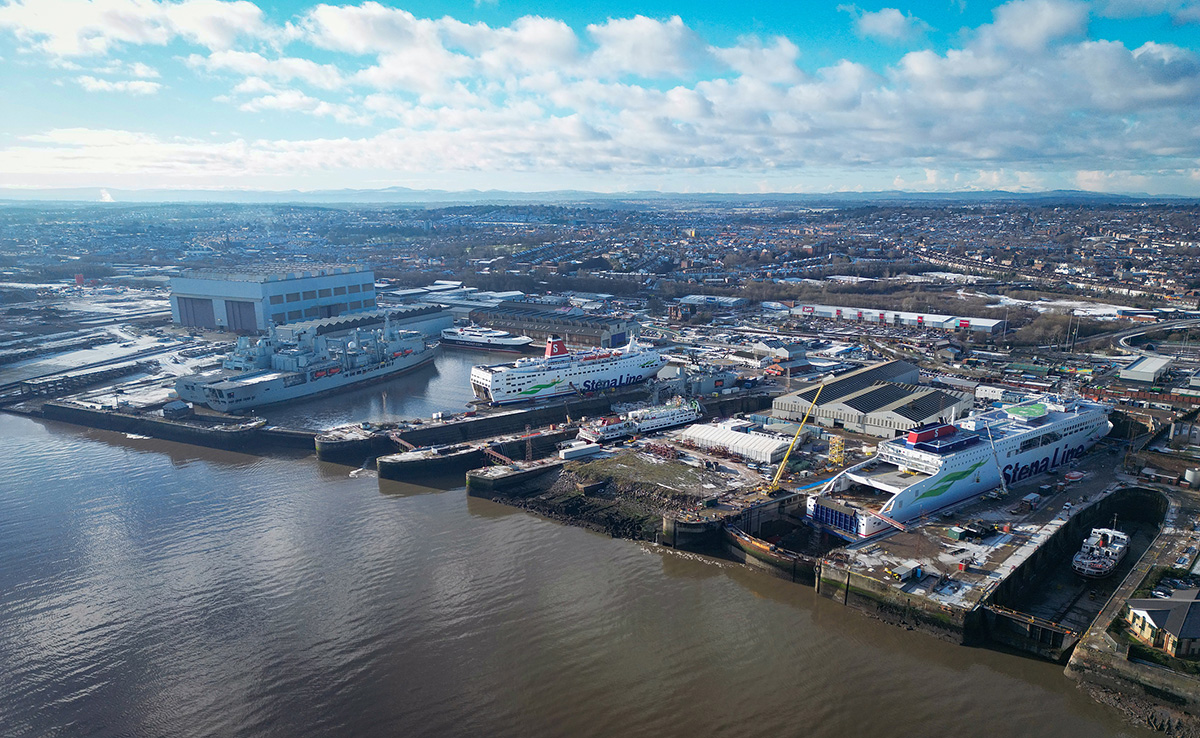
Shipbuilder Balaena has welcomed the decision by the United Kingdom and the Netherlands to jointly procure a new class of amphibious transport ships under a £2.4 billion programme, describing the move as a major opportunity for British shipbuilding that will strengthen global security, deepen the relationship between the two nations and benefit the UK’s shipbuilding communities, the company stated.
The agreement was signed by Prime Minister Keir Starmer and Dutch Prime Minister Rob Jetten during a meeting of NATO leaders in Ankara on 7 July. It will see the ships built in UK shipyards alongside Dutch industry, based on a Dutch design, with each nation operating four vessels. At 160 metres long and 15,000 tonnes, the ships will transport troops, vehicles and equipment, including drones, with flight decks designed to operate current and future long-range uncrewed and autonomous systems.
Balaena has positioned itself as a candidate to construct the vessels. Simon Gillett, the company’s Chief Executive, said in a statement: “Balaena stands ready to build the 160-meter vessels from our major construction facilities in Birkenhead and the North East of England. Our facilities have the industrial capability and capacity to support complex warship construction, and we continue to deliver major military vessels in the UK.”
Gillett pointed to the firm’s recent naval work as evidence of that capability. “In 2026 we have delivered key structural components of the Type 26 frigate programme and other Sovereign defence platforms on behalf of BAE. We have also previously delivered significant units of the Queen Elizabeth-class aircraft carriers,” he said, as quoted in the press release.
The company also cited its commercial order book. “Our commercial shipbuilding activity remains strong. In 2026, we will also deliver three commercial ferries, the Royal Daffodil for Mersey Travel and two ferries for Western Ferries,” Gillett said, adding: “Balaena and our established UK supply chain is ready to play its part in the delivering the new amphibious transport ships, which will benefit our workforce and shipbuilding communities across the UK.”
The joint programme, officially known as the Amphibious Transport Ship in line with Dutch naming conventions, supersedes the UK’s earlier Multi-Role Strike Ship concept, which initially envisaged up to six vessels replacing the two Albion-class landing platform docks, the three Bay-class landing ships and RFA Argus before budget pressures scaled back those plans.
Balaena is not the only British yard to signal interest in the work. Navantia UK, owner of Harland & Wolff in Belfast, has also issued a statement on the programme, with competition for the construction contracts expected among the UK’s major shipbuilders.



What about a partnership spanning the Irish sea? It seems to me with their extensive refit experience, CL are well set to do fit-out. With the recent investments, Belfast is much better equipped for bulk steel fabrication, but they lack recent experience building complete ships. The two yards working together could therefore complement each other quite nicely.
Fitout is the stumbling block.
Automation gets you so far with hull subsections and some modules being very efficient.
Fitout is quite a different story. And it is essential that workers understand MILSPEC construction detailing.
Yep and I think it’s probably Belfast’s weakness, the local labour/skills pool isn’t nearly as big as NW England. Amphibs have lots of cabins, loads of plumbing & electrics, well deck/elevators etc. it’s a lot different to a tanker or bulk stores ship.
I thought you just used superglue?
Taxi!
I agree but Belfast has had loads of cash spent on it and are building fleet replenishment ships. With there Huge dry docks that can accommodate Queen Elizabeth Carriers with there Goliath over head Crains. IMO Harland & Wolff Belfast shipyard is of National Strategic Importance to UK Defence & RN. Belfast should get 4 of amphibious ships and 4 to another UK yard or something similar to this. IMO only of course.
Cammell laird has more recent experience building ships then Navantia UK (Harland and Wolff), Cammell laird have built 6 ships since 2013 including RRS Sir David Attenborough and are currently building two ships at the moment the yard also built blocks for the aircraft carriers, the Astute & Dreadnought Class Submarines and the type 26 they have modern extensive experience building ships and more than capable of building amphibious transport ships,
The governments export activities have ensured we have enough work to sustain three yards for decades. Opening up a fourth would put all that in jeopardy. These vessel should be tendered between either Belfast or Rosyth with other yards like CL doing block work.
If we intend to seriously upgrade our armed forces and also go for export orders then we also need to increase capacity – an extra yard makes sense and would demonstrate a committment to growth. In 1990 we had 7 or 8 yards, not 3… so going up to 4 still isn’t anywhere near a Cold War footing.
I think we all know it’s most likely going to Belfast and CVV will go to Rosyth, it just makes sense. But CL are in fairness ahead of both, having recently completed several whole ships. Albeit they failed on T45 PIP, and BAE had to take it over.
Did CL ‘fail’ with the PIP? That’s a story/account that I’ve not read. How did they ‘fail’?
T45 is a super complex ship and CL were well out of their depth.
Sonik and Supportive Bloke,
Sonik – “…they failed on T45 PIP, and BAE had to take it over.”
Supportive Bloke – “T45 is a super complex ship and CL were well out of their depth.”
Setting the record straight on the BS surrounding the Type 45 PIP.
No, Cammell Laird did not fail the Type 45 Power Improvement Project (PIP), nor did they require a rescue.
The narrative regarding “failure” and “rescuing” surrounding the Type 45 destroyers stems from a fundamental misunderstanding of the project in the first place, rather than Cammell Laird’s execution of it. The idea that BAE Systems “took over” the project is a total misconception born from how the contract was originally structured. The PIP was a commercial alliance project from day one; BAE didn’t step in to rescue or take over the project midway through. They were the prime contractor from the beginning, managing the overarching project, supply chain integration, and ultimate systems delivery, while Cammell Laird performed the heavy engineering and physical installation. The alliance functioned exactly as intended.
The PIP was a multi-million-pound engineering fix mandated by the UK MoD to rectify a major design flaw in the ships’ original configuration. Cammell Laird wasn’t the problem, they were an explicit part of the solution.
In 2018, the BAE led alliance alongside Cammell Laird and BMT won the highly competitive contract for both the design and physical installation of the upgrade. Cammell Laird’s shipyard in Birkenhead was selected as the primary location to carry out the incredibly complex heavy engineering. The work required cutting massive holes into the hulls of the £1 billion warships to swap out two inadequate diesel generators for three larger, highly reliable MTU diesel generators. As previously noted by UKDJ, Cammell Laird did not replace the massive Rolls-Royce WR-21 gas turbines. The ships remain hybrid-electric; the upgrade simply replaced the underpowered Italian diesel generators with three larger, highly reliable German MTU units, heavily optimising the complex Integrated Electric Propulsion (IEP) architecture.
Rather than faltering, Cammell Laird successfully delivered the first in class conversion on HMS Dauntless, which completed sea trials and successfully proved the concept. Following this success, subsequent Type 45 destroyers were slated to undergo the same PIP conversion.
The perception that Cammell Laird was “out of its depth” or that the Type 45 PIP was “too complex” stems from a few very specific, highly publicised issues. The main driver of the rumour was how long the first ship, HMS Dauntless, spent at Cammell Laird’s Birkenhead yard. Arriving in 2020, she did not return to sea for trials until 2022. To the uninitiated or oblivious observer looking from the outside, seeing a frontline Royal Navy warship sitting in a civilian yard for two years created the impression that the shipyard was stuck, overwhelmed, or struggling with the complexity.
The extreme delay wasn’t due to a lack of capability, but because the first conversion was a massive, uncharted engineering puzzle. Cammell Laird wasn’t just fixing an engine, they had to cut open the side of a highly complex, densely packed stealth warship, remove two enormous diesel generators, fit three completely different, larger MTU engines, rewrite the high-voltage electrical architecture, and patch the hull back together without ruining the ship’s structural integrity or radar evading properties. To add to the complexities, the engineering documentation from the original builds was often incomplete or completely different from the actual physical reality inside the ship … imagine that! Requiring Cammell Laird to essentially invent the installation blueprint as they went.
By the time the PIP started, the Type 45 class already had a terrible reputation in the British press for breaking down and being “dead in the water.” When the fix also took years to implement, the media and some politicians lumped Cammell Laird into a general narrative of “defence procurement failure.” It was easy for critics to blame the civilian shipyard for the timeline, rather than acknowledging that the MoD had asked for an incredibly difficult procedure.
… It would seem a lack of critical thinking still applies to the PIP project.
The delays weren’t just because a shipyard was slow; it was because the UK was trying to manage a hyper complex, multi site industrial conveyor belt.
For the initial hulls, HMS Dauntless and HMS Daring, Moving a massive warship from a civilian commercial yard to a top secret naval base, all while juggling different corporate contractors, workforce availability, and the strict security clearance required for advanced weapons systems, added layers of logistical friction that most people outside the defence industry completely overlooked.
Recognising that this regional back and forth added massive administrative drag, the MoD and BAE Systems adjusted the model for the rest of the fleet. Starting with the third ship, HMS Dragon, the heavy engineering was pulled directly into the military footprint at HMNB Portsmouth. Yet, even as the geographic footprint shrank, the underlying logistical high wire act remained, coordinating heavy structural hull cuts, delicate high voltage architecture alignment, and concurrent missile upgrades across highly vetted, separate teams.
The timing for the first ships could not have been worse. The role of the COVID-19 pandemic is the massive piece of context the “out of its depth” narrative conveniently ignores, yet the PIP was effectively derailed by the global events of 2020 to 2022.
HMS Dauntless arrived at Birkenhead in early 2020, right as the world locked down. Military vessels are notoriously cramped environments. The PIP required hundreds of specialised civilian contractors and Royal Navy personnel to work in tight, unventilated machinery spaces, sharing the same ladders and hatches. When social distancing mandates hit, the yard had to drastically limit the number of people allowed on board at any one time, causing work that normally took days to stretch into weeks.
The PIP wasn’t just about labor; it relied heavily on a highly specific European supply chain. The project required integrating brand new, specialised MTU diesel generators from Germany and bespoke high-voltage switchgear. Between 2020 and 2022, global shipping collapsed, factories closed due to COVID-19 outbreaks, and lead times for high end industrial electronics quadrupled. Cammell Laird could not install engines or wire electrical architectures that were physically stuck in logistical bottlenecks halfway across Europe.
Furthermore, a warship cannot be easily tested, commissioned, or run through harbour trials when the crew is mandated to stay apart. Even the Royal Navy personnel assigned to Dauntless to assist with the upgrade and learn the new systems were forced into home isolation and remote training packages during the height of the restrictions. When the UK MoD and Parliament later reviewed the delays, they explicitly noted that COVID-19 disruptions, labor isolation, and global supply chain shocks were the primary drivers for the extended timelines. Every major UK defence contractor, including BAE Systems and Babcock, suffered identical setbacks on their naval maintenance schedules during this exact window.
Once the engineering blueprint was established on HMS Dauntless, Cammell Laird applied the lessons learned to the subsequent ships. HMS Daring went through the exact same PIP process much faster, completing its installation on time and to budget.
If BAE had truly taken the job over due to a Cammell Laird failure, the Royal Navy would have entirely stripped the remaining Type 45 destroyers from their hands. Instead, the subsequent hulls went straight back into the alliance pipeline to undergo the exact same process. Cammell Laird didn’t struggle because the ship was too advanced for them; they had to pioneer a complex, first of its kind engineering overhaul in the middle of a once in a century global shutdown, and they delivered exactly what the Royal Navy needed to get back in the fight.
The delays were systemic, structural, and contractual, not a failure of Cammell Laird’s ‘craftsmanship’.
A very good summary buddy everyone is out to sell a story and don’t let the truth get in the way 👍
I agree Jim.
CL are now part of Balaena
It’s not opening a 4th as Cammell laird already exists and has the infrastructure and workforce..
To be honest I think there is way more work than Belfast can handle
3 40,000 ton solid stores ships
8 15,000 ton amphibious vessels
That’s a lot of work and don’t forget by 2035 the tides will be 20 years old and some thought will need to be made with those… there will also be the 6 strategic lift ships as well.
Belfast do have a single dry dock with more capacity than Rosyth’s and more than Rosyth and Scotstoun combined if you include the refit dock. That helps.
They will be able to build all 3 FSSS concurrently and could theoretically fit 6 of the ATS in the build dock at once. The current build programme isn’t close to their limits as long as they can recruit staff at a rate to match it.
*Rosyth’s 3
Why four ships for each country? The Netherlands is a very small country with fewer global responsibilities than the United Kingdom, as far as I know.
That shows the situation of this government; they don’t want to spend on defense. The Netherlands spends more than the United Kingdom on its armed forces considering its population and importance in the world, as does almost any country in the world proportionally.
That’s not true, the Netherlands spends 2.2% of GDP on defence and the UK spends 2.5% of GDP.
The four Dutch ships are to replace two Rotterdam class LPDs and four Holland class OPVs. The new ships are far larger than double the size of the Holland class, so they will be an increase in overall displacement and a decrease in hull numbers.
The UK and the Dutch have run joint marine exercises for a long time. It was always supposed to be a feature of the littoral strike/response groups. So having a uniform ship class has advantages.
Thus they don’t have aircraft carriers, SSN, SSBN, and a host of other things.
Individual comparisons are meaningless. I’d have liked 6, we’re not getting 6, and given the new set up of the RM, I’m pleased we’re even getting these 4 the size they are.
The Dutch are going to use them to replace 4 frigate sized OPVs ( the Holland class) as well as their 2 amphibious vessels..
So the Dutch plan essentially to use them as patrol vessels and their amphibious vessels..we are just using them as amphibious vessels..
It does mean they are likely to be designed with a good medium gun armament as a minimum because the Dutch wanted them better armed than the Holland class with its 76mm super rapid and 30mm.
I think they would likely get a good set of medium guns regardless, they aren’t optional in today’s drone infested battle space.
Rubbish. Netherlands defence expenditure has been just over 1%.of GDP each year from 2010 to 2019, rising to 1.4% and reaching 1.9% only in 2024.
UK has met the 2% NATO standard every year since 2010 except for the years from 2016-2019, when it fell to @1.8/1.9%.
I believe the future amphibious transport ships should be distributed across multiple UK shipyards rather than being built solely by a single prime contractor. My preferred lead builders would be Cammell Laird (Balaena), Harland & Wolff (Navantia UK), and a Ferguson Marine-led consortium using Inchgreen for fabrication and final assembly. These yards should be supported by smaller regional shipbuilders including Macduff Shipyards, Parkol Marine, Manor Marine and Mainstay Marine to manufacture standardised modules and blocks. This approach would accelerate construction, spread economic benefits across the UK, reduce programme risk, and, most importantly, sustain the objectives of the National Shipbuilding Strategy by providing smaller shipyards with consistent work, enabling them to invest, expand and retain skilled jobs for the long term
the problem with Inchgreen is apart from the dry dock, there isn’t a lot else there
3 larger 20000t vessels should be consider by both Countries Rathe than 4 15000t Lhds…..
I’m actually surprised the Dutch went as high as 15,000 tons, they said they wanted smaller than their present amphibious vessels and the Dutch are going to use them to replace 4 frigate sized OPVs ( the Holland class) as well as their 2 amphibious vessels..
So the Dutch plan essentially to use them as patrol vessels and their amphibious vessels..so large for the Dutch will not likely cut it.
What would it take to bring shipbuilding back to Portsmouth?
A shipyard 😀
The former VT yard at the head of the harbour now hosts Griffon Hoverwork and a massive dry boat stack, unfortunately.
The former Fawley power station site on Southampton Water would be much more suitable if we wanted a blank slate new yard, but we don’t.
More Orders.
As I heard it, HII want Babcock to build Romulus design ships in the UK, and it wouldn’t surprise me if that work was done in Plymouth, so I’d say Plymouth was a slight favourite over Portsmouth for the return of South Coast construction.
Presumably if the Dutch intend to dual role at least their four to replace the Holland Class OPV they will need to be a bit more ‘ fighty’ than the name Amphibious Transport Ship would imply. Last time I looked the Holland’s had quiet a respectable gun armament , at least one 76mm and a couple of CIWS if I recall. Sure if these vessels do end up having a semi through deck flight deck and a decent hanger as some of the CG1 would imply then they should be much more capable in a sea control patrol type role as the type of drones envisaged should be able to patrol and if necessary strike over quiet a large bit of water on their own . My concern is however is that if they don’t have a reasonable gun armament as a backup like the Holland’s , at least a 57mm or a pair of Bofors 40 Mk IV then they won’t be able to do the constabulary piece without the support of yet another rare and scarce escort on their own.