

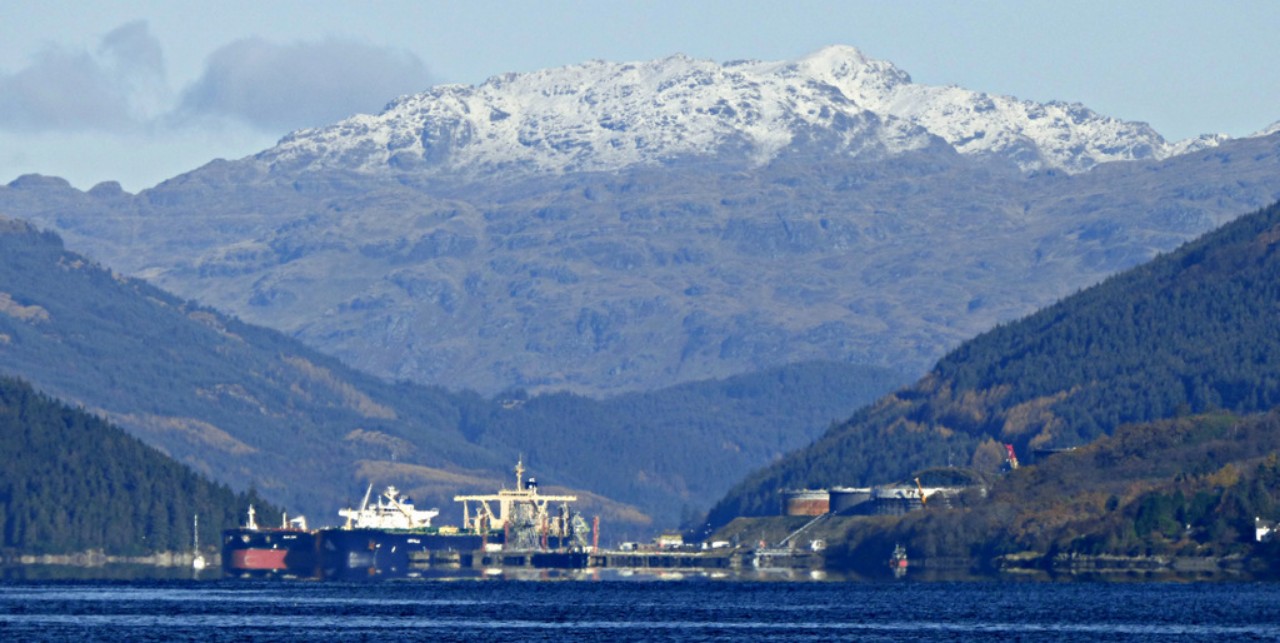
The Ministry of Defence has completed the purchase of the Finnart Oil Terminal on Loch Long, a multi-million-pound acquisition that expands the Royal Navy’s sovereign fuel-holding capacity and strengthens operational resilience at a time of heightened geopolitical uncertainty, the UK Defence Journal understands.
The deep-water terminal, on the eastern shore of Loch Long a few miles from HMNB Clyde, was built by the US Navy during the Second World War and spent decades handling crude oil for the Grangemouth refinery, first under BP and later Ineos, with a berth capable of taking tankers of up to 324,000 tonnes. Its future had been in doubt since September 2024, when operator Petroineos announced the site would close following the end of refining at Grangemouth, and the MoD’s interest in the site had surfaced in reporting over the past year, including its appearance on a leaked list of potential locations for new munitions production.
By making use of existing infrastructure, the department says, the purchase delivers value for taxpayers while creating skilled local jobs and supporting the wider supply chain. The site also provides additional space needed to progress the Clyde Transformation Programme, the long-term redevelopment of the Faslane submarine base.
The acquisition was confirmed as Defence Minister Luke Pollard visited HMNB Clyde to announce £26 billion of investment over ten years to modernise the Royal Navy’s three main bases at Clyde, Devonport and Portsmouth, funding the MoD describes as the largest programme of naval infrastructure investment since the end of the Cold War. The money, confirmed in the recent Defence Investment Plan, will pay for modernised waterfront infrastructure, new docking facilities, refitted buildings and new single living accommodation, alongside training facilities, out-of-water engineering infrastructure and research and development capability.
“The threats facing the United Kingdom are real and they are growing. This Government is not waiting – we are acting now to ensure our Royal Navy has the bases and infrastructure it needs to be ready to fight,” Pollard said, as quoted in the announcement. “This £26 billion investment is the largest in our naval bases since the Cold War, and Scotland is central to it. Clyde is critical to our nation’s defence. This investment is securing thousands of jobs up and down the country and strengthening our Armed Forces for the challenges of today and the future.”
Scottish Secretary Douglas Alexander said Faslane, which he described as Scotland’s largest military establishment and its second-biggest employment site with more than 6,500 military and civilian personnel, would be transformed with £15.1 billion of Defence Investment Plan funding “into a modern, more efficient base, future-proofed for war-fighting”, as quoted in the announcement. He said the investment would make Britain “safer at home, stronger abroad” while delivering a defence dividend for Scottish communities.
Alongside the naval funding, the Minister confirmed more than £240 million in RAF sustainment contracts benefiting Scotland. Boeing Defence UK has been awarded a £115.2 million two-year extension to sustain the RAF’s nine P-8 Poseidon maritime patrol aircraft at Lossiemouth, safeguarding over 200 skilled jobs and more than 20 apprenticeships, while a separate £127.5 million E-7 Wedgetail sustainment contract will support around 180 jobs with a further 60 to 80 new roles projected. A £20 million investment in Inchgreen Marine Park on the lower Clyde will revitalise one of the UK’s largest operational dry docks, supporting 350 direct jobs and a new skills centre.
The ten-year base upgrade programme forms part of the Defence Investment Plan’s £298 billion package to transform the UK’s Armed Forces, and the MoD says it delivers directly on the Strategic Defence Review’s commitment to warfighting readiness.
Image Thomas Nugent, Creative Commons Attribution-Share Alike 2.0






Interesting how many of the existing MoD POL Depots are already in Scotland, with Loch Striven and Loch Ewe OFDs being declared to NATO, OFD Campbeltown, and OFD Gareloch Head, close by to HMNB Faslane. Now joined by this.
Others elsewhere in the UK include OFD Thanckes for HMNB Devonport, with its Yonderberry Jetty, and OFD Gosport serves HMNB Portsmouth.
Overseas, there are also the OFD at Gibraltar at Kings Lines, buried in the rock, the POL Depot at Mare Harbour in the Falklands, and the OFD at BDSSU at Sembewang, Singapore.
Non Admiralty, West Moors serves the Army, assume it and the varied Admiralty OFD all linked to the old GPSS, now the Exolem Pipeline system, parts of which remain controlled by the OPA and the MoD, which also links to various airports and RAF Stations.
There are also a large number of “Refuelling Points” on wider MoD estate which were published under a FOIA request.
Looking at GE, Finnart sits nicely in between existing MoD sites on Loch Long at Glen Mallan, Glen Douglas, and Coulport.
Seems the UK is not short on infrastructure here?
Yes, much of the reason is to support NATO fleet in the North Atlantic. Scotland will be the main rallying point. Also with the new ballistic and cruise missile threat refuelling depots are a magnet for attacks.
Not short of infrastructure perhaps, short of SHORAD to actually protect it when these ‘threats’ actually materialise though. Different story.
Good. The Government should hold onto many strategic assets which support legacy fuels until such time as our entire military is running on wind power 🙂
If they’re interested in war-fighting resilience should they not also be looking to reverse the post-Cold War trend of closing multiple, distributed facilities and consolidating them into a small number of critically important locations (aka ‘targets’)?
👌
That’s when cost wins and the resilience can be conveniently sidelined.
Underground bunkers as well, where’s the money to refurb and reactivate those which were abandoned?
Some of the RSG apparently have a clause allowing HMG to reoccupy but, they’re now widely known, so only so useful.
Portland ?
Does Portland have a big roll to play here… I heard rumours that the old Bunkers were being considered for storage of some sort ? 🤔
It does seem to be a very active port even though It’s private now. 🫡
Just asking because I know you know a lot of shit about a lot of shit….. 😁
Bugger….. “Role” 🤦♂️
Not heard of that mate.
Certain sites had the onsite UG stuff mothballed as it was cheaper to move to the surface. Others never left. I’d support money flowing into this area, in the Cold War we spent a lot on UG.
I think It was Gas Storage but not sure.
Have a look on Sub Brit.
Some forward thinking…Should have purchased the old Murco site at Milford Haven a few years back aswell..
Pity we don’t yet have the ships to take advantage of this purchase…
Can we build a pipe line to the Bay and It’s fleet of MCM Drones….. 🤔
They must be running short of fuel waiting around for Trumps War to end ?
In other news: Navy fuel reserves to be boosted due to a lack of commissioned frigates and laid-up Destroyers
Ha 🤣👍
I heard the Pumps had mostly all ceased up now.
Would the fact we now only have four 4 operational refineries in Britain and weve sabotaged our own North sea oil and gas production….!
point to a certain flaw in this bright idea…?
Knew there was a silver lining. 🥳
When the MOD starts directing scarce funding to improving the resilience of low profile infrastructure, its time to take seriously all the warnings that the UK may be involved in a major conflict by 2030, if not earlier. I just wish that this government, despite all of its rhetoric, was not still burying its head in the sand and operating a de-facto “10 year rule”, kicking all the hard funding decisions on to the “next parliament” … c.2030.
Depends on if their already looking at appeasement as their best bet against Puntin if he does happen to come our way….!
Wonder if our Allies are fully aware of our fallback position yet…!
Not sure even this ‘head in the sand’ Govt can seriously believe at this stage appeasement will work with Putin, certainly much beyond the present irritating provocations. If he, after the present drubbing gets to a position (or simply kicks off out of some Monty Python Black Knight delusion) where he is overtly attacking, I doubt he is going to back down even with a gun pointed to his head. Watching series one of the Secret War again and the latest Silo and its spooky just how relevant they are to very current affairs with Russia and Iran.
Should be very weary of western media reporting of Iran.. their hatedred of Trump and the fixation with the straights tends to mask the damage the US military is inflicting on Iranian infrastructure and military hardware…!
It was suggested on Navy lookout that the land was already owned by the MOD but not the infrastructure. That is what has been purchased
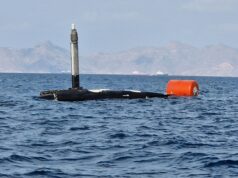
Curiously, just seen that Finnart will also be used for the autonomous MCM vessels.
No idea why with 3 half empty naval bases.
Maybe as a base for protection of the general area of the Clyde ? It also isn’t too far from BUTEC
Why not just do that from the berths 12 Sandown MCM once sat at, Faslane.
Curious to say the least, it flies in the face of everything the MoD has been doing, putting eggs in as few baskets as possible to save money.