

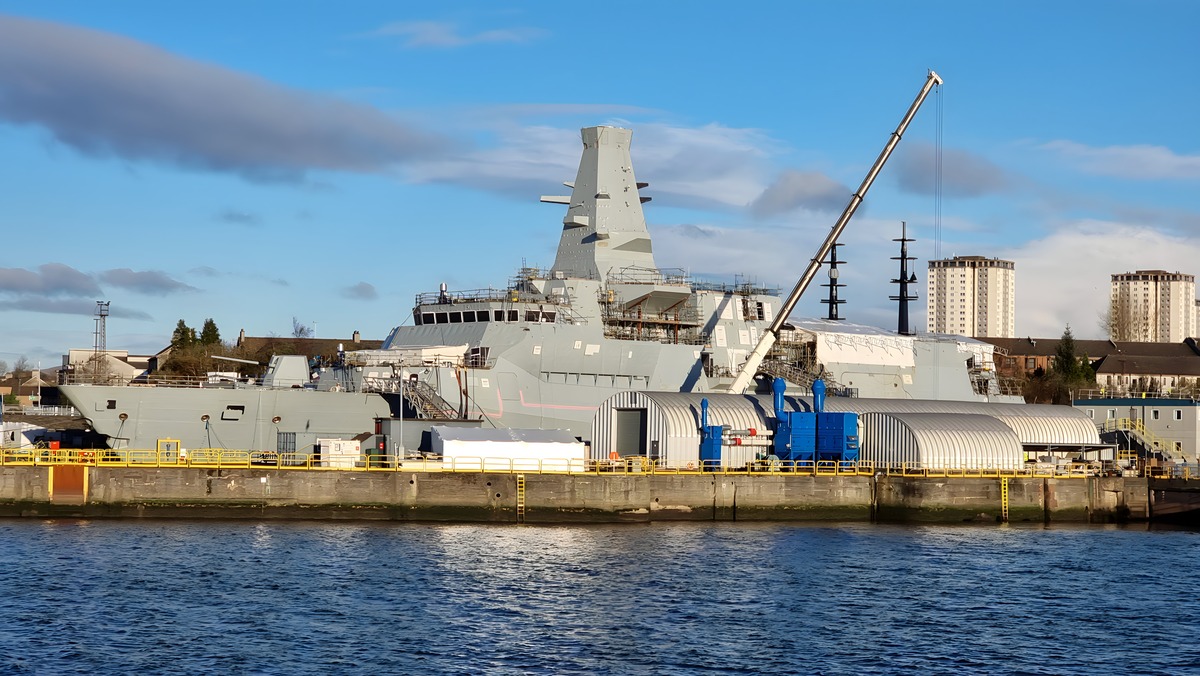
The allocation of individual Type 26 build slots between the Royal Navy and the Royal Norwegian Navy has yet to be settled, with detailed production scheduling continuing to be developed with industry and international partners, Defence Minister Luke Pollard has told Parliament.
Responding to a written question from Conservative MP Ben Obese-Jecty, who asked how many Type 26 build slots are allocated to each navy during the near-term investment period set out in the Defence Investment Plan, Pollard said the programme “remains focused on delivering a combined fleet of at least 13 frigates to hunt for Russian submarines in the North Atlantic, the biggest British warship deal in history and centrepiece of the Lunna House Agreement.”
That fleet comprises eight Type 26 anti-submarine warfare frigates for the Royal Navy and at least five for Norway, he said, adding: “Detailed production scheduling and the allocation of individual build slots associated with United Kingdom and Norwegian requirements continue to be developed with industry and international partners.”
The answer follows confirmation from the Government earlier this year that build slots currently allocated to the Royal Navy were being assessed for potential transfer to Norway.
In a written answer to Conservative MP Mark Francois, Pollard said at the time that the UK was “working together with our Norwegian Partners” and “assessing options for offering Type 26 build slots currently allocated to the Royal Navy to the Royal Norwegian Navy.” That marked the first direct acknowledgement that such an approach was being actively examined, although the possibility had long been discussed in defence industry circles given that the combined fleet would, the Government argued, be carrying out tasks in the same area as part of broadly the same effort.
Ministers have consistently maintained that the Royal Navy’s own programme will not be reduced as a result. “The Royal Navy will receive all eight Type 26 ships during the late 2020s and 2030s as planned,” Pollard said in the earlier answer, describing Norway’s biggest ever defence procurement as creating a combined Anglo-Norwegian force of thirteen anti-submarine warfare frigates operating jointly in Northern Europe and significantly strengthening NATO’s northern flank.
Norway selected the Type 26 in 2025 to replace its Fridtjof Nansen-class frigates, with the ships to be built by BAE Systems on the Clyde alongside the Royal Navy’s vessels. The sequencing of Norwegian hulls within the existing production run has been one of the central questions hanging over the arrangement, given Oslo’s desire to field its new frigates quickly and the Royal Navy’s need to replace its ageing Type 23s, which are leaving service faster than their successors arrive.
The programme itself continues to progress, with first-of-class HMS Glasgow powered up for the first time in December, generating her own electricity through onboard diesel generators that form part of the class’s hybrid propulsion architecture, designed to support the low acoustic signature central to anti-submarine operations.








We want 8 and we can’t wait. 😁
Personally, I want about 15 but appreciate that is just wishful thinking.
Yep 15 + the 5 T31s will take the navy to the peacetime frigate strength it was assessed to need in the nice calm 1997 period.
I believe public outcry got 8 last time.
This time…public opinion???
AA
given state of t23s and Astutes the first 4 need to be prioritised for the RN
Exactky! The RN is now in such a poor state we are desperate for these ships.
Fair enough. No rush really. We have five clapped out 23’s we can use after all..
The oldest (Sutherland) is 30 years old and Lancaster already made it to 35. All remaining T23s are later YSL builds (SH builds seem to die sooner). If all five make it to the end of the decade (which seems plausible) we will be back to eight ASW with tails i.e. 5x T23 and 3x T26. And we should by then have at least three T31 to cover GP duties such as FRE. The timing of the dip in numbers is arguably perfect, because Russian finances are screwed right now, and Putin is doubling down on his failure in Ukraine. By the time they turn it around (5-10 years, if ever) we will already have a solid and growing fleet.
The problem is it’s not just about age it’s about the fact that 5 years after their lifex each T23 needs a full Loyds survey of its hull and plating thickness and they all come up as needing massive levels of remedial work on the hull plates.
“if all make it”?, “should have three 31’s, “dip in numbers is perfect”, ” growing fleet”.. All of this assumes that the government allows everything to go ahead as planned and that Putin isn’t going to panic. I don’t really trust either, my friend.
Besides the UK, Germany, Norway, Canada, Sweden and Poland have all made big commitments to expanding their fleets with AIP submarines and/or first class ASW ships, and together we have an expanding fleet of P8. Russia are already struggling just to sustain tanker escort through the English Channel. I think together with our NATO allies, we have it covered, even excluding the USA.
In that case why buy any? We can let our allies do it for us. Defence should not be about what you can get allies to do. It’s about what we WANT to do, not just in NATO, but in the rest of the world.
All eight is already a cut from 13.
It looks like they’re doing the same thing that they did with the type 45. Start with 12/13 normalise a cut to 8 then cut again to 6 because IIRC CEC would make them equally effective (never fitted) and aslo (best one ever!) To free up capacity to get the T26 into service faster (I think that joke was around 2018 or so!)
A lot of attention has been given to the intention to replace T45 with CCV and USVs. But for the next decade AAW capability will actually improve as T45 PIP is completed and CAMM is added. Once all six are operational, AAW capability will be as good as s if not better than it has ever been.
The real crisis is the state of ASW assets. With all SSNs awaiting maintenance and just five T23s left, getting T26 into service is urgent. However attractive a big export deal seems, the RN must have priority for deliveries. Selling off old vessels that you no longer need makes sense. Selling brand new ones that you desperately need to counter the only real naval threat from Russia is madness.
That fact that improved from existing don’t mean it did not get worse for AAW. That evaluation depends on what the enemy got in meantime, The other side might not have been static.
Is there anything more capable than Aster and Sampson or the similar radars used on France and Italy’s Horizon AAW ships?
I was only arguing that whilst AAW capability is improving, slowly, ASW is getting weaker. Hence the need to prioritize it.
It’s notable how DIP stated an OSD of 2035 for T45 (which is plainly ludicrous) then government immediately walked back on it. It’s almost like they intentionally made conflicting announcements, to muddy the waters, to blunt protests over T83 being ‘canceled’. Albeit what they’ve really done with this slight of hand, is given BAE’s potential T83 order to Babcock, under the guise of the ‘hybrid navy’ concept. T83 lives on, but now it’s called CCV because politics.
CCV = Type 32
I’d argue that they effectively *combined* the requirements for T83 and T32 into one type of ship, principally so they could go with Babcock’s cheaper hull. The name change to CCV is just smoke and mirrors.
You are right. Added to this is the fact that both the T26 and T31’s are running late. At least as far as one can make out maybe 2 years late. The consequence of this is Its not just watching paint dry; its like watching the ASW arm dissolve in rust on steel.
Cop out.
The fair option would be that any hulls currently in progress are for the RN only.
Promising exports before we have the capacity to build them in a reasonable timeframe is madness.
Get on with building and fitting out the ships ffs. The build is taking way too long just like the maintenance on the Astutes.
Does BAE need to revisit the 2014-15 Scotstoun shipyard development? May be not the building dry dock, but the advanced steel working facilities, with emphasis on pay down and high fit out, with panel line, 3d unit panel lines and paint facility, with a load in/load out area. Would this help the Janet Harvey Hall assembly? 250 million pounds at that time, with the dry dock.