

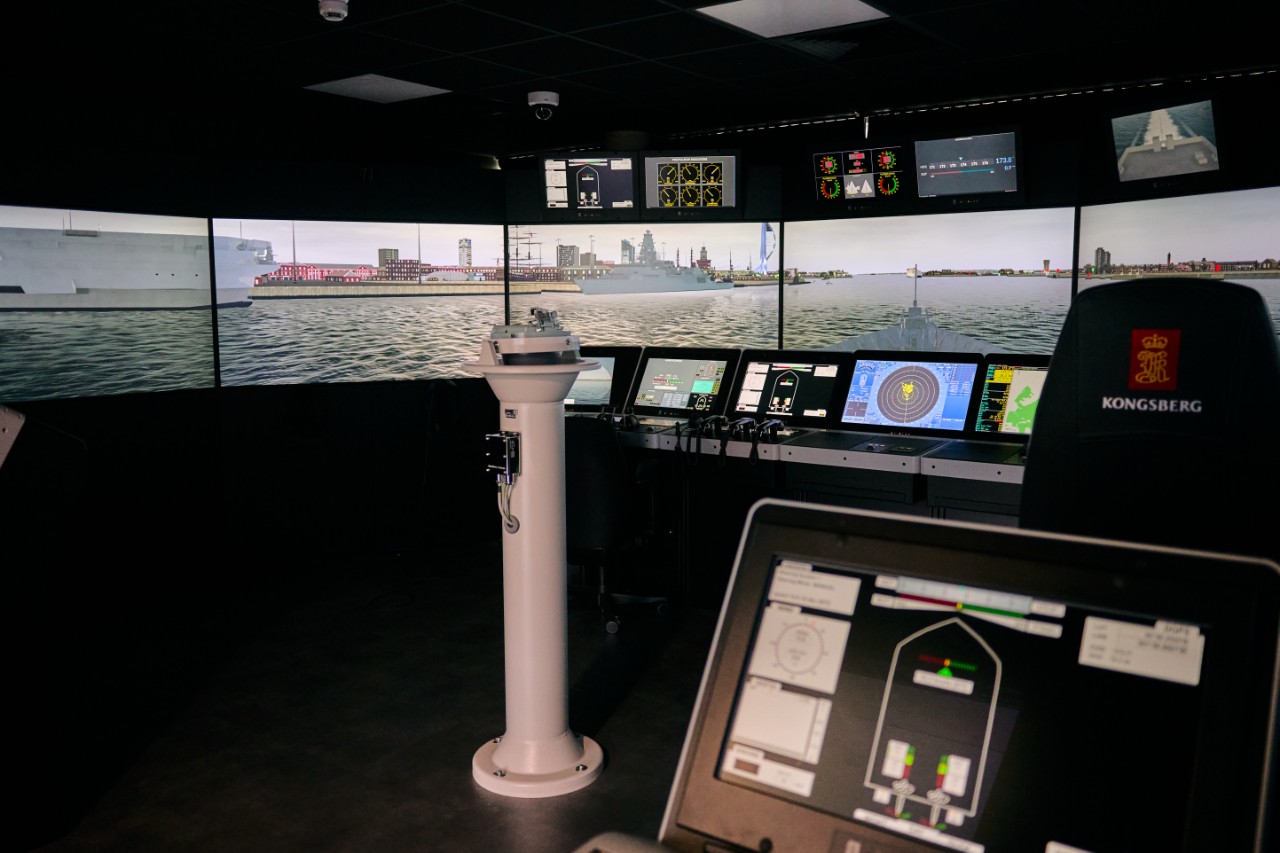
Royal Navy sailors are using a virtual reality bridge simulator to practise taking a warship through the Strait of Hormuz at heightened readiness and hunting a Russian submarine in the English Channel, with the system built by Portsmouth firm Metaverse VR.
The Bridge Simulator is already in use at several sites around the country, putting officers and ratings on the bridge of a range of vessel types and handing them the ship to command and navigate, with an adversary somewhere out there to worry about, be that a warship, a submarine or an uncrewed underwater vehicle.
Capita, which showed off the system alongside Metaverse VR at the firm’s base at Portsdown Technology Park, says it is giving crews a level of preparation for a confrontation at sea that was previously thought impossible, and a simulated engine room runs as part of the same setup.
The kit reached the Navy through Project Selborne, the twelve-year training contract run by the Capita-led Team Fisher consortium until 2033, and Metaverse VR is one of the smaller firms working under that arrangement, having earlier won a Selborne contract to build an interactive 3D walkthrough for submarine qualification training at HMNB Clyde.
Capita says the Bridge Trainer has doubled the Navy’s navigation training capacity, and holds the relationship up as proof that a big prime can pull good ideas out of its supply chain, arguing that pairing a prime with a specialist SME is how defence capability should be delivered in future. The practical case for training this way is straightforward enough, since a crew can rehearse something dangerous again and again without the cost of putting a frigate to sea, and without needing one to be available.
Speaking previously to the UK Defence Journal, Richard Holroyd, Capita’s Chief Executive of Public Services, explained how simulation and artificial intelligence were changing how courses run across the programme more broadly. “We’ve used AI to build a schedule optimisation tool. We identify the best way to put the building blocks of the courses together. Take the training needs analysis, apply technology to it, and understand how you shift people through the lessons faster without compromising on quality,” he said at the time, adding that the point of it all was simple: “Our mission is to get more sailors to the front line faster.”
The simulator is one piece of a much bigger overhaul, with Selborne having folded 27 legacy training contracts into a single arrangement covering 80 per cent of the Navy’s shore-based training across 14 sites, where more than 1,500 uniformed and civilian educators now work as a single workforce. Five years in, Capita says AI and digital tools have cut some course lengths by up to 40 per cent, the achievement rate for Royal Navy apprenticeships stands at 76.3 per cent against a national average of 65.4, and Ofsted has rated training quality ‘good’ or ‘outstanding’.
There is a very good argument for doing this ashore, nobody is going to stage a close-quarters run-in with a Russian submarine for practice. In the simulator they can get it wrong, work out why, and go again.









Easier than finding a platform to do it for real.
😊
Yuk, i do not like this “having earlier won a Selborne contract to build an interactive 3D walkthrough for submarine qualification training at HMNB Clyde”. Part of the challenge of passing the SMQ was doing it live, under pressure, crawling into the most hideous of spaces. I can’t see a simulator providing the same opportunities to demonstrate your level of knowledge to a bin bag who is trying to make the experience as uncomfortable as possible.
I bet on Unreal engine
Crapita???! God help the RN