

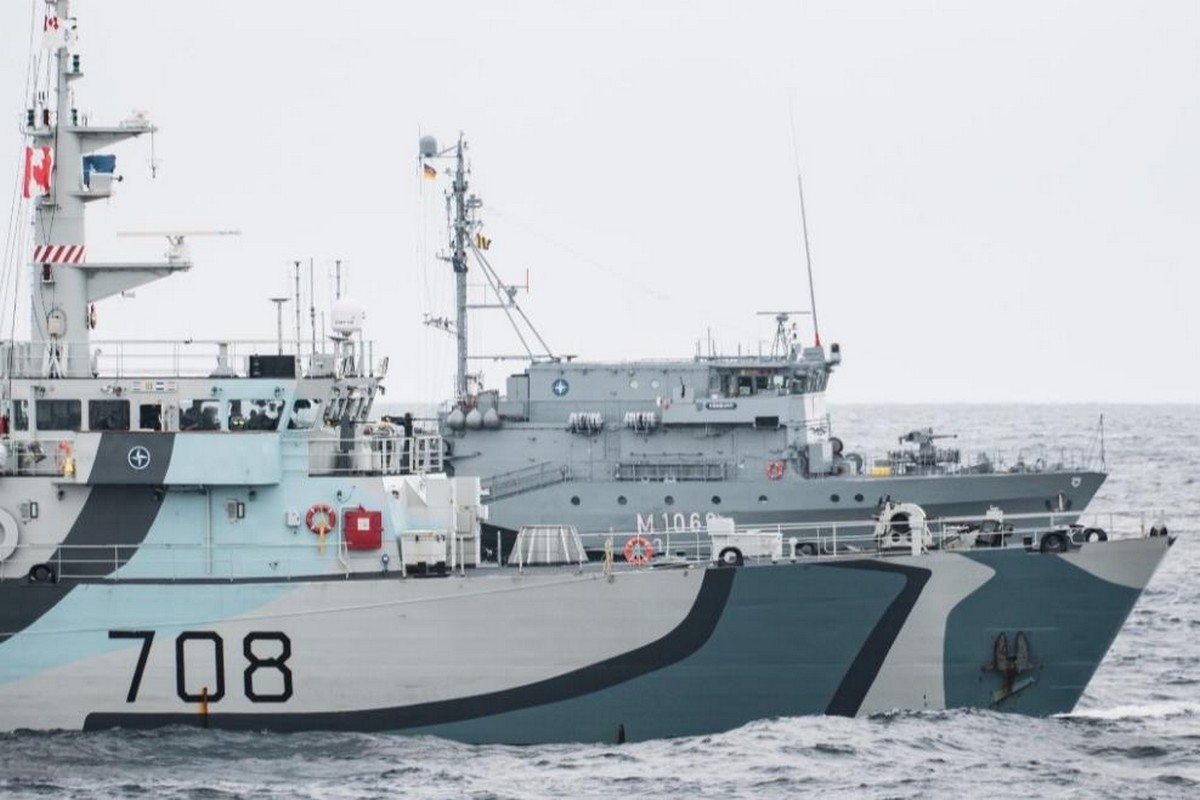
NATO warships, minehunters and specialist teams are exercising around Iceland as Northern Viking 26 tests the defence of the strategically important sea routes linking North America and Europe.
NATO naval forces are training around Iceland in Exercise Northern Viking 26, with operations focused on the defence of Iceland and the strategically important sea lanes running through the Greenland-Iceland-United Kingdom Gap, the UK Defence Journal understands.
The US-led exercise forms part of NATO’s wider Arctic Sentry activity and brings together air, surface, subsurface and mine countermeasures forces in the North Atlantic. According to a NATO Allied Maritime Command news update, forces from the United States and Iceland are operating alongside personnel and assets from Belgium, Canada, Denmark, Finland, France, Lithuania, Germany, Norway and Poland.
Standing NATO Mine Countermeasures Group One, currently under Lithuanian command, is taking part with minehunters from Canada, Germany, Lithuania and Poland. The formation is also supported by a Danish mine countermeasures team and a Portuguese Explosive Ordnance Disposal team, giving the exercise a substantial focus on keeping maritime routes open in the event mines or other underwater hazards threaten freedom of movement.
Standing NATO Maritime Group One is operating alongside the mine countermeasures force, bringing NATO’s surface warships into the same training environment. The two standing groups are exercising across surface, subsurface and mine warfare tasks, with NATO describing the activity as a means of improving coordination between forces that would have to operate together during a real contingency in the High North.
Commander Donatas Gečas of the Lithuanian Navy, Commander of SNMCMG1, said, as quoted in the news update: “Exercises such as Northern Viking demonstrate the value of bringing together Allied mine countermeasures forces with other maritime and joint capabilities.”
He added: “By training together in a demanding operational environment, we strengthen interoperability, share operational experience and improve our readiness to contribute to the security of the North Atlantic.”
The waters separating Greenland, Iceland and the United Kingdom form a series of maritime passages connecting the wider North Atlantic with northern European waters. NATO describes the GIUK Gap as a critical maritime corridor linking North America and Europe, making the ability to monitor and protect movement through the area important to reinforcement and resupply across the alliance.
Northern Viking is also intended to improve allied familiarity with the operating conditions around Iceland and the High North. Naval forces in the area have to contend with difficult weather, cold water and long distances between support facilities, while the combination of surface vessels, submarines, aircraft and mine warfare units places additional demands on multinational command and control.
The exercise places particular emphasis on mine countermeasures because mines can restrict access to ports, channels and other maritime routes even without a large conventional naval force being present. NATO’s standing mine warfare groups are maintained to locate, identify and neutralise such threats while allowing other naval and commercial traffic to continue operating.
Northern Viking 26 forms part of Arctic Sentry, NATO’s wider effort to reinforce awareness and readiness in the High North. The alliance says the exercise supports both the defence of Iceland and the protection of critical national and NATO infrastructure in the region.
SNMG1 and SNMCMG1 are two of NATO’s four Standing Naval Forces, formations kept at high readiness to provide continuing maritime presence, protect freedom of navigation and respond to emerging requirements. Their combined participation around Iceland gives NATO an opportunity to exercise those roles along one of the most important maritime approaches between Europe and North America.




Have we sent a rowing boat armed with a spud gun?
Reforger has gone. The sosus lines mean very little now Russian subs are as quiet as ours.
Clinging to old infrastructure when we couldn’t defend it forty years ago.
Sad that the RN is not represented in some form. Our navy used to maintain a near permanent participation in the NATO standing naval forces, clearly we are no longer able to do that.
I also note that there were a number of newspapers (including the Sydney Times) commenting the John Healey may be about to row back on the 3% of GDP spending on defence that he resigned over..! Yet on the other hand the Times this morning is reporting that Navantia has be told to speed up the delivery of the new supply ships. Hopefully the former is just rumours.
Cheers CR
Just to clarify Healey is delaying the decision until next year’s spending review..! Even so it stinks, our defences are desperately in need of rebuilding.