

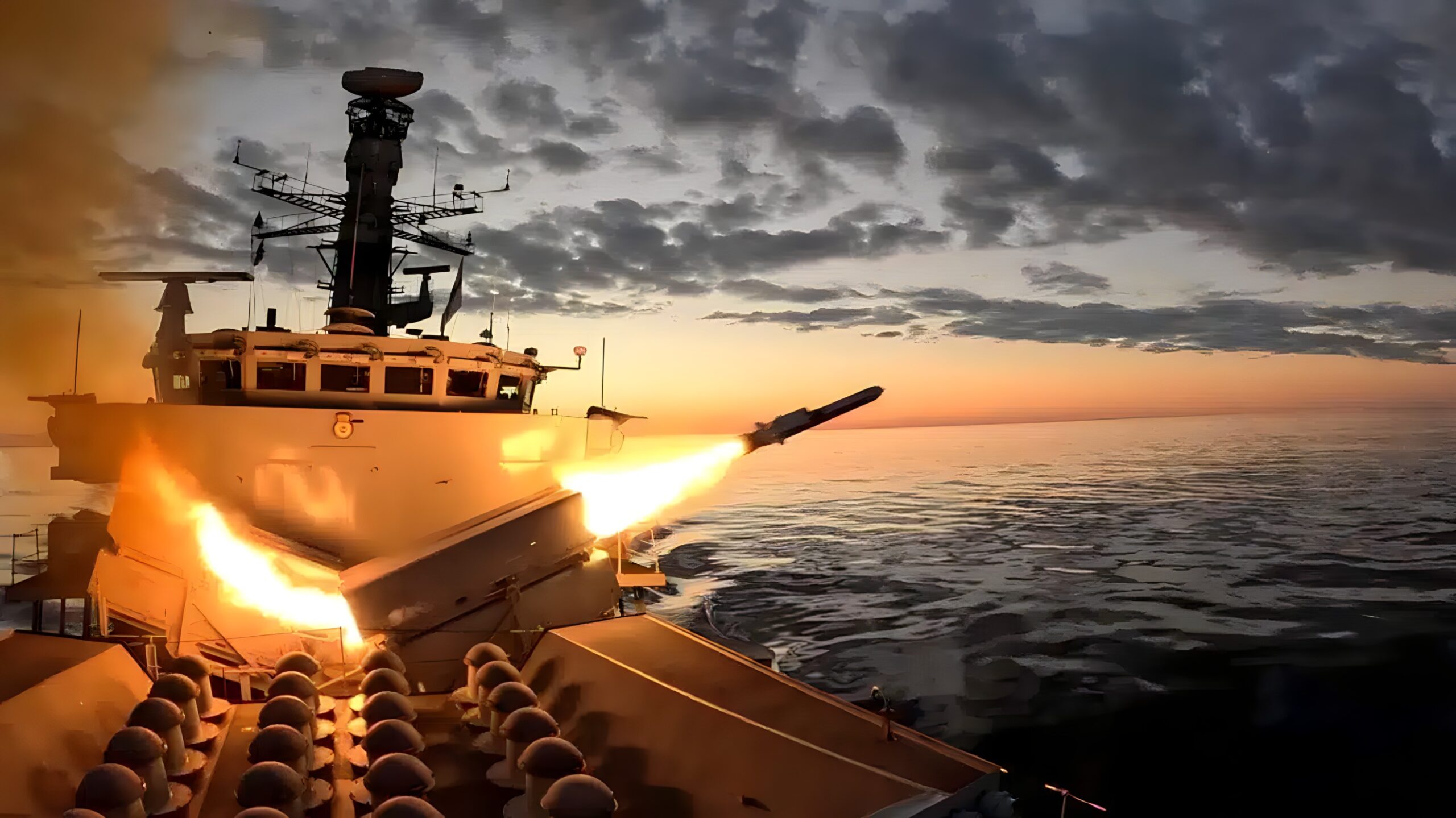
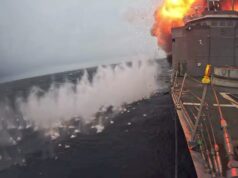
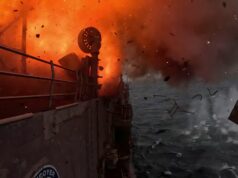
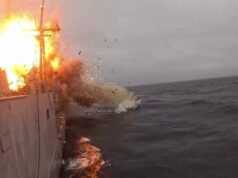
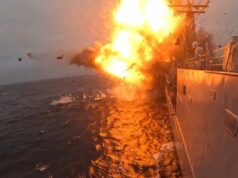
The Royal Navy used both of its newest anti-ship missiles during a joint US-UK live-fire exercise off the Hebrides that ended with the sinking of the decommissioned American frigate USS Klakring, firing the Naval Strike Missile from HMS Portland and Sea Venom from a Wildcat helicopter of 815 Naval Air Squadron operating from her flight deck.
The round Portland fired carried a warhead and was aimed at a real ship rather than a range target, which the service describes as the first Royal Navy firing of a Naval Strike Missile, although HMS Somerset launched one off Norway in September last year.
Lieutenant Commander Louise Kirkaldy, HMS Portland’s principal warfare officer, said: “The successful firing of Naval Strike Missile marks a significant milestone for the Royal Navy, demonstrating our ability to deliver credible, modern maritime strike capability. This achievement reflects the professionalism, dedication and teamwork of all those involved, whose hard work has ensured we remain ready to meet the challenges of today and tomorrow.”
Petty Officer James Kenyon, an above water warfare specialist aboard the frigate, fired it. “To be involved in such a high-profile exercise is the highlight of my career,” he said. “Being the first person to fire war-shot Naval Strike Missile and achieve a hit is a very proud moment, and one that will stay with me for the rest of my career. This was the culmination of over a year’s effort in planning and bringing the drills into service, and I am glad that I was able to contribute.”
Commander Dafydd Bryden, the ship’s commanding officer, said: “The opportunity to fire anti-ship missiles against a decommissioned warship is an important test of our warfighting capability. This engagement proved the effectiveness of these systems as well as the sailors and aircrew who operate them. We remain ready to fight and win at sea.”
Sea Venom was fired from the Wildcat during the same serial, and Captain Kelechi Ndukwe, commander of Task Force 65, confirmed to journalists that it was the missile’s first live firing since reaching initial operating capability, and that it hit the target. According to the Royal Navy, the helicopter completed the full kill chain by detecting, identifying and striking the target rather than simply releasing the weapon.
Lieutenant Commander Rhydian Edwards, test and evaluation commander at the Maritime Aviation Strike Operational Advantage Group, said: “This was a landmark moment for the Wildcat Force. For the first time we demonstrated the live firing of an operational Sea Venom missile against a representative maritime target. More importantly, we proved our ability to execute the full maritime strike kill chain under realistic operational conditions.
“This was about giving commanders confidence that Wildcat can find, fix and strike maritime targets using Sea Venom as part of a wider task group. The lessons learned from this activity will directly inform future tactics, training and operational capability development, ensuring Maritime Aviation Strike remains ready to fight and win when called upon.”
The Naval Strike Missile was brought into Royal Navy service under an interim arrangement to replace Harpoon, which left service in 2023, and has been fitted to Type 23 frigates and Type 45 destroyers using equipment transferred between hulls as ships enter and leave refit. Built by Kongsberg, the weapon is a sea-skimming missile with a low radar signature and a range well beyond that of the system it replaced, and it can strike land targets as well as ships. The service says it carries an advanced warhead, travels close to supersonic speeds and can reach targets more than 100 miles away while evading detection by skimming the sea, and that it will be complementary to the Future Cruise Anti-Ship Weapon, intended to become the fleet’s premier long-range anti-ship missile aboard the Type 26 and Type 31 frigates through the Mk41 vertical launch system.
Sea Venom, built by MBDA, is the Wildcat’s principal anti-ship weapon and replaced the Sea Skua carried by the Lynx. The Royal Navy describes it as designed to defeat corvette sized vessels or disable frigates, destroyers and other larger ships, with a Wildcat able to carry four at once, and says it can also be used overland against bunkers, buildings and vehicles. Readers will have seen the same missile turn up this week on a very different platform, fitted by STARK to an uncrewed surface vessel built near Plymouth.
The two British weapons were part of a wider engagement in which USS Paul Ignatius demonstrated the maximum damage and range capability of an anti-surface variant of the Standard Missile 6, and the submarine USS Massachusetts engaged the target with the Mark 48 Advanced Capability Torpedo, which delivered the final hit and sank the ship, as we reported.
Weapons were used in order of reach too we understand, with the longest range ordnance going first. Ndukwe said the American side started with the SM-6 before moving in to shorter range systems, a sequence designed to get the most out of the sensors fitted to the hull for battle damage assessment.
Atlantic Thunder 2026 was led by United States Sixth Fleet and drew in forces from five American task forces alongside the Royal Navy, the Royal Air Force and the United States Air Force. Lieutenant Commander Paul Atkins, the United Kingdom lead project officer for the exercise, said: “Atlantic Thunder 26 demonstrated the enduring strength of the UK-US alliance and the close partnership between the Royal Navy and the United States Navy. Operating together in a demanding environment, we showcased our ability to integrate seamlessly, share expertise and deliver a highly capable, interoperable maritime force. Through combined training and operations, we have strengthened our collective warfighting capability, reinforcing our ability to deter potential adversaries and deliver maritime combat power whenever and wherever it is required.”





Great weapons and the RN willl soon be even better served with STRATUS as well but we need to get NSM on all the T45’s quickly.
With so few vessels at sea, a small buy of JSM for P-8 could be considered as the Germans are. It will also be integrated on MQ-9B.
That seems a simple way of adding deterrence in the interim , especially as the Russian navy seems to be permanently loitering of our coast guarding it’s shadow fleet.
Or on the F-35B’s
They’d have to be carried externally, as they wouldn’t fit in the weapons bay on the f35b. That would remove the steath of the plane.
But it would me a good alternative to use while we are waiting for Spear3.
I’d imagine it won’t happen though as GBU53 Stormbreakers would fill the role and allow for the plane to fly in stealth mode.
Well done all – great to see the RN using these fantastic assets. Agree with Jim – need to see NSM on T45s asap (Richmond’s set is going spare).
It would be nice to know at what range the NSM was fired from.
The SM-6 was fired from maximum range reportedly (300km or so), so the NSM was probably similar (150-200km).
That would imply a big no fly zone.
This is good.. but the fact they are showing the Russians the RN can actually hit a ship shows to me the huge requirement for a fixed wing based anti ship option
Both the F35s and Typhoons need a way to sink the Russian surface fleet.
Because we don’t want our precious ASW frigates getting in missile range of a Russian surface vessel we want them hunting Russian SSNs and protecting the carriers and T45s.
It’s the same with the Uk SSNs.. we don’t want the 1-2 we would have available attacking Russian surface combatants they will be needed to 1) protect the deterrent 2) try and kill Russian SSNs as they leave the bastion or attack the bastion and Russian ports.
The P8s will again need to be utterly focused on the Russian SSNs and should not really be out throwing themselves at Russian surface vessels..
The very simple truth is the single most effective weapon we have against a Russian surface group is the carriers.. if the RN can place an effective carrier battle group in the Norwegian Sea maritime access to the UK is effectively gone..a carrier battle will alway murder any surface action group.. it creates a no go area for SSNs that don’t plan on dying..
But to be effective it must have. A couple of ASW frigates and a T45 as well as a couple of squadrons of F35s with a long range maritime strike option.. it would want a lot of Merlin’s and it would want land based AEW and strategic tanker cover.
Personally I think they need to focus the whole concept of the CBG being essential a sea denial tool for the high north.. as well as providing quick strike options at Russia.
So for me long range maritime strike on the f35s is utterly fundamental.. they should buy the AGM-154 Joint Standoff Weapon now and when available the joint strike missile.. these two weapons would fundamentally change the maritime dynamics in the Norwegian Sea.
Makes a lot of sense.
Yeah, basic logic. What a strange concept. RAF do not seem to be interested.
Sea blindness the RAF have always had a what in any normal sense would be mutually exclusive.. they hate the FAA getting resources and yet at the same time have massive sea blindness.. this is bad enough if it was most nations.. but for a maritime nation where all threats come from the sea as well as all opportunities it’s basically institutionalised insanity… essentially since the RN took the FAA back under its control in 1939 the RAF has essentially had a bit of a piss on about maritime air power.
Have you seen many 7* hotels in the high North Atlantic?
As strange as it may be, the fairies have had a pretty solid logic for the past couple of decades.
They haven’t had to seriously threaten a surface warship in decades, but they get ordered to bomb a desert every year or two; in that context, when you budget is extremely limited, do you want precision bombs for your long-range bombers (which Lightning is somehow supposed to replace), or do you want a big anti-ship missile that you’re unlikely to fire in anger?
A significant part of HM armed forces issue for the past 25+ years is that they’ve only had the budget to do what they had to do at that given moment, not to actually prepare for a future war.
I think the Navy needs a Very long range strike drone for anti ship work.
Wonder how long it will take to buy replacements for the missiles we fired? Just adding a pessimistic flavor to the joy 🙂
Actually, when you read the first sentence of the article, “The Royal Navy used both of its newest anti-ship missiles during a joint US-UK live-fire exercise off the Hebrides” it does seem we only had 2 and they have just used them!