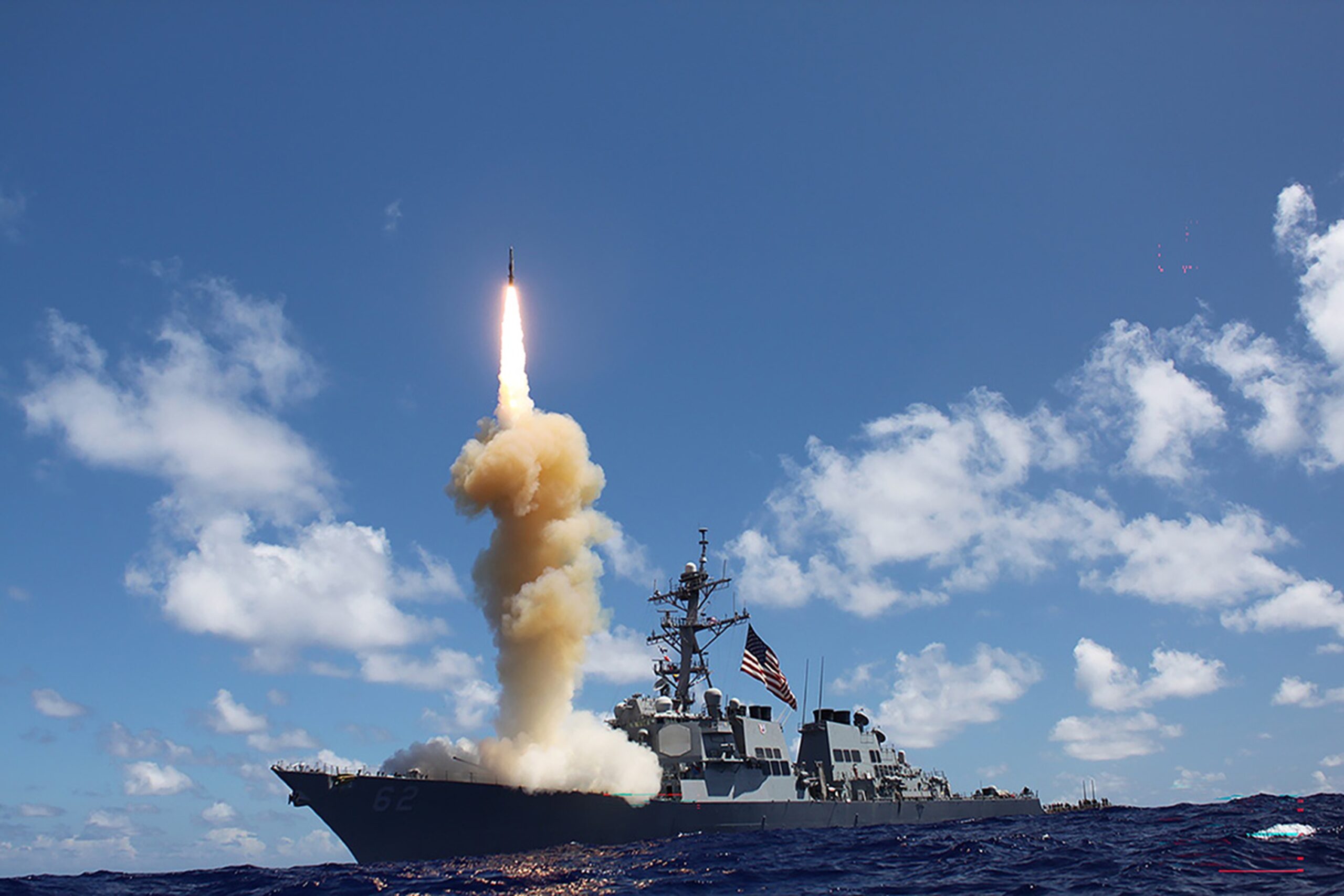
Boeing is increasing production of key hardware for the SM-3, a ship-launched anti-ballistic missile designed to destroy ballistic missile threats outside the Earth’s atmosphere.
The United States is moving to increase production of Standard Missile-3 interceptors, with Boeing signing seven-year framework agreements covering critical hardware for the SM-3 Block IB and Block IIA, according to the company.
Under agreements with the U.S. Department of War and Raytheon, an RTX business and prime contractor for the weapon, Boeing will increase production of avionics and ejector assemblies required for the two SM-3 variants. The companies and the Pentagon intend to begin ramping up production ahead of a final multi-year contract award, providing industry with an earlier signal to expand manufacturing capacity.
The Standard Missile-3 is an anti-ballistic missile interceptor primarily associated with the US Navy’s Aegis Ballistic Missile Defense system. Its role is to destroy ballistic missile threats during the midcourse stage of flight, including engagements outside the Earth’s atmosphere. Rather than using a conventional explosive warhead, the SM-3 employs a kinetic kill vehicle which destroys its target through a direct high-speed collision.
That places the weapon in a different role from many conventional naval surface-to-air missiles. Systems such as SM-2 or SM-6 can perform air-defence missions against aircraft and other aerodynamic targets, while SM-3 is specifically designed around ballistic missile defence and exo-atmospheric interception.
Bob Ciesla, vice president of Boeing Precision Engagement Systems, said, as quoted in a news update: “This gives us a clear demand signal to build and deliver SM-3 interceptors at the levels needed to counter threats.”
He added: “The SM-3 is an essential part of the layered air and missile defense architecture that protects the U.S. and its allies worldwide.”
The framework covers both the SM-3 Block IB and Block IIA. The latter is a larger and more capable development produced through US-Japanese cooperation, designed to provide greater engagement reach against ballistic missile threats. Both versions form part of the wider Aegis missile-defence architecture operated at sea and, in some configurations, from land-based installations.
Boeing’s part in the missile supply chain centres on specialist components rather than prime-contract responsibility for the complete interceptor. Increasing output of avionics and ejector assemblies is intended to ensure that component availability does not constrain Raytheon’s ability to raise production of complete weapons.
Boeing said it, Raytheon and the Pentagon will begin increasing output while negotiations continue over a multi-year award. The approach is intended to shorten the period between a formal procurement decision and higher missile deliveries by allowing manufacturers to begin investing in capacity before the longer-term contracting process is complete.
The SM-3 arrangement follows an existing agreement involving Boeing, the Department of War and Lockheed Martin to increase production of seekers for the PAC-3 Missile Segment Enhancement interceptor. PAC-3 MSE and SM-3 occupy different layers of missile defence, with PAC-3 intended for engagements within the atmosphere while SM-3 provides a higher-altitude capability against ballistic missiles in space.