

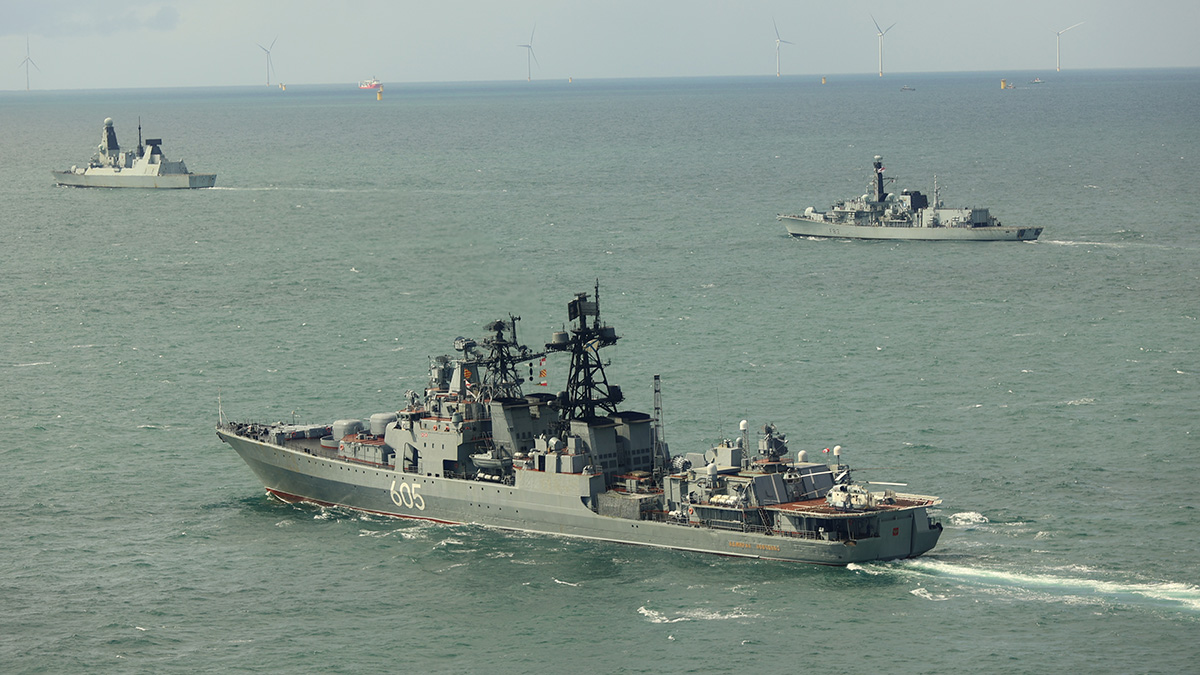
Three Royal Navy warships and a Merlin helicopter have completed a 72-hour operation tracking Russian naval vessels and sanctioned cargo ships through the North Sea and English Channel, the UK Defence Journal understands.
HMS Duncan, HMS St Albans and HMS Severn monitored the Russian destroyer Admiral Levchenko as it escorted the sanctioned cargo vessels General Skobelev and Sparta south towards the Channel. The operation also involved a Merlin helicopter launched from HMS St Albans, extending surveillance of the vessels as they approached the Strait of Dover.
Russian frigate Neustrashimy was also deployed during the transit. The Ministry of Defence said the frigate had been sent to protect the Russian vessels as they moved through waters of interest to the UK.
The Royal Navy maintained contact with the group as it passed through the North Sea and English Channel before handing responsibility for monitoring to a NATO ally near Ushant, off the French coast. At the same time, patrol vessel HMS Mersey was monitoring the Russian replenishment ship Akademik Pashin in a separate operation.
Commander Oli Ayers, Commanding Officer of HMS St Albans, said: “As part of the UK’s response to increased Russian activity within UK waters, St Albans was part of a group of NATO warships and aircraft escorting Russian warships and merchant vessels through the North Sea and English Channel, monitoring their activity.”
He added: “As the Royal Navy’s very high readiness frigate, this is our core business. We will continue these sorts of operations, working alongside NATO allies, over the next few months.”
HMS Duncan, a Type 45 destroyer, joined the operation after returning from deployments in the North Atlantic and High North with the UK Carrier Strike Group.
Commander James Mitchell, the destroyer’s Commanding Officer, said: “Fresh from operations in the North Atlantic and High North as part of the UK Carrier Strike Group, HMS Duncan was tasked alongside HMS St Albans to monitor and escort a number of Russian military and civilian vessels through areas of UK interest.” He continued: “The Royal Navy maintains a persistent watch on activity around the UK, and this operation demonstrated our readiness to respond whenever required.”
Mitchell said that although such monitoring operations are routine, they demand sustained surveillance and coordination between ships and their crews.
He added: “Whilst this type of activity is routine, it requires sustained vigilance, professionalism and teamwork. Their commitment and expertise throughout reflect the very best of the Royal Navy and underline our ability to protect the UK’s interests at sea, whenever and wherever we are called upon to do so.”
The operation was also the third occasion during August on which Portsmouth-based HMS Severn had been dispatched to monitor Russian naval movements.
Earlier in the month, the patrol ship tracked Neustrashimy through the Channel. It subsequently worked alongside HMS Tyne to monitor the Russian frigate Admiral Gorshkov, hydrographic vessel Romuald Muklevich and Akademik Pashin.
Following the latest operation, HMS Duncan sailed to Copenhagen for an engagement with Denmark, while monitoring of the Russian group was continued by allied forces as the vessels proceeded south.



Why have Duncan and St Albans not received their NSMs? At a time of heightened tensions with Russia its sheer negligence not to have them fitted. Have the MoD/ RN completely lost their minds?
Why are we ditching the B1 Rivers next year? We need to replace them before ditching them
Suspect thinking is batch 2 replaces batch 1 and Type 31 replaces Batch 2 over short term in contablory role while recruitment ramps up and until additional VLS are fitted to Type 31
That has been the Treasury-style thinking, because it’s the cheapest possible plan given current commitments.
However, we desperately need T31 frigates to fulfil the frigate role, because (as even the Treasury must have noticed) we are very short of those. The B2 OPVs are purpose-built for overseas work, active for more days a year than any frigate possibly could, and for a fraction of the cost. So using frigates as presence/constabulary vessels, and global OPVs in the English Channel, while remaining short of frigates doing military patrol work, isn’t a good plan. In fact it’s bonkers.
Instead we could get half-a-dozen replacement OPVs for the price of one T31, to keep a continuous presence in home waters.
Don’t Disagree….but