

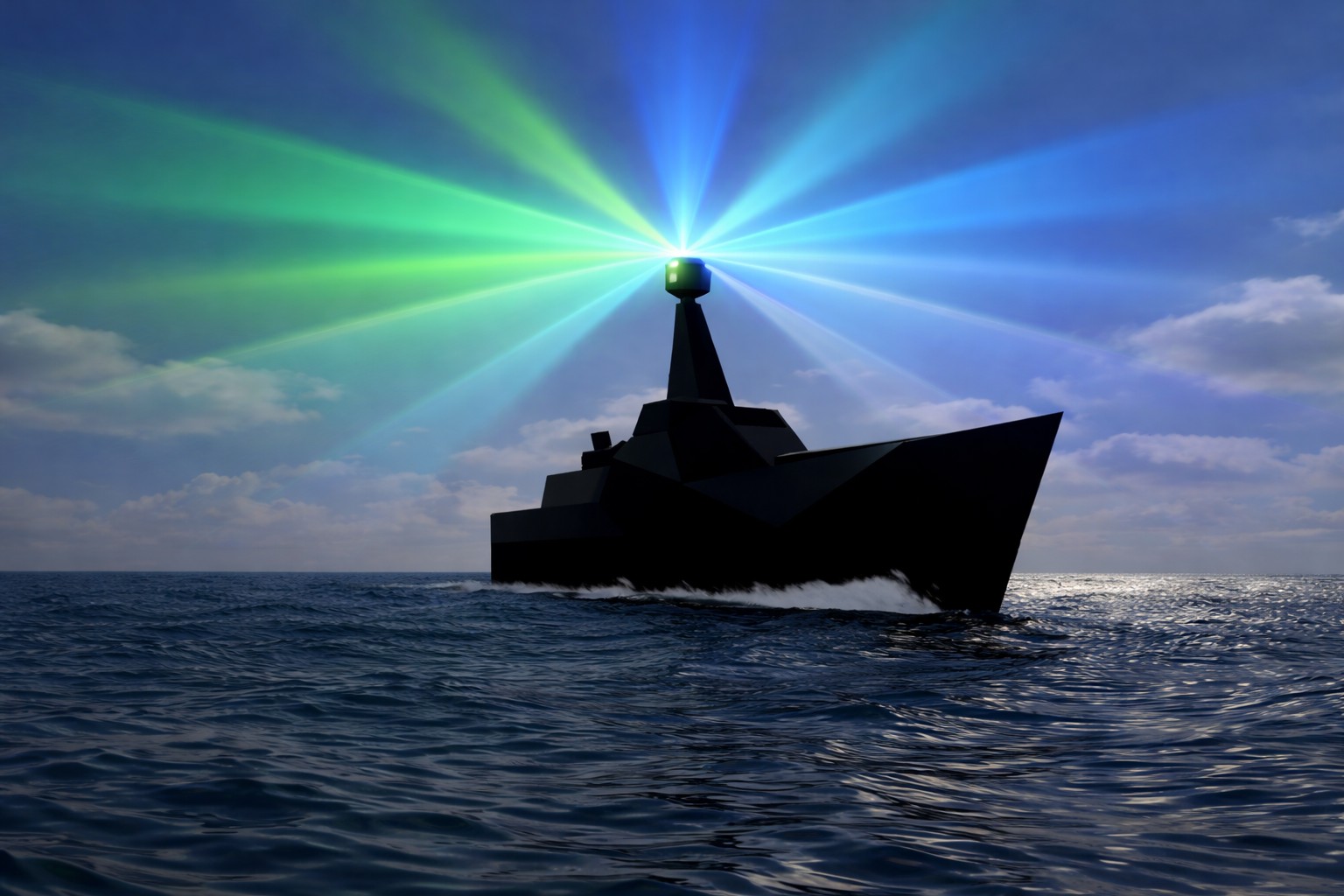
Project HORUS, the Royal Navy effort to deploy persistent air-search sensors on uncrewed maritime platforms, is now under contract as the service moves ahead with a distributed system intended to detect and track airborne threats.
The status of the project was confirmed in a written parliamentary answer from Defence Readiness and Industry Minister Luke Pollard, following a question from Conservative MP Ben Obese-Jecty asking for the scope of the programme.
Pollard said: “Project HORUS is supporting urgent operational requirements for a rapidly procured, persistent air-search capability using uncrewed maritime platforms fitted with sensors to detect, track, identify and report airborne threats. The project is on contract and is intended to help the Royal Navy generate distributed sensing that reduces risk to personnel, and will inform future procurement decisions.”
The confirmation represents a step forward from the market-engagement stage reported by the UK Defence Journal in March, when the Navy was seeking mature systems that could be brought into service at pace. At that point, the requirement called for “a rapidly procured and persistent air search capability” able to detect, track, identify and report threats including drones, fast jets and cruise missiles from sensors carried aboard maritime platforms.
The original market notice envisaged moving rapidly from industry engagement to an initial capability. It stated that the intention was to select credible solutions, place contracts and deliver the first capability within four to six months, with an emphasis on mature products and suppliers able to work quickly.
HORUS is built around distributing sensors across multiple lower-cost uncrewed platforms rather than relying entirely on crewed ships or a small number of high-value assets.
The earlier requirement described a “System of System Approach” intended to introduce greater mass through numerous lower-cost sensors operating from uncrewed platforms in areas where sending personnel could carry greater risk. Persistence was also central to the concept. The March requirement sought platforms capable of remaining on station for 30 days as a threshold requirement and as long as 90 days as an objective, without in-person human intervention or maintenance.
The performance targets outlined during that earlier market engagement included the detection of NATO Class 2 uncrewed aircraft, anti-ship and land-attack cruise missiles and third and fourth-generation fighter-bombers at distances of at least 15 nautical miles.
Industry was also asked to consider how the system could eventually be expanded to detect surface threats, including fast attack craft and uncrewed vessels. The initial requirement envisaged persistent surveillance across an area of around 2,500 square kilometres, pointing towards several sensor-carrying platforms operating together rather than a single picket.
Alternative commercial approaches were also being considered, including what the Navy described as “SENSE as a service”, potentially allowing industry to provide the sensing effect rather than Defence purchasing every element outright.
Those figures and performance requirements were set out during the earlier market-engagement phase and do not necessarily describe the final contracted configuration. Pollard’s latest answer confirms, however, that HORUS has moved beyond that initial stage and is now on contract in support of an urgent operational requirement.





One of the often over looked benefits of the Royal Navy drone program and off board missiles and sensors is that it opens up the best route for air and missile defence for the British isles. The best location to intercept ballistic missiles inbound for the UK is from the North Sea.
The Army clearly doesn’t give two f**ks about defending the UK so it’s time for the navy to do the job.
Yes, I was thinking North Sea too. Not ballistic missiles; but rather ‘unattributable’ drones and even cruise missiles launched stealthily from the shadow fleet of merchant ‘Q ships’ at our UK energy infrastructure or ports or naval bases anywhere. Grey zone threats.
Hmm, that area (2500m2) covered is tiny. We are only talking a detection range of around 28km. A small low powered X-band will easily provide that kind of range. Though it won’t give you a very high detection altitude. A lot will depend on the target you are hoping to detect and track. For a general example, if looking to detect a large commercial ship, you would need around 100W of transmitter power to detect at that range, due to the ship’s really high radar cross section (RCS). However, a stealthy plane would need over 1kw or a lot more if the RCS is very low. I’m obviously generalising as I’m not considering the antenna’s gain or the receiver sensitivity. But if the drone is going to be used to detect small drones and stealthy cruise missile, you really need to consider pumping out a lot more power, as a minimum over 1kW to detect stealthy objects at this sort of range.
For example, Leonardo don’t advertise the power output of their Osprey 30 AESA radar. Which is classed a low size, weight and power (SWaP) radar. But they say it can detect objects at 200 nautical miles, and clearly don’t state the object’s radar cross section. But we know its an X-band AESA radar, with a fairly small antenna array area. I could confidently say it would need to be pumping out over 10kW to detect an object with a RCS of 5m2 at 200km, so for 200 nautical miles it will need to be higher. However, if you increase the antenna’s overall area, the power required to detect objects drops due to the antenna’s increased gain (amplification). There are some on-line details that say it has a peak transmitter power output closer to 100kW, which then would tally up with the 200 nautical mile detection range for large RCS objects. It is supposed to draw around 500W of electrical power. Which means the craft will need a decent power set and generator. But you could easily network a number of these radars together, to give a very good low level picture of the surface and airspace.
My thought was that it would be a Giraffe 1X type radar, which would fit on just about anything. It has a 75km instrumented range but SAAB’s original brochure only lists a 13km range against small UAS, which would be a good fit for HORUS. Additionally if it were mounted on a Kraken K3 USV the detection range for a target 10m off the deck with the antenna 2m above sea level would only be about 13km.
I was thinking Giraffe 1x as well which claims detection range out to around 75km and weighs about 300kg. It’s already used in small boats, it’s in the UK arsenal and its UK manufactured so what’s not to like.
Maybe a bit bonkers but could this Giraffe radar potentially be deployed as a backup radar on the T26 and or T31s, in a retractable, plug in way? If the single main radar goes how operable are guns and missile systems, is there a low level redundancy to still be able to use them in a reduced manual way?
Both of the primary air search radars on the T26 and T31, Artisan and NS100, operate in the S-band. Giraffe operates in the X-band, so it won’t realistically interfere with the S band radars. Therefore, the radar could be up and running full time. It makes a lot of sense for the ships to include an additional radar operating in the X-band. Both Artisan and NS100 have dedicated channels required for laying guns on to targets. But this takes up resource time from the radar doing other tasks, such as volume search or long distance tracking. If the primary radar can detect the threat an offload it to the other radar to track and lay the guns. This would make the primary radar operate more efficiently. Additionally S-band radars don’t like tracking objects very close to the sea, as they pick up a lot of clutter. Due to the wavelength that X-band uses. Significantly less clutter is detected when its look at the sea. Thereby making it much easier to track very low level threats.
Both CAMM and the guns can be laid on to a target by the optical sensors the ships have. The main problem here is that the sensors generally can only be used to engage one target at a time.
Yes, the Giraffe 1X would be a better candidate. Both radars are X-band AESAs, but the Giraffe has a bigger antenna array surface area and therefore has more gain. So requires less less power to detect objects at distance compared to the Osprey. It’s likely that the smaller drones will only be detected below 13km. But as they’ll be travelling fairly slowly, there would be plenty of time to work out a track for interception. Being X-band it should be able to detect and track objects very close to the sea’s surface without the clutter obscuring the object.
Well that’s nice and quick. Presumably on a small USV like the Kraken boats, or possibly the K3s themselves with a Giraffe 1X type sensor. Would be useful for spotting Iran/Houthi style drone attacks early while not being a target for missiles themselves.
Alternatively could be a slightly larger set on an ACUA Pioneer/Oceanus12 type vessel that wouldn’t be so good for accompanying warships, which is what is implied by the “reduces risk to personnel”, but might make an early warning system for Akrotiri etc.
Imagine the radar trembling picture that a small sea drone in a mere sea state 4 gives…
I think a panneled radar is more realistic for a kraken sized drone when cost is also considered.
Some like Echodyne’s Echoshield radar or one of Leonardos cheaper options.
@AlexS,
A stabilized compact AESA combined with digital motion compensation can handle sea state 4 effortlessly. Light autonomous surface craft to survive up to Sea State 6 or 7, but their effective operational window, where they can reliably maintain precise station-keeping and high-fidelity sensor tracking without losing data integrity, usually caps out around Sea State 5.
High-precision Inertial Measurement Units (IMUs) feed multi-axis roll, pitch, and yaw data straight into the digital signal processor at microsecond intervals. The software mathematically shifts the radar’s reference frame to cancel out hull movement, ensuring the processing grid remains stabilized regardless of how the vessel rides the swell.
Instead of relying on a mechanical motor to physically tilt the antenna against a pitching deck, AESA arrays shift the radar beam electronically. This allows the system to instantaneously adjust its elevation and azimuth sweeps to compensate for wave action without mechanical lag.
The “Networked Spatial Diversity” acts as the overlapping safety net and is the ultimate trump card of a distributed ring. If a 2.5-meter wave crest momentarily dips one USV’s low-altitude horizon or spikes its local clutter, the adjacent nodes in the 30 km network are looking at the same sector from slightly different angles and heights. The core combat system fuses these overlapping tracks instantly, filling any momentary data dropouts from a single pitching hull.
Even a little boat being 10km upthreat would significantly improve detection ranges over a decent range of angles. Giraffe 1X can have both mechanical and electronic stabilisation so it ought to be able to deal with coastal waters, which is what this system is all about I think.
Waste of resources
. There is not enough to pay for dozens of drones and radars necessary for this. Drones and missile can have way-points to make them use non direct routes.
The radar might be useful for self protection of large sea drones.
More radar coverage is always useful, simply going around known radar covered zones is great when you know where the larger crewed vessels are covering or fixed instalations are. Having additional mobile sensors to plug the gaps around those zones makes you less vulnerable to weapons designed to maneuver through perceived gaps in coverage.
But if you put the radar in 200t drones what you think you will happen if the waves are 2-3m?
A radar network for good weather only?
Yes I was wondering how many of these drones would equal an additional T31?
@AlexS,
“There is not enough to pay for dozens of drones and radars necessary for this.”
Using a high-end asset like a multi-billion-pound t-45 or a t-31 for picket duty in a high-threat choke point burns through operating/fuel costs. That could be considered a waste of resources.
By utilising commercial-style COCONO (Owned, Contractor-Operated, Naval Oversight) frameworks, the MoD avoids massive, upfront capital outlays that get locked into rigid multi-decade treasury approvals. Instead, they slice the funding into operational service lines that can be scaled up, cut back, or rapidly re-allocated as technology shifts.
The underlying fear for naval planners is that if they try to buy a FEW bespoke, exquisite boats for everything, they will crush the procurement budget and end up with a tiny fleet that can’t be everywhere at once. Going light, modular, and commercially backed lets them buy mass, ensuring that if a few nodes get smashed by a 3-metre swell or taken out by a missile, it doesn’t punch a multi-billion-pound hole in the defense budget.
They wont be 200 tonnes, more like 2.5 tonnes (2,500 kg).
This is very affordable. A batch of 20 to 40 production-standard blue-water littoral pickets at maybe around £2 or 3 Million for each USV all up, plus setting up remote command-and-control (RCC) ground stations, secure cryptographic architectures, and writing the middleware to inject tracking data straight into a CMS like CMS-1 or Aegis – £250 Million tops.
That image is like a clip from the Philadelphia Experiment.
Now with AI you can create a lot of those pictures.
Whilst i’m intregiued by the concept, i must say i am somewhat sceptical as to what we’ll get from this.
I’m assuming a reasonably static “picket force” for a key installation or axis of concern, rather than a deployable swarm operating around a mobile fleet. Even still, what size drones are going to be needed to survive North Sea or Atlantic conditions, let alone provide a platform viable as a sensor base?
My other concern is sensor capability. Others have reasonably suggested the Giraffe 1x radar but these have very limited ceilings (20,000 ft i believe) and will need to be tightly packed to catch anything. They will also have a limited track duration against anything sinister. Approximately 8min optimal tracking time for a drone and 1 to 1.5min against even modestly capable cruise missiles.
So it’ll take 6 drones to cover 2,500km2 (optimal performance) that should cover the enterance of an estury out to ~15 miles. We are going to need an awful lot of these to get any reasonable picture and even then we are likely to just be informing ourselves what we are going to be hit by rather than informing a layered defence.
For me the concept needs scaling up significantly to be useful. Larger vessels, greater power and sea keeping capabilities and therefore much greater detection capabilities. However doing this, you lose the cost benefit of operating a drone. I fear it is going to take a lot for me to warm to the drone fleet for anything other than mission specific roles (ie strike ship at “x” or survey point “y”). I hope i’m found to be wrong.
I’m not sure where you’re getting the numbers from for your 6 ship to cover the 2500km2 area using Giraffe 1X. The radar has a range of over 25km against the targets listed in the requirement, so it will cover the 2500km2 with a single set.
My suggestion would then be to mount them on our new high speed K3 USVs or their larger K5 cousins. Those can fit in the RIB bays of our escorts while also being fast enough to keep station with them on flatter water.
Going by the spec requirements rather than the published figures for the 1x if truth be told. The radars performance will be seriously impacted by power, platform stability and mounting. None of which will be as tested.
K5’s stand a chance of mounting the unit elevated but i don’t think you’ll get away with much on the K3’s without seriously compromising stability.
Regardless, the posted technical requirement is all but useless in any tactical environment and i just don’t get it. I want drones, as force multipliers, to work. I just don’t believe this scale of offboarded detection, offers anything even remotely viable to our armed forces.
What I find most interesting here is the urgency. Does this relate to a specific, known threat? Or is it just more of a general precaution, based on recent events in the Gulf and Ukraine?
Cyprus? Trying to give shore based teams additional reaction time is my guess.
I was thinking more north sea but good point. I guess they can be deployed as needed.
I just don’t believe this whole CCV, Type 94, Type 91 concept will ultimately work and the next Government will pull the plug with headlines about ‘structural losses’ in the MoD running to £millions (many). Much time and resources will have been expended.
Cheap radars on ‘attritable’ hulls is a fantasy. Radars, the DGs or GTs to power them, the secure data links and even the hull, are not ‘cheap’. I’ll assume that any ABM radar is on the CCV to keep to Type 94 relatively small and envisaged to counter the low level supersonic missile and drone threat. Would that be fair?
Your enemy is going to have a SEAD doctrine to overwhelm the Type 94 with a mixture of above and below water platforms. They will relatively cheaply ‘poke your eyes out’ thus rendering your CCV and Type 91 as ‘operationally degraded’ against further ‘waves’ of attack and looking to ‘withdraw’ to a safe range….
Time will tell but I hope they can squeeze another 15 years out of the Type 45 hulls.
This seems a pretty ideal kind of system for protecting our coastal offshore infrastructure e.g. wind farms and power cables. We would be able to see any (Russian) surface vessels approaching and at least have some timeframe to react. Adding just a single missile to such a UAS could then provide a pretty significant deterrent to otherwise-unarmed ships trying to sabotage our undersea infrastructure.