

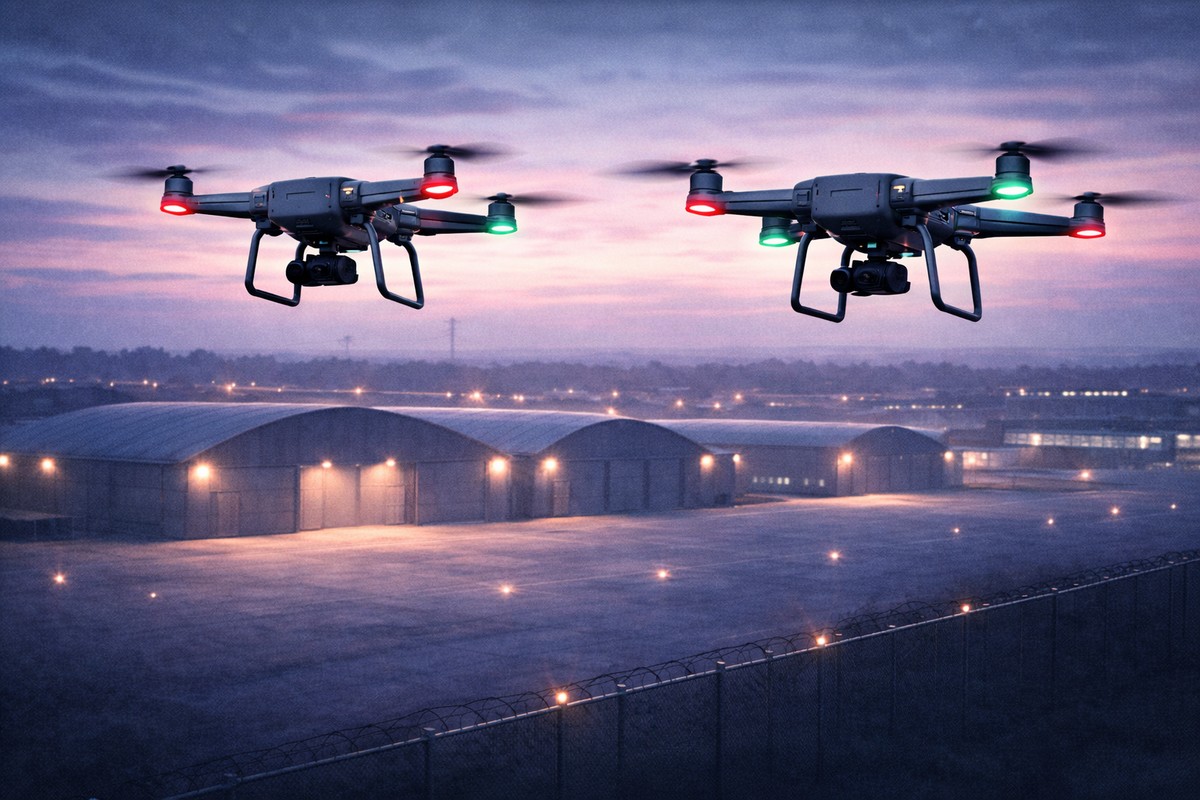
Britain’s counter-drone systems are deployed flexibly across defence locations according to the assessed threat and are not permanently assigned to every military base, Louise Sandher-Jones has said, according to an answer given in Parliament.
Conservative MP Stuart Anderson asked what steps the department is taking to ensure that all major military bases and defence-critical sites are equipped with effective systems to detect, track and neutralise hostile drones.
Sandher-Jones, Minister for the Armed Forces, said: “Defence takes the protection of military sites and critical infrastructure seriously and continually assesses the threat posed by increasingly sophisticated uncrewed aerial systems. Our approach is layered, intelligence-led and threat-based. Defence has a range of counter-uncrewed aerial system capabilities in operation and continues to enhance its ability to detect, track and defeat hostile drones through integrated sensing, command and control, electronic warfare, and kinetic and non-kinetic effectors. Counter-drone capabilities are designed to be deployed flexibly across Defence locations and operations according to the assessed threat, rather than being permanently assigned to every military base. The Defence Investment Plan announced a series of capability enhancements, including £240 million on Project Presagium, an enhanced counter-drone system, providing effective detection and defeat of emerging drone threats, operated by the RAF Regiment and wider Defence users.”
Anderson also asked how much the department spent on counter-drone technology in each of the last two financial years and what it plans to spend over the next three. Luke Pollard, Minister for Defence Readiness and Industry, replied: “The Ministry of Defence continues to invest in counter-drone technologies to protect Armed Forces personnel and operations against the growing threat posed by hostile drones. Detailed expenditure on individual counter-drone capabilities is not routinely released outside established departmental spending reporting. The Defence Investment Plan includes £200 million of further investment in deployable counter-drone technology to enhance the protection of Armed Forces personnel and operations against the growing threat posed by hostile drones. It also includes £240 million for Project Presagium, an enhanced counter-drone system, providing effective detection and defeat of emerging drone threats, operated by the RAF Regiment and wider Defence users.”
Asked in a third question what exercises have tested the Armed Forces against drone and swarm attacks, Sandher-Jones said: “The Armed Forces routinely assess their ability to operate against the threat from uncrewed systems. Recent exercises, including Exercise WESSEX STORM, have tested our personnel against these threats. Lessons from this activity, alongside operational experience and insights from Ukraine, are being incorporated into doctrine, training and operational planning. We do not comment on the detailed capabilities or force protection measures tested during individual exercises and the lessons learned, as doing so could prejudice the security and effectiveness of the Armed Forces.”
Both answers name the RAF Regiment as the operator of Presagium. The £240 million programme was disclosed in an earlier answer to Anderson in September, alongside a further £470 million to improve security at military sites in the UK, which we covered at the time.
In October, counter-terrorism police arrested two Latvian nationals inside the perimeter of RAF Molesworth, which houses American and NATO intelligence functions, and the department said it had strengthened security across the estate after incidents there and at RAF Fairford. Sandher-Jones said at the time: “We remain highly vigilant to threats against Defence sites.”
Members of the Defence Committee have also questioned the pace of Britain’s drone effort. Labour MP Fred Thomas told the National Armaments Director last December that Germany would send troops to Lithuania with €350 million worth of one-way effectors while Britain had no comparable capability in Estonia, adding: “We are not doing them anywhere near quick enough,” MPs heard.
Britain previously deployed counter-drone systems to RAF Lakenheath and RAF Mildenhall, and restricted airspace now covers fifty defence sites. The Army has also looked at off-the-shelf kit to stop drones over bases.
The government has put millions into protecting military sites and has backed homegrown drone defences while deepening ties with Ukraine on the technology.






Usual bullshit answers covering lack of investment.