

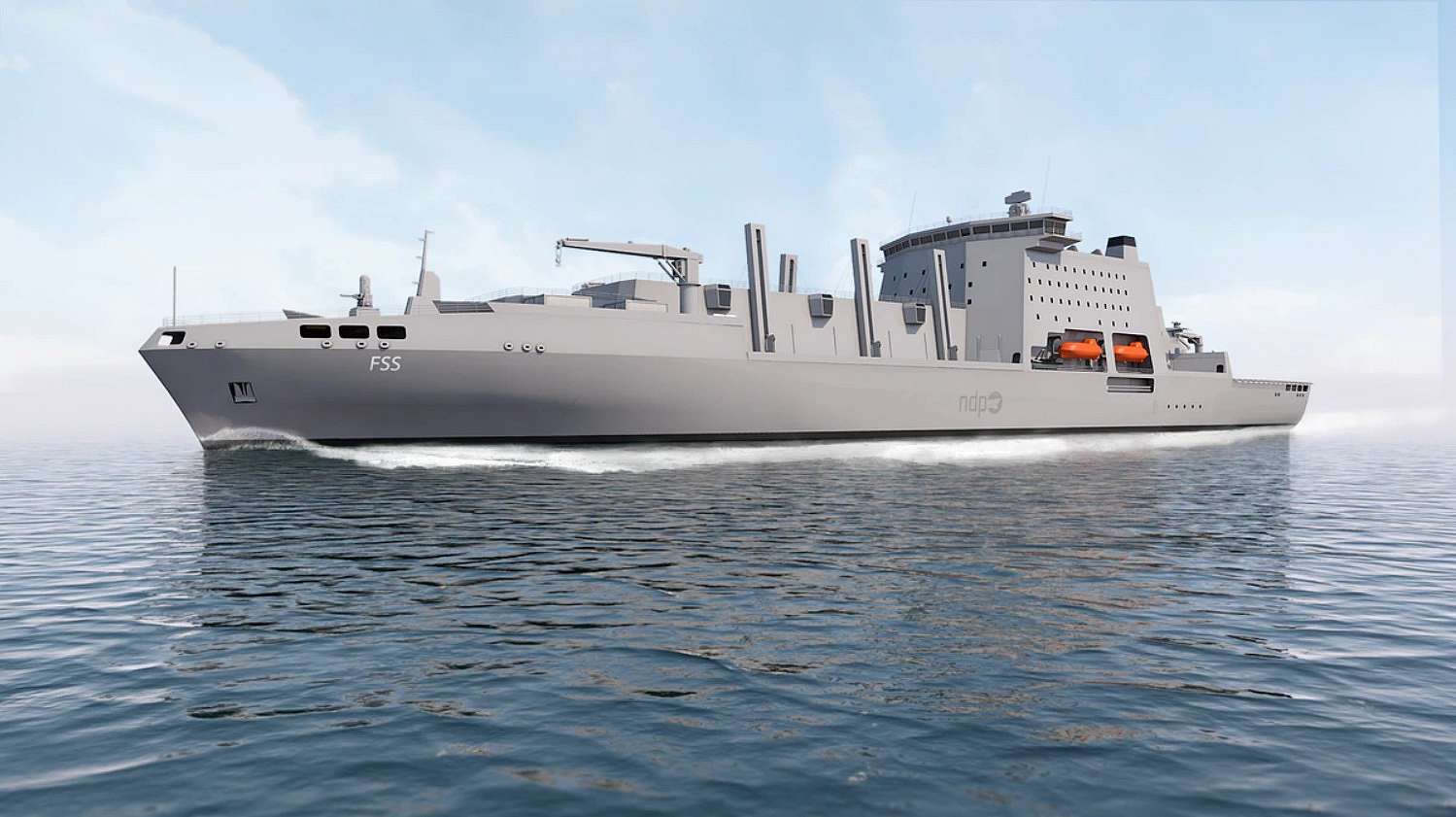
Consideration of the most appropriate gun solution for the Fleet Solid Support ships is ongoing, according to a written answer published on Thursday.
Luke Pollard, Minister of State for Defence Readiness and Industry, was responding to Ben Obese-Jecty, the Conservative MP for Huntingdon, who had asked what the Royal Navy’s most likely future gun solution is.
Mr Pollard said: “Consideration of the most appropriate gun solution for the Fleet Solid Support ships is ongoing.”
The question followed an answer given on 7 September, in which the minister confirmed that the automatic small calibre gun requirement had been removed from the manufacture contract with Navantia UK at a cost of £1.704 million recorded as a constructive loss, on the basis that it no longer matched the service’s likely future gun solution.
In that earlier reply he described a gun rationalisation programme introduced since the manufacture contract was placed, aimed at reducing the number of gun variants across the fleet and bringing commonality, which he said would provide longer term value for money. He also said at the time that changing the requirement then avoided incurring greater losses later, which would have been associated with fitting and then replacing an incompatible system, and that the ships would be designed to accept a range of future gun systems.
The three Fleet Solid Support ships are being built by Navantia UK to carry ammunition, stores and provisions to the carrier strike group and the wider fleet. Construction is spread across the company’s British facilities, with Harland and Wolff in Belfast having begun work and the Methil yard in Fife having delivered the Seahorse pontoon that will move ship blocks between Appledore and Belfast.
Harland and Wolff completed the installation of eleven new cranes this week, bought for £1.5 million from Walter Watson Ltd of County Down as part of a £98.5 million modernisation of the Belfast yard.






Does anyone at the MOD/ADMIRALTY Have any idea what joint up thinking is…?
Nope. However I suspect this is about freeing up cost for the manufacturer to ensure they make a profit on the deal
Nope – they’re not even on the carriers
Surely it would make sense to just standardise on the Bofors 40mm MK4 now.
Quite so Kind of amusing at one level: remember when 40mm Bofors was on just about everything for close in air defence?
Back to the old problem – set up a contract then start changing the order… eventual result a massive cost increase…
More “news”.
Sigh…….even the simplest of tasks are dragged out with ridiculous amounts of time and money wasted going round the houses.
A plan to rationalise on the 40mm Bofors should have been enacted as soon as they were selected for the T31.
They could go the whole hog and add them to the T45s and B2 Rivers replacing the 30mm and even put on the carriers and maybe T26s? Will the T26s have Phalanx’s and 30mm if they’re getting Dragon Fire as well? Would be a bit crowded.
The 30mm can be left or recycled for light patrol craft and Paladin 30mm AA/C-UAS platforms.
Is it dithering or penny pinching?
Dithering…
I remember being told about how a group of flag rank officers were overheard arguing over whether an expenses claim could be signed off in Main Building. The story went that the claim was for a few quid, can’t remember the number now. It seems that once you get to strategic rank there of very few decisions that actual justify your existence.
As General Eisenhower put it leading up to the moment he had to make the go no go decision for the D-Day landings he was the most powerful man in the world, but the moment he made the decision it was all in the hands of the field commanders from divisional commanders to section leaders. He was basically along for the ride.
So once a buy no buy decision is made the VSO’s are simply along for the ride unless they can create a decision point to keep themselves busy for awhile. They are obviously debating which guns to standardise on, I would hope. Howevr, it should be easy enough; 50cal, 30mm, 40mm, 57mm and 5inch. I have decided Phalanx will be replaced in service by DEW. 🙂 Job done. So put 40mm on the support ships possibly backed up with 30mm.
Sorted. Next.
Cheers CR
I would hope for 40mm (in place of Phalanx) and Ancilia as a baseline fit on all the support ships. A pair of 30mm on the larger FSS would be useful.
That’s a nice crew room dit. Completely made up.
40 and 30 is duplication, 20 and 40 is layering.
A brace of Bofors 40mm goodness, its really that simple.
They will kill most things from a good distance too, bar a supersonic anti ship missile.
Unlikely but 57mm forward and 40mm Either Side aft would be my choice..!
Executive decisions are in short supply these days.
Have we got any 15 inch mountings leftover from HMS Vanguard in a warehouse anywhere?
That’s the spirit.
👍😊
Cancelling the 30mm gun requirement midstream may appear as another example of procurement mismanagement on the surface, but it is actually the most logical move the Ministry of Defence could make under the circumstances.
The manufacturing contract originally had to be locked in using legacy 30mm specifications because the Royal Navy’s fleet wide gun rationalisation programme did not even exist at the time of signing. While that review is still fluid and the final choice has yet to be revealed, removing the legacy design now addresses the desire for fleet standardisation.
The upcoming t31 frigates are already pioneering a new pairing. Bofors; one 57mm main gun on the bow and two 40mm guns on the flanks. As this new commonality group is already bought, paid for, and integrated into the Royal Navy’s ecosystem, standardising the FSS auxiliary ships on either of these two mounts is the most likely outcome to protect the fleet from having to source entirely separate mechanical parts or ammunition lines.
If the MoD had pressed ahead with the original blueprints to avoid a modification fee, they would have spent millions installing a soon to be obsolete weapon system on 3 new ships. This would have locked the fleet into decades of unnecessary maintenance, custom spare parts sourcing, and disjointed training pipelines.
Thus, swallowing a one off constructive loss of £1.7 million right now to redraw the blueprints is a drop in the preverbal ocean compared to the lifetime support costs of maintaining a dead end capability.
… is it is a rare example of the MoD choosing a minor short term financial hit in order to solve a clash of procurement timelines and secure long term operational efficiency?
“two 40mm guns on the flanks”
?
Whatever gets fitted to FSS the one thing we can deduce is that Phalanx is on the way out. But it’s not so obvious how to replace it for the the rest of the fleet.
Is it though, many folk are so keen on 40mm. Here is the reality, its a jack of all trades, master of one. Boats, drones, swarms of either, some missiles, any helo stupid enough to get in range fine. But a P-800 coming at you, 1100kts, while manoeuvring, I’d take the millimetre accuracy and response time of Phalanx any day. Ppl also talk oof layered defence, replacing 20mil & 30mil with 40 isn’t layering, its flattening. 50cal, 20mil, 40mil, camm, aster is layering.
As a Fleet a layered defence would be the optimum end product but for an individual FSS what would their Lordships require as a basic fit?
40mm, 20mm, .50 and Ancilia?
Yep, Exactly 🙂
Consideration of the most appropriate gun solution in MOD speak means that like QEC they won’t get any guns ! 🇬🇧👎🏴
The carriers got no guns as they deliver no extra effect beyond what the 3x Phalanx already deliver.
They need something that reaches out well beyond Phalanx – 40mm or 57mm better.
It is a shame that Phalanx never got the 25mm upgrade Oerlikon proposed, two decades ago.
Phalanx didn’t really need a bigger round. It’s job is to put a hail of Tungsten or DU APDS rounds onto the armored nose cones of incoming AShMs and shred them
Yes, but it needs to do it further away, or you get hit by the debris.
The plan is to standardise on 20mm Phalanx (high end point Defence on high value warships) ) and 40mm Bofors (everything and one else)
Isn’t 40mm a bit too fighty for auxiliaries, which for legal/political reasons are supposed to carry self-defence weapons only?
Canada’s new Support ships will have 2x Phalanx and 4x .50 RWS along with the armaments available to 2x Cyclone helicopters. The HMCS Protecteur is fitting out currently and the HMCS Preserver should launch in 2027.