

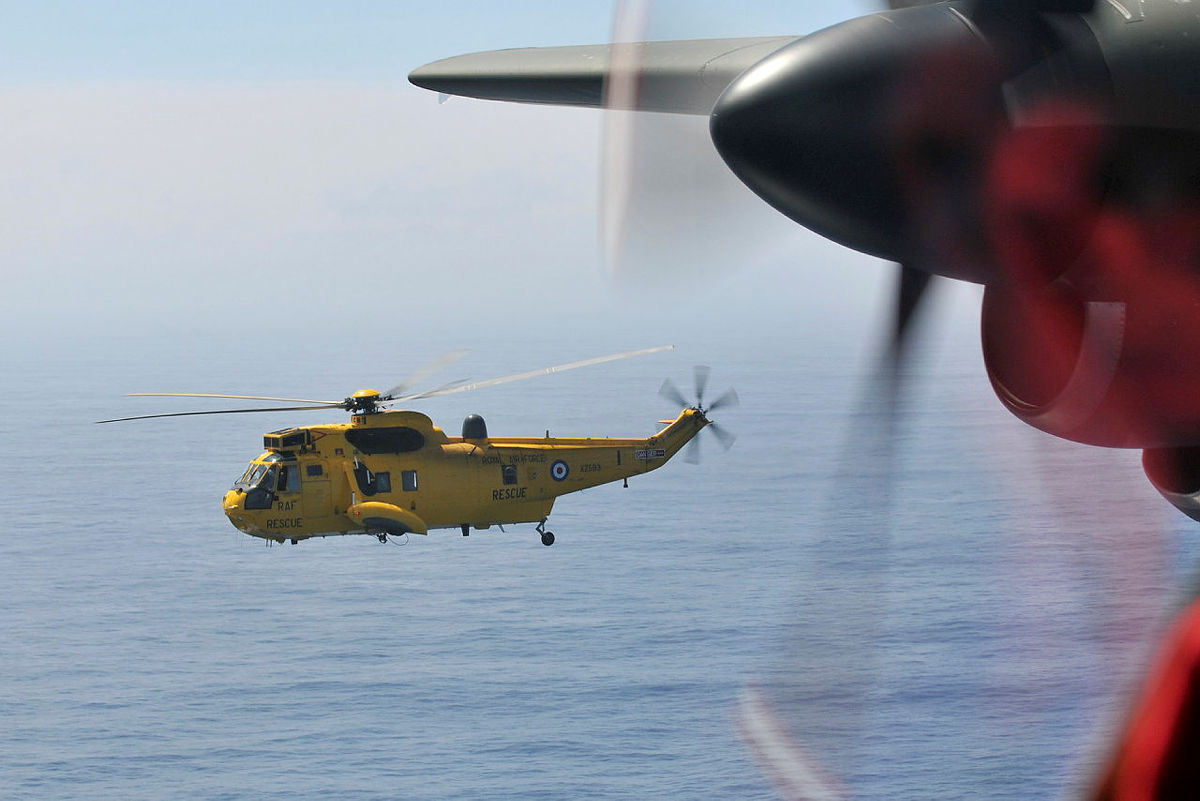
The RAF’s search and rescue legacy spans more than eight decades, from the creation of the first Search and Rescue unit in 1941 to today’s Poseidon maritime patrol aircraft crews monitoring radio traffic over the North Sea, according to the RAF.
Before being stood down in 2016, the RAF’s Search and Rescue Force was one of the longest peacetime operations conducted by any British military unit, responding to over 36,000 distress calls and rescuing more than 26,000 people. Its personnel earned the highest number of non-combat gallantry awards given to any RAF unit, including six George Medals and more than 50 Air Force Crosses.
The RAF say here that while the Search and Rescue Force may no longer exist as a formal unit, but the RAF continues to support search and rescue operations across the UK through a combination of operational assets and volunteers. Flight Lieutenant Phil of 120 Squadron said that alongside normal operational duties, his unit helped support the UK Coastguard with Mayday calls, using the Poseidon’s sensors to assist when ships or yachts were in danger.
He said crews aboard Poseidon aircraft monitored radio traffic during routine patrols of the UK and North Sea, allowing them to respond on an ad hoc basis to anyone in danger. “Having been involved in a number of these operations in the past searching for yachts lost at sea, they are very rewarding operations,” he said.


I’ve gained $17,240 only within four weeks by comfortably working part-time from home. Immediately when I had lost my last business, I was very troubled and thankfully I’ve located this project now in this way I’m in a position to receive thousand USD directly from home. Each individual certainly can do this easy work & make more greenbacks online by visiting
following website—.,.,.,.,.—>>> JobatHome1.Com
Many fond memories of being chucked out of the side of the sea king onto a moving boat when they were allowed to use cadets as volunteers/volunteered 😁
Kids don’t have enough fun nowadays
Absolutely loved seeing them beautiful yellow helicopters flying over head I lived in Wales on the coast and often had them fly over into morriston hospital, and then later on was based at RAF leconfield were they operated from,was very sad when they were removed from service.
Biggest mistake the Government of the day made was to take the Search and Rescue element away from the Armed Forces.
Why? HM Coast do a great job… many other nations.. maybe most?… use their Coast Guard or equivalent. Military crews still practice all the skills (RAF Valley)… and probably supply the CG! I remember as a Cadet visiting the ASR unit at RAF Chivenor (Whirlwind!) and being told that the first call for the crew was to find military personal and civilians came second. We were told to slam our backs against the walls if there was a scramble. There wasn’t!
I heard that aircrew were more often as not, on the lookout for Naturists at Crow point.
I would expect nothing less!
I remember chatting to “Woody” (RAF Fighter Ace !) and a couple of other chaps (Choppers) at the Williams Arms back In the 1980’s about such “Searches”. 😁🚁
In some way, It can be said that the roots to this all stem from one “T.E,Shaw’s” original efforts to save downed Aircrew prior to WW11 In the Sea.
In an age where Helicopters were yet to appear significantly.
Hit me !!!
Bring back the flying boats, that’s what I say. The Japanese still do a good line in them, though of course they have fewer suitable sites for airfields than we do.
That, or developing an air-sea lifeboat for the P8 bay?
I too share that desire.
Flying Boats can Increase capability everywhere for fractions of the costs of Naval assets.
Rather than dicking about with Tilt Rotors off Carriers, just buy ShinMaywa’s and sell the bloody carriers to Brazil.
Steady on! US-2s aren’t cheap, apparently $160M each. But nothing else does what they do for SAR and flexibility of deployment. It says something that Saro were still producing flying boat designs to compete with Nimrod in the mid 1950s of effectively the same lineage as the 1930s Shrimp.
If we were going to do flying boats I think it would be better to base off the general arrangement of the Martin Seamaster and Beriev Be-200 Altair with a swept, anhedral wing and turbofans rather than turboprops. Higher speeds and quietness are needed for long-range ASW and STOL can be recovered using the US-2s auxiliary turbine idea for blown flaps and upper surface blowing using the jets.
There is also a requirement I can see for a much smaller unmanned flying boat with folding wings to fit in a RIB bay for ISR and sonobuoy dropping, but that is on an altogether smaller scale.
As for where to build them, there’s a nice big shed next to the GKN factory in Cowes still!
“Blown Flaps”
I can’t, I just can’t 😁😁😁
Fine, call them boundary layer control systems if you can’t handle it. Takes a lot longer to type though 🙂
Another element of the armed forces long since cut.
A CSAR capability for the UK would be good, last I read, it was very limited, using people from Four Two Cdo in whatever helicopter was available.
The US CSAR use in Iran was impressive, as aways, when assets and money are no object.
Was reading the other day about the US’s CSAR efforts in rescuing the downed F15 crew. The operation was huge, plus they lost a few more aircraft in doing so. Supposedly two MC130s, four Littlebirds (AH6s), one A10 and one MQ-9 Reaper.
When the RAF had the six ex-Danish Merlin HC3As, these were earmarked for CSAR. Then all the Merlins were given to the Navy as the Sea King replacement. The RAF in part lost that capability. However, the Chinook force were then tasked with the role. As the Chinny with the added ferry tank or the ones with the fat tanks had the required range. Plus could carry a better trauma team as well as a force protection element (RAF Regt). But I do fully expect the Merlins when the Jungly are embarked on the carriers, will do the role for the task group if required.
Thanks Davey.
I had read way back that elements of the RAF Regiment were involved when the Merlins were at Benson, but knew no more than that.
Spot on mate, the main gate had to be raised and lowered and all the sandwich wrappers out of the back of the Merlins had to cleaned up……. ;0)
Ah the days and nights spent on duty as the SAR responding Sqn, (42 Sqn)
Aircraft at readiness at the dispersal awaiting the call that often came, (Usually in the wee small hrs of the night)
That adrenaline rush when dashing to board…in my case Shackleton MR3 Phase3, engine starts and off to the runway 4 turning and 2 burning (Viper jets)
Bloody heck, you must be like Well Old init bro ?