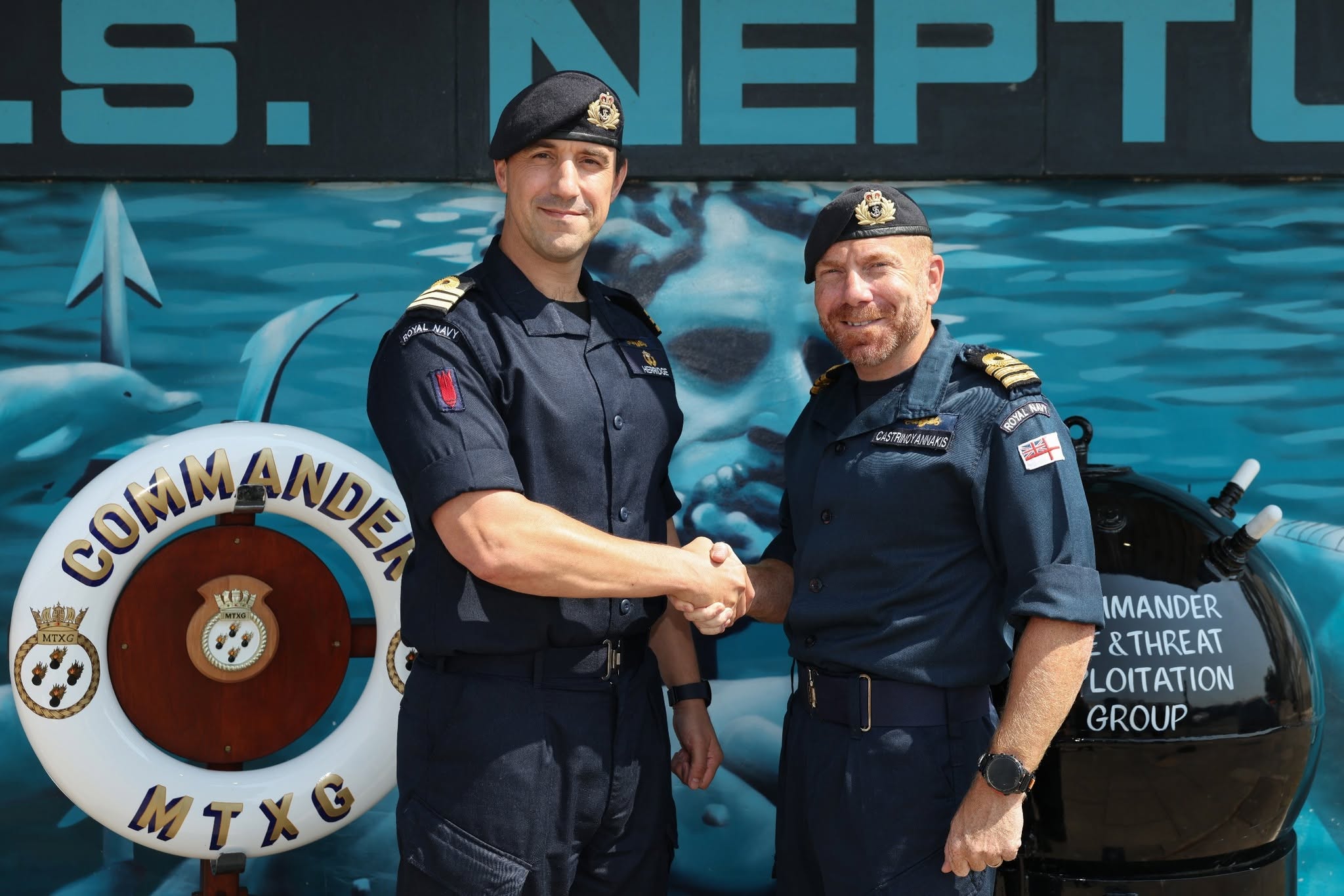
The Royal Navy’s Mine and Threat Exploitation Group has a new commanding officer, with Commander Daniel Herridge handing over to Commander Tim Castrinoyannakis on 16 July, HM Naval Base Clyde stated.
Headquartered at HM Naval Base Clyde, the group comprises around 250 Royal Navy personnel, including operators, logisticians and engineers, spread across the UK and overseas. According to the Royal Navy, the group leads the integration of autonomous technologies across the battlespace through the adoption of automation, digitalisation, artificial intelligence, machine learning and uncrewed systems.
The group is organised into four squadrons, Whiskey, X-Ray and Yankee based at Portsmouth and Zulu at Clyde. Each holds its own equipment set used to locate and identify mines and other underwater threats across large areas of seabed. The equipment is configured in modular form and can be moved by road or sea to set up for minehunting, an arrangement the Royal Navy describes as more agile and flexible than conventional warships and as a cornerstone of what the Hybrid Navy vision aims to deliver.
During his time in command, Herridge oversaw a shift in how the Royal Navy conducts minehunting, with the group working alongside industry partners and manufacturers on the Maritime Mine Countermeasures system, and pioneering the deployment of equipment from Royal Navy ships and boats as well as civilian vessels and temporary staging bases ashore. He joined the Royal Navy in 2001 and has specialised in mine warfare, clearance diving and maritime operations, deploying on Operations Telic, Veritas and Kipion. A qualified Mine Warfare and Clearance Diving Officer and Principal Warfare Officer, he has commanded Southern Diving Unit 2, the First Mine Countermeasures Squadron’s vessels and the UK Mine Countermeasures Force in the Arabian Gulf.
Herridge was quoted as saying: “As I hand over Command of MTXG, my overriding reflection is one of pride in our people. Through sustained change, operational demand and the challenge of bringing Maritime Unmanned Systems into service, the team has consistently demonstrated professionalism, adaptability and determination. Together, we have moved from aspiration to reality, generating trained operators, sustaining equipment and preparing capability for operational employment at the forefront of the Royal Navy’s Hybrid Navy transformation.”
He added: “My greatest respect remains with those delivering, or poised to deliver, operational effect on behalf of the Nation. Their commitment reminds us why our work matters. MTXG’s achievements have only been possible through the collective efforts of our people, our families, colleagues across Defence, industry partners and international allies. I leave immensely proud of what has been achieved and with great confidence in what comes next.”
Castrinoyannakis joined the Royal Navy in 2006 and has served across frigates, mine warfare, clearance diving, explosive ordnance disposal and maritime command, deploying on Operations Calash and Kipion. He has commanded a number of Sandown-class minehunters, including HMS Grimsby, Pembroke, Shoreham and Bangor, led EOD operations across Scotland, Northern Ireland and northern England, and served as Chief of Staff to Commander UK Mine Countermeasures Force. He was promoted to Commander and took up the role of Commander Global Sea Training for FOST Ships in January 2025.
Taking up the post, Castrinoyannakis was quoted as saying: “MTXG are leaders in innovation and are at the forefront of autonomy. Although our equipment and emerging capabilities are impressive, it is our people who make the difference and ensure we remain an effective and credible Mine Counter Measures force. I am honoured and humbled to assume Command and look forward to supporting our people in meeting our nations expectations.”
The handover comes as the Royal Navy moves its mine countermeasures capability away from crewed minehunters toward uncrewed systems, with the Ministry of Defence having confirmed this week that the last Hunt-class vessel is due to leave service in 2031.