

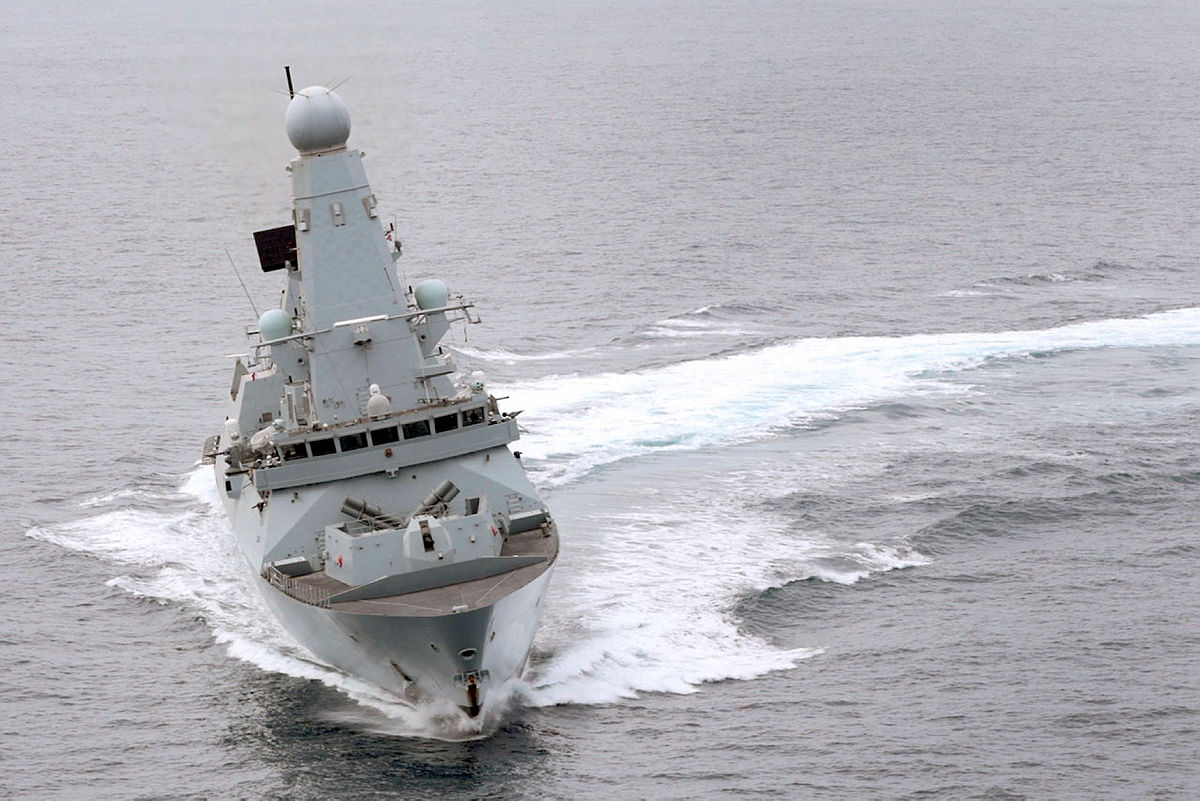
The Royal Navy’s six Type 45 destroyers could remain in service beyond their planned retirement from 2035, with a life extension now the subject of a funded study rather than something the department has ruled out, according to a written answer published this week.
Luke Pollard, Minister of State for Defence Readiness and Industry, was responding to James Cartlidge, the Conservative MP for South Suffolk, who had asked whether the department plans to implement a full life extension to the fleet.
Mr Pollard said: “The Defence Investment Plan has allocated a specific funding line within this parliament to conduct a study on the transition between Type 45 and the Hybrid Navy Maritime Air Defence capability, including whether a life extension will be required. As previously stated, this will be assessed in 2027-28.”
That sits a considerable distance from where the department stood two months ago, when the publication of the Defence Investment Plan on 30 June was accompanied by a senior defence official confirming to us that the six destroyers would leave service from 2035 without a life extension, with £1.3 billion of additional funding going into the hybrid fleet intended to replace them over the decade that follows.
The plan itself stated that a new hybrid maritime air defence system, consisting of uncrewed missile platforms designated Type 91 and sensor platforms designated Type 94 with a Common Combat Vessel serving as command hub, would “ultimately replace our Type 45 destroyers, which are scheduled to begin retiring from service from 2035”.
The position first softened in July, when an answer to Ben Obese-Jecty turned an extension into an open question to be settled through transition planning with industry, and this week’s reply goes further by putting a date on that process and attaching a funding line to it.
An extension would buy the Royal Navy time it does not currently have, because on the plan as it stands the destroyers begin leaving service in 2035 whether or not the systems intended to replace them are ready, and keeping the ships beyond that point is the only mechanism available for covering a delay in the hybrid fleet.
The replacements remain at an early stage, with a prototype Type 91 uncrewed missile platform intended to be in service by 2030 but no service entry date yet set for the class, while the Common Combat Vessel is still in initial design with hull form options being explored and does not appear as a firm commitment until the 2030 to 2035 tranche of the investment plan, which speaks of building at least six.
The upgrades position sharpens the arithmetic further, because the missile system improvements now being carried out on the class complete in 2032, which on the plan as published in June would have delivered an enhanced capability three years before the ships it improves began leaving service, an outcome the analyst Francis Tusa described in a paper last month as a wasteful upgrade for only three years’ planned use while calling for a ten-year Capability Sustainment Programme instead.
The Type 83 destroyer, which was to have replaced the Type 45 as a conventional crewed warship, was cancelled in favour of the Common Combat Vessel and the distributed uncrewed architecture built around it, leaving the study announced this week as the mechanism through which the potential gap between the two fleets will be managed.







Canceling the T83 is a terrible decision, which will come back to bite us, no doubt.
The proposed “drone fleet” with CCV command hub is yet unproven and will probably take along time to develop and solve all the technical and logistic challenges that it will bring.
One CCV problems is the size it needs to have a proper ABM/Hypersonics radar.
I agree. We are risking everything on an unproven idea whcih nobody else is attempting and now we are expecting the T45’s to go on even further. In itself that is no surprise. Whether a T83 or a derivative of a T26 we are literally entering dangerous waters. We should look again.
Yes, it’s unproven which is why they are examining extending the life of T45 instead of pissing £6 billion up the wall on T83 just Incase.
IMHO: We know that crewed ships work.
T83 would have mitigated the risk while these newer technologies are developed fully.
The additional risk is to expect the T45s to go on beyond the expected retirement date.
Has the RN/ MOD learned nothing from the T23 fiasco?
I’m sort of betting they will end up building a direct T45 replacement.. BAE will have an empty Frigate factory from the late 2030s and the Australians have got BAE to design them a pretty good AAW version of the 26 already…
Come 2035 the RN will come out and say the CCV and drone buddies will not cut the very high end AAW need and they will ask for a AAW vessel in the 7,000-10,000 ton range.. que BAE flogging the RN a T26 AAW version.
Not good that the DIP is being rolled back on already, even if that was one of the stranger decisions.
But being ready for an extension if FADS doesn’t meet its aggressive planned ISD is sensible.
Feel like it makes sense to use the 45s as interm CCV’s, get the drones and operating systems built and functional and use the 45’s as command vessels whilst the figuring out the SOP’s and solving glitches. That way if something happens you can still rely on the radar and missle load out of the 45’s. Once you’ve got everything ironed out and the everything proven then move on building the CCV’s.
Any thoughts on what such a life extension might involve?
They don’t need much in terms of additional sensors or weaponry. They’ll all be getting NSM, Sea Ceptor, A30B1NT, Sea Viper updates anyway. Four will get Dragonfire too. I think it’d be focused on the more mundane aspects of the ships (checking the hulls, wear and tear rectification).
By start of 2030’s rotating dishes should be considered obsolescent. Any serious upgrade to T45 in start to mid 30’s needs fixed panels.
France and Italy are retaining the less capable EMPAR rotating radar but adding Leonardo X and C band Grande Kronos radar panels.
AFAIK Kronos Grand Naval Leonardo instead of EMPAR and SMART-L MM/N Thales instead of S1850. They will remain rotating dishes unfortunately. The 2 Italian ships should return to service in 2028 and 2029. French ones roughly 2 years later.
Exactly.
It is the 1850 that would change to panels.
It will still be rotating.
Nope the successor to 1850 won’t.
Son of SAMPSON will rotate.
I agree, but such an expensive upgrade simply wont happen.
Sea Viper upgrades, Sampson upgrades, I would like to see Sea Ceptor ER fitted, but as they have gone for the cheap mushroom farm upgrade, I doubt that will happen.
The biggest increase in anti drone capability would come from Dragon fire, landing the laundry washing line ( the useless mk8 gun) and replacement with a Bofos 57mm mount, preferably twin 40mm mounts too.
I suspect in reality, little will actully be done.
Most of it will just be extending support contracts but they will also have to examine hull life especially with the knowledge of what happened with T23.
Ah, you mean the dreaded Lloyd’s Register? Putin’s lackeys who are deliberately condemning the T23’s?
Morning Jim, luckily I think the T45 hulls are somewhat more robust by design, they had to pack a large amount of heavy gear into those large hulls, requiring substantial construction.
Also as a class, they havent had a great deal of use.
Don’t trust this incompetent – hypocritical and horrendous Labour Government on any level whatsoever – they have and will continue to decimate the British military.
Yes bring back the Tories, they improved things so much lol!!
At least T45 is kept in service rather than gapped….
Defence spending is actually rising under Labour…maybe that’s why you don’t like them
Healey is set to ignore 3% defence spending target. No wonder T45s are being extended.
Why is Britain so short of money for the defence budget at a time when the last Prime Minister stated we should contingency plan for a conflict by 2030?
“Social” spending trumps everything.
Fiscal prudence unlike the cousins that whap it all on the credit card. The UK is overly cautious because of the Liz Truss moment. America is about to re learn respect for the bond market.
‘Yields on gilts…climbed as high as 5.79 per cent this year, the highest level since 1998, yesterday. Ten-year gilt yields rose to more than 5.1 per cent, heading towards highs seen in March which have not been matched since the financial crisis in 2008.
Both are above the levels seen in 2022 in the aftermath of Liz Truss’s disastrous mini-Budget – an episode that Labour repeatedly wielded as an electoral weapon on its way to power two years later.’
“The money would be found by cutting the long-term investment budgets of other government departments by 1%.
The Department for Transport (DfT) is making a further £700m in savings from roads projects, with the A38 Derby Junctions and A46 Newark Bypass scheme being considered for cancellation.
The Department for Energy Security and Net Zero (DESNZ) is finding an additional £2bn from its budget.’
That gets us to about £10bn. Healey might find a bit more but won’t get to the 3% of GDP figure.
Nothing like enough if Putin goes nuclear this year or next, as he very well might.
The really frightening thing is the level of complacency, intransigence, in parliament, in the country and even, in some instances, on here.
‘In the weeks before the invasion, I was among those who had been fairly sceptical of the idea of an assault on Kyiv – I thought Russian military action in eastern Ukraine was more likely. I assumed, however, that Putin’s intelligence services would give him enough information to conclude that even if an initial assault on Kyiv succeeded, holding on to Ukraine or imposing a pro-Russian leader on the country was never going to work. Volodymyr Zelenskyy had the same view: even as London and Washington made public statements that war was coming, most of my Ukrainian sources told me they thought it was all nonsense.’
Most people think it’s always nonsense..
How many of the public have 10-14 days of water a few months of food, a standard FM AM battery radio, money at home, some form of lighting etc.
Less than 1% is the estimate.. and yet you can get 6 litres of bottled water for £1.50.. so essentially emergency water for 10 days for a person costs £5, food wise you can stockpile what you eat, so it costs you a net of nothing.. infact it allows you to buy in bulk when the offers are on and get ahead of food inflation so it’s a net gain.. a radio.. £20 quid, a wind up or solar charger and lights another £20 quid..
Then get yourself a water filter so you can drink river sludge.. that about £20 for something that will filter about 3000 litres before packing up..
Honestly most people can set up a family of five to be food, water light and communication independent for 6 months for about £80 -£100 pounds net cost ( yes you will need to front up a big one off food bill)..
And then beyond that it’s piss easy to learn some basic skills.. anyone can build a dosimeter system for very little.. you can build a 200-300 PF fallout shelter in your garden.. that can survive a 5psi over pressure in 24 hours hard work using nothing but what is found in the house… anyone can learn how fallout works and manage the danger.. yes anyone within 3-4 miles of a 1MT air blast is dead, but you can keep pretty much everyone else alive.. as long as they know how to put 3 feet of earth between them and the blast and or fallout shine..
The UK is the oddest Nation in regards to preparedness.. is so easy but everyone seem to to embarrassed to do it even if it means theirs kids will liquify.. because they did not know how to build a basic door roofed trench shelter… when a spade, 5 door, the mud in their garden and 2-14 days of food , water and a bit of knowledge could have saved them from hell..
But not in Poland.
‘Poles stand out for being the most likely to say that “military attack from hostile states” is one of the biggest threats to global peace at the current time, at 43%’
They are, of course, closer but so probably better informed.
Britain?
‘67% of Britons view climate change as a major threat to the UK’.
How many in Britain realise that a Russian attack on Poland or the Baltic States and almost certainly the use of tactical nuclear weapons by Russia in Ukraine will mean war for Britain…and that could quite easily happen within 12 months?
Where do most of us build a bomb shelter? We dont all have massive back gardens.
All the other stuff, amazing how much of that can be found in my fishing / camping equipment stockpile.
Hi Bob you need less than you think.. the expedient door roofed fallout shelter is essentially the size of 4 internal door laid flat next to each other.. with a 3 foot wide entrance hole either end.. you will need space to pile the earth up away from the trench and that is it so you need a lawn 10 foot wide by about 18 foot long.. and a place to pile the earth as you dig..
It’s true it’s best if you have the shelter 40 feet away from houses.. but that’s to manage smoke from fire so it only matters if your within about 10 KMs of a 1 MT blast.. so if your just 20 miles or down wind dig it right next to your house..
To be honest If your more that 15miles away from the blast just fortify a small internal anti Gamma radiation fortress.. the secret is… every angle must have same amount of cover of material.. Gamma rays bounce so you must have a 90 degree angle for the entrance and any ventilation.. essentially the 90 degree angle creates a baffle against the bounce or shine.
Gamma radiation is only attenuated by significant mass of material.. you will get 99.9% attenuations from
36 inches of packed soil
24 inches of stone wall, red brick or concrete wall. ( remember an old brick wall is hollow and only and new brick walls are sometimes only one brick thick).
And that’s what is needed for the very heavy fall out within say 20-40 miles.. you can probably get away with a
24 inches of earth and 16 inches of brick beyond 50 miles..
The key thing to remember is your roof does fuck all and your doors and windows do fuck all and you will die from shine from your roof, doors and windows unless you have created that fortress with a roof of 24-36 inches of soil..
How long have you got ?
To be honest it all started to go pear shaped with the Tudors 🙂
It did. If we still had Calais, that would be saving us a fortune!
Sounds like the very rushed DIP has started to undergo a reality check review ! Who in their right mind would cancel the T83 for a completely untried, unproven theoretical Drone based system and not wonder why not even Japan or the US is yet ready to go down that route.
Meanwhile we have 6 T45 that are beginning to fulfil their full potential and due to the previous issues are relatively low mileage and due to their original KUR have quite a bit of built in growth margin.
That latter little titbit is very significant as it flew in the face of previous Treasury limited build it to the requirement now, not for the future so no Growth Margin (previously called the Admiralty Margin).
So yes makes sense to carry out a set of further upgrades and lifex to take them through to 2040 or even 45. And if anyone thinks that’s mad I’d just point out the the USS Arleigh Burke OOS has now being extended from 2026 through to at least 2030 at which point she will be 39 years old.
Upgrade the S1850 to LMN capability and take a leaf out of the French / Italian Horizon upgrades and add either the Leonardo Grand Kronos X / S panels or the Australian CEAFAR system to enhance the Sampson radar.
Meanwhile continue to develop the future.
On and can someone point out to MOD that building a modern undercover Frigate / Destroyer Refit Complex will save money in the long run and increase asset availability by shortening refit / maintenance times.
Considering the time they’ve been alongside, besides releasing crew it makes no sense to retire these ships so soon.
Oh here we go … it wasn’t long ago we had:
Type 45 Destroyers will not see service life extended … By George Allison – June 30, 2026
Would be interesting as to what exactly they mean by LIFEX this time. The PIP upgrades could be considered a sort of LIFEX I guess, but maybe they mean further on down the line they intend to do even more I’m guessing? But then what would that entail? Do they mean a refit? Or do they expect to replace all the electronics etc. again (similar to PIP) 10 years or so down the line?
It’s an improvement on ‘going without the capability and replacing them with T31 design’, I’ll give them that …. but yes, it’s all to play for.
In reality the lifex work will have all been done.. all they really need to do for 2035 is the Lloyds 5 year survey and any remedial work.. as the hull plate thickness of these ships should be fine for about 35 years it’s probably going to be very little capital expenditure…
The big question is if you run this T45 fleet until say the 2045-50 then you are essentially creating a 24 ship fleet.. not a 19 ship fleet and that’s an ongoing cost and personal issue..
So I suspect the viability is actually what personal and on cost will the RN need to keep the T45s and CCVs running concurrently.
The Type 45’s were always going to run on. They have at least a decade of hull life left, as they have not been worked as hard as the Type 23’s. I’m glad they are being extended on in service. They are the world’s BEST air defence Destroyers and with all the current upgrades, they will soon reach their full potential. So good news all round.
Exactly 💯
Prudent move. After 2030 Rosyth might be kept busy building T31 variants for export rather than CCVs. NZ, Denmark?
I think the drone fleet is only being talked about and maybe budgeted for because the UK is still in a declining Navy Stage only because of failure of all govt to budget properley for defence . The RN is still in decline and instead of bring one of the biggest Navies in Europe along with France , the UK is at risk of falling behind if not akready so to Spain Italy and upcoming nations. Even Turkey looks to be ever expanding on a limited budget . The RN is desperately short of another dozen frigates to keep oace with currenylt commitments let alone future commitments when other Navies will be packing bigger bpunches such as Beadil India and even Indonesia to name a few . Fortunately the Russia Navy is in declline partly thanks to Ukraine . But China could quite easily send 15 frigates to the Atlantic and all of a Sudden it will be too late . Have mentioned before but all of UKs dependencies especially the islands in atalntic south Atlantic are highly prised by our friends and enemies. Look how valuable Diego Garcia is now , though everyone knows they are valuable and laughing at UK for giving them away and then paying to give them away lol
I did say this was blindingly obvious from the start.. I sometimes think people take government officials parroting the present position as something that is.. when infact it never is the case.. it’s simply an assumption that was written at a specific time that nobody has got around to changing and if it’s not been changed they will just say what is written..
Nobody is going to say,
“we have just just spent billions on updating them and the will be totally current 3 years before we scrap the 10 billion of investment… so of course we are not following a supposition from 2010 about their retirement.. do we look like cockwombles,”
nope as a paid up government cog they will say what the last agreed assumption was even if they know it’s utter tosh..I’ve sat there in a meetings with the public myself thinking “ of course we are not closing your urgent care centre ( it took me 6 years to get you the bloody thing) .. but we may sort of shuffle stuff around” but I still had to parrot the line of official nonsense such as “ we are reviewing the urgent care requirements of the population as a whole and will be consulting on the assumptions from that review”… sounds awful but in my head all I’m really thinking is “blimey those sinks are a right health hazard we are changing those for sure)…
It was always clear that the RN are playing cheeky chess due to defence spending increasing from 2030 but suffering a squeeze due to lots of new requirements now..
I’m betting they looked around at would could be built soon abc simply decided they wanted more T31 general purpose type hulls and lots of drones… they looked around at what could be thrown to the treasury wolves and figured they could call the extra frigates CCVs ( hiding the fact they are just ordering more frigates).. then say well they may just be able to take over from the T45s in the 2035-40 timeframe if the drones are really good.. knowing this was actually total bollox and that they could prove they needed the T45s after all and ooohhh look they will definitely be current and run well till 2045-2050 with a little of all that money we are getting from 2030.. I’m sure we will have the drones acting like proper AAW destroyers by 2040 something… and all of a sudden from 2035 the RN are heading to 24 escorts… ( whoops how did that happen) and then at about 2035 they will go.. look it’s flaming impossible to get a drone to be an AAW destroyer.. we really need direct replacements for the T45 from 2045.. and by 2035 BAE will be needing an order to replace the T26 production line… it that point I bet BAE goes what about 6 of these ( say something like the hunter class).. the Navy will go yes please and the Treasury will be handing over 3.5% at that point so 5 hunter class frigates in the 2040s will be sod all from the capital investment streams..
Yes, I’ve often wondered if the CCV will, in time , simply become the T83 in all but name. With a few drones as a side order.
The Russians, Chinese, even the yanks will be a challenge, but what really scares me most is HM Treasury!
A rare sign of sanity at last. Selling off low mileage, full modernised, high-end destroyers with scarce BMD capabilities that are good for a least another decade of frontline service is madness. The capability gap will only makes sense to the bean counters, I can imagine South American navies (Brazil, Chile, Argentina) being willing to pay £100m a piece for them.
For sale, six former Royal Navy T45 Destroyers, one reckless owner, hardly used, more of a passion project, a weekend doer-upper. The purchase of twelve radio-controlled RHIBs necessitates sale; space at the dock needed for Celebrity Cruises. Offers in the range of £100 million; we will not pay you a penny more to take them off our hands.
Enquiries to: Clueless Labour Minister
A thoroughly pragmatic step. Upgrading the weapon suites to peak efficiency with Sea Viper Evolution by 2032, only to phase out the hulls by 2035, was an completely indefensible procurement strategy. Extending the Daring class into the 2040s provides the necessary safety buffer while the uncrewed surface combatant architecture is matured and trialled.
The UK is woefully lacking in air defences in general and particularly against ballistic missiles (Putins favourite). Isn’t it only logical that the UK has decided to keep the T45s beyond 2035 if only for its sea defence systems like Sea Viper which can deal with ballistics and of course the question of cost savings?