

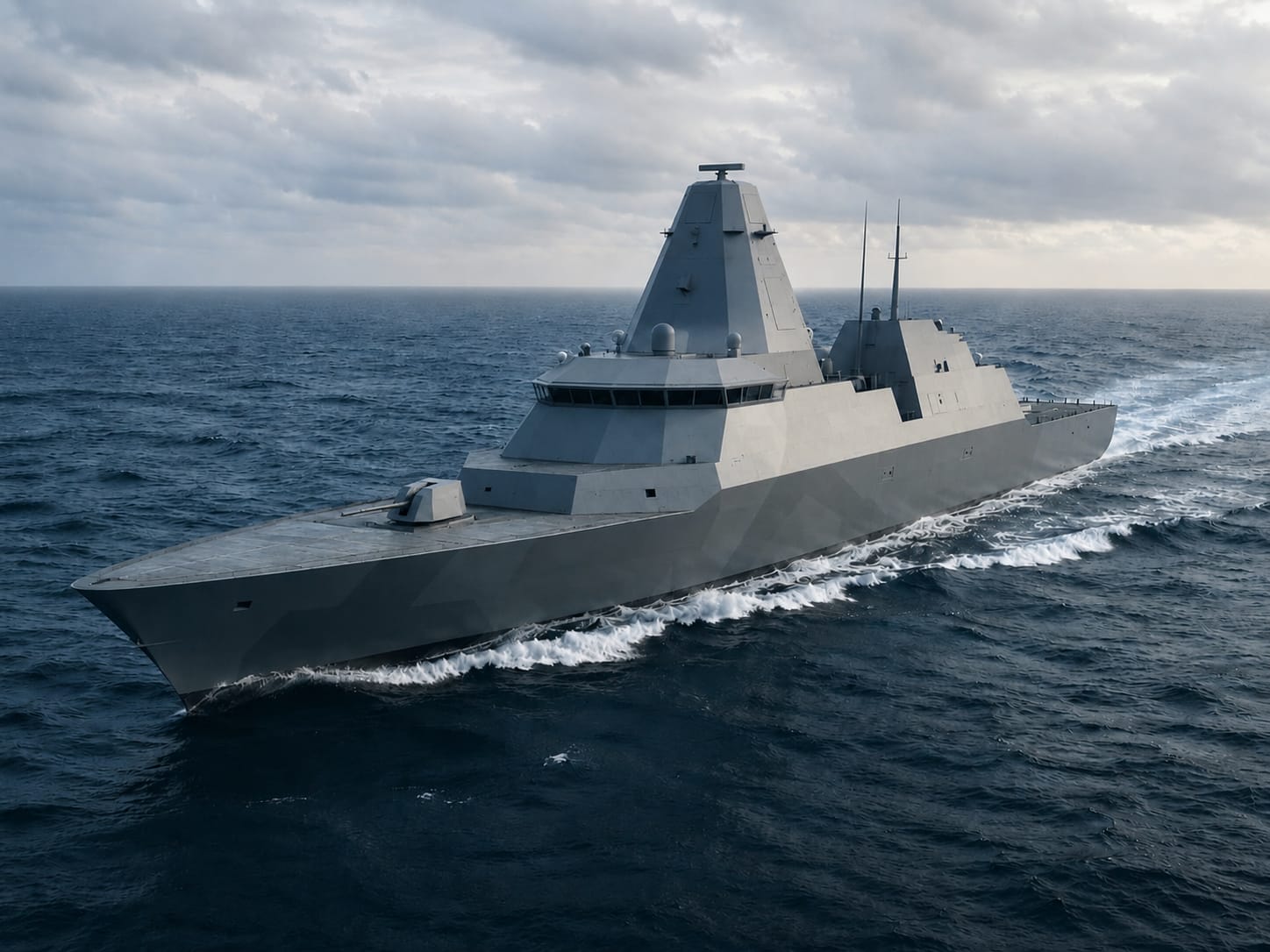
The Common Combat Vessel will be the Royal Navy’s first hybrid warship, coordinating uncrewed systems in the air, on the surface and under the sea, with its arrival intended to coincide with the retirement of the Type 45 destroyers from the mid-2030s, the Ministry of Defence has said.
The description, the most substantive the government has yet given of the ship at the centre of the Hybrid Navy, came in a written parliamentary answer from Minister for Defence Readiness and Industry Luke Pollard on 8 July, responding to Graeme Downie, the Labour MP for Dunfermline and Dollar, whose constituency neighbours the Rosyth yard building the Type 31 frigates and who had asked about the timing of the vessels’ construction against the completion of Type 31 orders and whether the design will be based on the frigate.
“Common Combat Vessel will be the Royal Navy’s first ‘Hybrid’ warship, coordinating uncrewed systems in the air, on the surface and under the sea to deliver more resilient air defence at the centre of the Hybrid Navy,” the minister said. “Whilst the CCV remains in the initial stages of design, the Navy’s aspiration is to sequence the arrival of the CCV and wider Hybrid Navy Integrated Air and Missile Defence capability with the out of service dates of the T45s in the mid-2030s onwards. There are options for hull forms we are exploring and announcements will be made in the usual way as the project progresses,” the minister said, with the reference to hull form options leaving open whether the Type 31’s Arrowhead 140 design is among those under consideration.
The industrial timing behind the questions is live, since the Type 31 programme’s five ships are due to complete in the coming years and the yard’s follow-on steelwork demand depends heavily on Denmark’s pending frigate decision, a dependency the Scottish Labour MSP Paul Sweeney highlighted to the UK Defence Journal this week in warning that core surface shipbuilding sites need a sustained drumbeat of work to avoid a return to boom and bust.
The Defence Investment Plan commits to six Common Combat Vessels as part of the transition to a fleet mixing crewed warships with uncrewed platforms, and the answers confirm the class is conceived first as an air defence ship, taking on the task of the six Type 45 destroyers, which a senior defence official confirmed last week will retire from 2035 without life extension. The vessel’s coordinating role connects to the wider architecture taking shape in public, from the Future Air Defence System work under which the department has asked industry for missile silos able to operate aboard uncrewed vessels and remain ready to fire for 30 days without human interaction, to the missile barges and sensor platforms ministers have described sailing alongside crewed ships.
With the design in its initial stages, no builder, displacement, weapons fit or in-service date has been announced, and the aspiration to match the Type 45s’ departure leaves little margin, as the first destroyers are due to leave service in the mid-2030s whether or not their replacement arrives on time.







From what I have been reading the idea for ballistic missile radar is very much to digitally mesh the separate arrays on the type 94 and the Command Ship into a single large array.
If this all works then any future RN task force could be very well protected from both ballistic and sea seeming targets.
This does sound much better to me than building two or three 10,000(t) cruiser for £6 billion.
£6 billion spent on this concept might produce something very powerful and very exportable. The T83 sounds more like a Trump class,
If this does not work out then we can just add some Canadian style River class T26 with bigger radars. The RN needs to get away from its own trick pony ethos on air warfare destroyers and BAE needs to adjust to not designing them on the government ticket.
The new radar panel technology BAE is designing sounds like it might be very useful though with the ability to fit different sized plates to both land and sea based platforms and work with a wide range of missiles families from Aster to CAMM. This is what we should really be focused on as opposed to which big floating metal box it’s going to be fitted to.
Smaller arrays, no matter how many you have, will suffer from range limitations.
You can work around this by building and distributing lots of radars, which is more survivable, but it much less portable and more expensive.
Tradeoffs.
Not with AESA radars, more arrays means more modules, more modules means more radar energy. More boats linked together means more power systems that can send power to their arrays, beam forming is likely to be affected somewhat with distance but spreading over a wider area probably also offers additional fidelity in tracking objects due to multiple surface reflection angles so better for stealth detection.
Main issue is going to be transmitting all that data between platforms and having a big enough computer to put it all together.
** see below
In almost all operational and physical contexts, the networked array of radars spread across multiple vessels will be significantly more powerful and capable than a single ship’s AESA radar, even if that single ship has a massive aperture.
When you network multiple AESA radars together and distribute them, you aren’t just adding more transmit/receive (T/R) modules—you are fundamentally changing the physics of how the radar system interacts with the environment.
Here is a breakdown of why the distributed, networked array wins out, along with the one massive engineering catch.
1. The Physics: Power Density and Coherent Combining
If the networked vessels achieve coherent distributed MIMO (Multiple-Input Multiple-Output) radar operation, the mathematical advantages are staggering.
Single Ship: Power scales linearly with the number of T/R modules (N). Signal-to-noise ratio (SNR) for a single radar scales by roughly N^4 (accounting for gain on both transmit and receive).
Networked Fleet: If multiple ships coordinate their radar pulses so they arrive at the target perfectly in-phase, the peak power focused on the target increases dramatically. Furthermore, because you have more total T/R modules spread across the fleet, the raw thermal and power generation limits of a single hull are bypassed. You can pump vastly more total energy into the sky without melting a single ship’s electrical grid.
2. Beating the Earth’s Curvature (The Horizon Problem)
The greatest limitation of any shipborne radar isn’t power—it’s the horizon. A single ship, no matter how powerful its radar, cannot see a low-flying anti-ship cruise missile or drone tucked under the radar horizon 50 km away.
The Network Advantage: By spreading the radars across multiple vessels spaced miles apart, you create a massive distributed baseline. If Ship A’s line of sight is blocked by the curvature of the Earth, Ship B (positioned 30 miles further downrange) can detect the target and instantly share the tracking data via high-speed datalink.
3. Angular Resolution and “Distributed Aperture”
In radar physics, the angular resolution (the ability to distinguish between two targets flying close together) depends on the size of the radar antenna relative to the wavelength.
By networking radars across multiple ships, you effectively create a virtual aperture that is miles wide. This technique (similar to interferometry used in radio astronomy) allows the fleet to achieve an incredibly fine angular resolution that is physically impossible to achieve with a single antenna array bolted to a single superstructure.
4. Geometric Diversity and Stealth Countermeasures
Stealth aircraft and missiles are designed to deflect radar waves away from the transmitting source. A single ship firing a radar pulse at a stealth target might receive virtually no return signal.
When you have multiple ships surrounding a target area, Ship A can transmit the pulse, and even if the stealth target deflects the energy away from Ship A, it will likely deflect it directly into the receiver of Ship B or Ship C. This is called bistatic or multistatic radar, and it completely undermines traditional geometric stealth shapes.
The Catch: The Synchronization Nightmare
While the networked array wins on paper, it relies entirely on mastering one of the hardest engineering problems in modern warfare: precise time and phase synchronization.
To work as a single, ultra-powerful virtual radar, the ships must know their exact relative positions down to the millimeter and sync their atomic clocks down to fractions of a nanosecond while tossing around on ocean waves.
If the sync is imperfect (incoherent combining), you don’t get the massive power amplification, though you still keep the benefits of horizon-busting, stealth countermeasures, and redundancy.
If the sync is perfect (coherent combining), the networked fleet behaves like a terrifyingly powerful, god-eye radar grid that no single ship could ever dream of matching.
Interesting, I guess my knowledge of radar technology needs an update. I’ll go do some more reading.
It’s all new to me too, just been listening to a few podcasts on it and read up a bit on it recently.
Fingers crossed it all works 😀
Certainly was very illuminating. I guess real time scenarios in a conflict will dictate if the theory and reality properly align but on paper sounds a big advantage. Will we make it work in the required timeframe? And how stable will it all work if countermeasures are employed. I hope the Govt isn’t under the impression this will be a cheaper option that’s for sure.
A nice explanation Jim, thanks. Is it AI (it has those features somewhat) or an industry article?
It’s AI mate.
Bi-static radar has been around since the dawn of Radar. The concept the energy is directed away was what was behind the F-117, now scrapped, and is only one of many techniques employed.
I do not believe that any of this, particularly the concept of combining many radar to improve performance will happen, beyond perhaps a PowerPoint slide or perhaps a technology demonstrator.
If the T45 is really for the bin from the mid 2030s with no extension considered, the end of the RN Area Defence capability is just around the corner.
Is that your expert opinion?
CEC Is already standard in the fleet. This is just a step further. It’s not rocket science.
I hope you’re referring to the USN there.
We don’t have CEC, it was dropped from the T45s to save money.
CEC does not exist in RN service.
Yes my fear too, this idea looks wonderful but is exactly the sort of leap into the future that has so often tripped us up when the complexity and costs escalate beyond what in the end is sustainable in the given timeline. Cobramist is a not dissimilar concerning example of how a perfectly feasible such concept with many, many millions invested, great effort to perfect it and state of the art technology yet was thwarted by Russian spy vessels simply interfering with it. Yes such sophisticated radar now exists but the road to get there was hardly smooth was long delayed and still arguably not totally foolproof technology.
👍
Incorrect.
More radars from differing angles can increase the resolution which in practical terms also increase the range.
But the increase is not substantial in context of ABM systems. You cannot make a 400km range radar into a 1200km radar by quadruplicating in 4 ships.
You get more range by putting it in a cruiser with more available emitted energy, assuming the system is fit to get more power.
Radars for ABM should not be employed against sea skimmers. There is a reason modern combat ships have dual or in rare cases triple frequency band antennas.
It’s the same principle as used by radio telescope arrays. The aperture goes from being the width of the antenna to being the separation between the two most distant antennas. In some cases that’s hundreds of miles. The Very Long Baseline Array has an effective aperture of 5,351 miles!
Of course, synchronising everything is considerably easier when you can connect every antenna by fibre-optic cable to the same atomic clock and there is a trade-off between angular resolution & sensitivity (which is based on the total area of the antennas)
Astronomical Radio arrays operate in fixed well surveyed locations, not moving platforms. I look forward to being proven wrong, but will have to live for some considerable time I fear. Content to stand by what I said.
Synchronising the times is easy for fixed telescopes on the earth is ok. Between multiple moving ships would on the face of it, seem impossible. But suppose a pair of radar sets could be synchronised in some way, in the factory or in port – like entangled quanta. So if you were looking at one set you would know the characteristics of the transmission of the other. Maybe by comparing the 2 reflected signals and satellite locations ( which you could exchange) you could get a lot of info. Just an idea.
Apologies I do not have a Phd in Quantum physics. I remain unconvinced that the solution will be as easy, cheap or as timely as described. It is I fear a distraction that will lead to further erosion of capability.
Neithet do I. It was the principle I wondered whether there might be mileage in an analgous set up. Probably not; as you say its a tough one with current technologies.
“It’s the same principle as used by radio telescope arrays.”
It is almost irrelevant, if the energy is not strong enough to return to the receiver there is no signal to process.
We can get much more energy available for a Radar in a 11000tcruiser than in a 2000t drone picket.
I agree to the context, but not the execution.
There’s at least one critical areas you have missed out, which is frequency vs atmospheric attenuation. However, I totally agree that you can mesh radars together, be that as a bistatic radar or a group of individual primary radars, but this is totally different to how AESA radars generate their beam. Which is also different to how you mesh telescope arrays together. To enable beam forming, each individual transmitter-receiver module (TRM) antenna within the antenna array, needs to be ideally half a wavelength away from the antenna of the neighbouring TRM. By using mutual interference and phase timing of each transmission from the TRM, you can add or subtract the beams together to increase the overall beam’s transmission distance/power and/or steer it. This won’t work when the antenna arrays are widely spaced apart. Instead what you will be doing is increasing the overall radar picture or if you will the field of regard in RF speak. Meaning the effective radiated power (ERP) of each AESA array remains the same. But the operator’s situational awareness has increased due to the larger radar picture.
But the main bone of contention is the operating frequency of the radar being used by the USVs. The size of the USV will dictate the size of the antenna array. Which will play a part in the operating frequency. It will be very easy to use say a 50m boat, slap on a Saab Giraffe 1X AESA radar, and think job done! However, that is very far from the truth. As there other considerations that need to be considered. For example a 50m boat won’t hold a lot of fuel, so will need to be regularly topped up at sea. If this boat is operating in the North Atlantic, how is it expected to do this when it either blowing a hooley or in waves greater 2m? The second part is due to power requirements. A small 50m vessel, will not be capable of holding a power system needed for long range radar. The electrical power requirements of AESA radar is significantly more than what is needed by equivalent legacy radar. The electrical power generation will also dictate the performance of the radar in both transmission distance as well as the type of cooling used.
If we take the Saab Giraffe 1X as the example. As it is used on many vessels ranging from small inshore raiding craft like the CB90 up to small corvettes. This is a modern gallium nitride X-band (8 to 12 GHz) AESA radar, with an antenna array weight of around 100kg. But it can only detect a large maritime patrol aircraft at around 100km. A fighter sized target will need to be nearer, and an anti ship missile (AShM) is likely to be closer than 50km. To make matters worse, it can only detect large targets up to 20,000m. Which means things like Hypersonic Glide Vehicles (HGVs) or warheads from ballistic vehicles, will be detected significantly lower. So its pretty useless for ballistic missile defence.
The BAES Sampson radar as used by the T45 can just about detect and track objects in low earth orbit. But it operates in the S-band (2 to 4GHz), meaning the required cross sectional area of the antenna array needs to be significantly bigger than an X-band array. It has a “published” instrumented detection range of 400km (250 miles). It is an older generation AESA where the TRM uses Gallium Arsenide (GaAs) components. Again, the published blurb say it has a power consumption of 25kW. For an X-band radar to have this kind of detection range, you will be looking at a minimum of 100kW of power if not more, depending on the radar cross sectional size of the object. As X-band frequencies are highly affected by atmospheric attenuation. The inverse fourth-power law of radar propagation is the knee to the groin for X-band and higher frequency radars. Even the newer Thales NS200 which is a comparable radar that also operates in the S-band, but only uses one mechanically rotating antenna array, weighs over 1500kg. Whereas Sampson with its dual mechanically rotating arrays (and older gen TRMs), weighs 4600kg. Though I believe Sampson can transmit at a significantly higher ERP for longer.
My concern is that the MoD have come out with a knee jerk statement due to the DIP, saying we will employ USVs as sensor nodes for a mothership, without either understanding the physics let alone the engineering required to host and operate a long range radar. If the sensor USVs are just being used to extend the mothership’s radar horizon, yes I can see that working. But for anti-ballistic missile defence, not a cat in hells chance. The USV doesn’t have the displacement margins or power generation to meet the needs for a long range radar capable of detecting objects in low earth orbit. Whereas, the mothership if its T26/T31 size should do. Especially when you consider the Thales SMART-L MM AESA radar (son of the S1850M), which operates in the L-band (1 to 2 GHz), can definitely detect and track objects in low earth orbit, where the antenna array alone weigh 9000kg. There’s no publicly available power requirements for the MM, but I’d expect it to be at least the same as Sampson, but more likely higher.
Thanks for a great explanation as usual! The ideal scenario to my mind is to put the Artisan-based evolved SAMSON on CCV and use the drone boat mesh purely as an OTH range extender. Space for power generation really isn’t an issue – you can fit a 1MW genset in a 20ft ISO (and not even a hi-cube). Personal I think that the huge fixed AESA arrays per AB and Hunter are cumbersome and not actually that useful – its a solution driven by tech, rather than by operational output. Yes you get great resolution (and TBF good ABM) but range is limited by the weight of the sensor necessitating that it be mounted lower. Hence BAEs idea of combining smaller fixed panels with a double faced rotator is IMO a good compromise. And even the basic Artisan has been shown to have reasonable BM detection.
What is an ‘Artisan-based evolved SAMPSON’? I have never heard of that one.
To do that you need to exactly distance them according to wavelength.
On a ship or ground installation that’s fine and easy enough, on a ship that’s moving differently to a ship it’s trying to match with, it’s pretty much impossible
The main issue is timing.
The level of precision in timing required for a multi component radar transmit receiver array is challenging to say the least.
Not only does the timing need to be spot on but the phase changes caused by ships motion need to be compensated for in so it is coherent.
Aah Jim you seem to have answered a question that came to mind reading yours and Leh’s comments. While smaller modules would theoretically have shorter range than larger ones much of that can be claimed back by the greater numbers of them having greater fidelity at their maximum range than a single larger module at its maximum range and thus the usable and effective range difference is not only reduced but in use and with enough of them might actually offer a clearer picture of events, so the balance of effectiveness is not black and white. Is that correct? My mind was just thinking around widely spaced Earth based space sensor systems being more effective than single larger ones.
To add to Jim’s piece, stealth aircraft are designed around focussing radar waves, whatever their point of origin, away from the direct return direction. That forms spikes of higher radar return (like sidelobes on an AESA) at odd angles, which if they line up with a radar instantaneously will cause a ‘glint’ on the screen that quickly disappears.
By using multiple radar points even if they are individually less sensitive they are more likely to pick up the reflected waves in a multistatic operation and so negate some of the effectiveness of stealth design.
I can also understand the resolution problem. Part of the reason I want a really, really big radar is that it helps a lot with accurately tracking the position and movement of fast targets. Radar is really good at finding range and not so good at azumith, so using multiple smaller radars might well allow better position finding than a single larger array.
There is still a minimum size to allow a good detection range away from the outer picket, though.
That’s not the whole story. Yes you can use shaping to reduce the platform’s radar cross section. Where as you say the transmission is reflected away from the source. This is why bi-static radars were seen as the answer to radar stealth. However, it is the radar absorbent material (RAM) which is used as the significant means to counter radar. The legacy RAM, incorporated specific sizes of ferrous material at 1/2, 1/4 etc wavelengths, these absorbed the RF and converted it to heat energy. However, they in essence could only be used on specific higher frequencies due to the size of the particles, and were usually aimed at countering SAM tracking radars. However, this in part changed with the F22 and in particular with the F35. Where rather than the ferrous materiel being held in an applied external paint. The RAM was incorporated in composite panels, meaning the depth of the RAM increases. This is important as RAM sort of acts like a sponge. It can only absorb so much RF, where it reaches a threshold, and will start to retransmit. Both aircraft also include what are called radar traps. This is where the RF passes through an out material and is “bounced” around a cavity than may or may not contain RAM, wing leading edges are an example.
The issue with all RAM is that the designed in counter to radars is fixed. At present you can’t electrically tune the RAM, plus it becomes increasing hard to manufacture effective RAM for lower radar frequencies. Yes its doable, but becomes too bulking to fit to an aircraft. Plasma, is a very effective RF absorber, but having not only the necessary power to generate it, but also controlling its shape when generated will be very difficult for an aircraft.
A lot of the problem with resolution is to do with the beam width, lower frequencies radars naturally suffer from poor resolution due to the operating wavelength and the beam the generate. Plus the beams naturally diverges, which is further compounded by the antenna shape. AESA radars are much better in this, as they generate much weaker sidelobes when transmitting, so more energy goes into the main beam and less is wasted in the sidelobes. But also explains why higher frequency radar can generate much higher quality target resolution. For example W band (75 to 110GHz) can generate near photo image quality resolutions. As the wavelength (4mm to 2.7mm) is less susceptible to ghosting, as the beam is so small.
Thanks DB I was hoping you’d come and rescue us all from our amateur debates.
With the heavier RAM panels for longer frequencies might that be yet another reason for GCAP being as large as it is?
There is a radar phenomenon known as resonance. Which is where a straight edge acts like an antenna. For this to happen the length of the straight edge must be around half the length of the radar’s transmission wavelength. This phenomenon is used by long wave radar, ie HF, VHF, UHF and some of the lower L band frequencies to detect “stealthy” aircraft. Aircraft like the F35 is susceptible to this kind of detection. As the straight edges on the fins, tail plane and main wings fall into the resonance trap areas, depending on the transmitted frequency. Aircraft like the B2 or B21 are less susceptible, although the wing tips could be susceptible.
GCAP’s size is I believe predominantly based on the need for a much greater unrefuelled range (therefore greater internal volume for fuel storage), along with the larger weapons bay to not only maintain a low radar cross section, but also to enable a greater mission duration, ie the ability to carry more weapons. Without the need to balance the fuel load against the weapons load. Making the aircraft much larger than the Typhoon could have a positive effect in mitigating resonance. But BAES etc won’t publish if it does or not for obvious reasons.
There is a radar phenomenon known as resonance. Which is where a straight edge acts like an antenna. For this to happen the length of the straight edge must be around half the length of the radar’s transmission wavelength. This phenomenon is used by long wave radar, ie HF, VHF, UHF and some of the lower L band frequencies to detect “stealthy” aircraft. Aircraft like the F35 is susceptible to this kind of detection. As the straight edges on the fins, tail plane and main wings fall into the resonance trap areas, depending on the transmitted frequency. Aircraft like the B2 or B21 are less susceptible, although the wing tips could be susceptible.
GCAP’s size is I believe predominantly based on the need for a much greater unrefuelled range (therefore greater internal volume for fuel storage), along with the larger weapons bay to not only maintain a low radar cross section, but also to enable a greater mission duration, ie the ability to carry more weapons. Without the need to balance the fuel load against the weapons load. Making the aircraft much larger than the Typhoon could have a positive effect in mitigating resonance. But BAES etc won’t publish if it does or not for obvious reasons. ..
Would it be fair to say..
More vessels more targets to defend…
lose the mother ship and it all falls like a pack of Cards…??
Absolute crap Jim, complete rubbish from start to finish
You seriously have a problem David, how do we make a complaint about you
Do we know his mother…. or carer?
Agreed.
Because you don’t understand what he said…?
I was agreeing with David. This thread has suffered from an excess of experts.
Please specify which aspects were as you say “Crap” ? It would be most informative to see your disagreement in black and white rather than a one sentence generalisation.
Merci
They have no aspects to explain they are merely erratic, troublesome trolls trying to disrupt interesting and intelligent discussion here.
Buzzwords that mean nothing. The inverse square law doesn’t dissappear because its convient. A radar 1/4 of the power with have 1/16 th of the signal strength at any given distance. 4 radars with each with 1/4 of the power will add up to half the signal strength. The cost of 4 type 31s is the same as 1 type 45. The T91 is too small to carry Aster 30 in numbers and the t31 hull can’t physically carry the same number of missiles of a hull twice the size. Its a downgrade dressed up with buzzwords
And if they ever do match the capabilities of the Type 83, they’ve just don’t it in a riskier and more expensive method
Its obvious it’ll be in a cheaper, less risky way, if you were to put aside your prejudices aside for a moment and to actually consider the facts.
Not really. Cheaper for sure but there is inherent risk in jumping all in on a system that exists only on paper. Having a big radar on a ship brimming with missiles is about as de-risked as we can make it nowadays. We’ve been perfecting the idea for sixty years. The arsenal and sensor drone based systems are a problem, none of that has been proven to work in a theatre combat situation by anyone in the world so we are currently as the point of maximum risk with the concept.
Do I think it is the way to go, yes. Do I also think that we need to be upfront about the risks? Hell yes. We should be building a proof of concept at half scale right now but until we can prove it works, expecting our service people to risk their lives on something that might not work it not a place I would like to find myself in so those big old cruisers, just build them with a drone control centre for this iteration and work from there when we know the concept works.
You really you contradict yourself in your argument 🤷🏻♂️🤦🏻♂️
How so. Do I think it is the right way to go in the future? Yes
Do I think it is the right decision to disregard the last 60 years of proven warship design for a technology that hasn’t been proven to actually work? No
This iteration should be old school basis with a full proof of concept that can be deployed with the regular forces and when, and if, the technology is proven we make the shift. To do otherwise is taking risks with our service personnel’s lives on a completely unproven technology.
I see no contradiction in that only a clear statement that I think they are on the right path but I think they are too focused on saving money now and not enough on doing what is right for the country and it has the potential to blow up in their faces.
I see the contradiction in saying this is the direction to go, but you’d rather be on an old design.
It’s like saying you think ironclad warships like HMS Warrior are the future, but you’d prefer to be in HMS Victory instead…
“but I think they are too focused on saving money now and not enough on doing what is right for the country”
There’s no evidence for that whatsoever in the announcements, just your political bias/prejudice.
Hmmm, allow me to explain my political bias. I am biased against small people choosing to prop up their political futures over defence of the realm. There hasn’t been a government of any political persuasion in the last 40 years that has. My bias is that they are all equally guilty.
As for the rest if you were actually bothered to read and take the time to understand then you would have actually picked up on the fact that I didn’t want to be on the Victory because although she is proven, she is old. And I didn’t want to be on the Warrior because she hasn’t been built yet. So right now I’ll take the Gloire, all the abilities of the Victory and some of the things we are looking at for Warrior so that we can prove that Warrior will work. Once we have, then bring on the Black Fleet.
Yes that’s my fear, all for moving forward but if that is done on the basis that you as a non expert but hold the purse strings, have been deceived into thinking it will be better and cheaper, then that is obviously a concern to say the least.
Wonder what prefix will be painted on the side how about js( joystick 🕹️? I hope they are named first batch battlecat s lion, tiger, leopard, jaguar, panther. I hop we can churn these ships out like lightning ⚡
This is Ajax for navy. An unproven concept with an unrealistic in service date and will undoubtedly cost considerably more and probably still not work as intended. The T83 was a better idea 6-10k ton upgraded destroyer/ light cruiser x6 with integrated sensors and able to co-opt other weapons systems. Comparisons with Trump’s proposal are daft. His 30k ton plus large surface combatant, hardly.
The T83 was pretty much undefined. A ‘6-10k’ displacement is so widely varied as to be entirely useless as a indicator of what was wanted.
Similarly, 70-128 VLS is so non-specific as to be meaningless.
Agreed. However the concept of a platform able to work as a standalone platform in a degraded environment is not undefined. If I asked you what a well equipped destroyer would look like, you’d have a view. What would a well equipped ‘Common Combat Vessel’ look like? I want to send one to Australia, I cant spare a T83 because I didn’t build any. Can I send it, can it defend itself as a standalone platform with no comms and little support. Can it do all those other jobs the navy does? Or is it just a floating server farm. I’m not knocking the idea as such, it’s just the big bang implementation of it. The sh*t or bust approach which cannot be rolled back if it fails. I would prefer to see a middle ground T83 built as well. No more bs about we cannot afford it either. The UK government needs to line up it’s ducks and pronto. Sorry for the rant.😃
Which is why LIFEXing T45 is essential.
I do hope that doesn’t mean that hull maintenance is now firmly aimed at 2035 OoS….if so another T23 mess awaits.
I see this as either a smoke and mirrors exercise by the MOD, where the common combat vessel (CCV) is a destroyer in all but name, where it has the necessary capabilities to take on the specific role of the T45 on its own, but can be backed up/expanded in capability with “loyal wingmen” uncrewed surface vessels (USVs), that have additional sensors to extend the radar horizon, along additional vertical launch cells. Or, the MOD has the rug pulled from under its feet and is frantically looking at how to mitigate the loss of the T83.
It wasnt the business case was nearly ready the recommendation being an ah160 with 57mk 41 vls plus camm at about 1.7bn per ship.
T83 was going to have to be a complete redesign at 10,000 (t) But you were never getting 6X T83 because of the cost.
What you describe is much more like what I’m saying as a back up based on the T26 hull just like the Canadian River class.
A T26 that is a proper destroyer. For all we know that is what the Command and Control ship will be.
Canadian River class has a measly 24 mk.41 as it’s armament. Hardly good enough for a proper AAW destroyer.
Lose the mission bay and add several more, ormake use of close escorting offboard armament drones.
Firepower Upgrade, courtesy of BAE Systems Australia (YouTube video by NavyLookout) and you’ll see that they’ve done just that in a render, along with the 32x VLS up front, they’ve got another 64 in the Mission bay just forward of the Hangar, whilst retaining the full hangar size.
Reckon we ought to give that a go for Type-83/CCV as it would allow us to maintain commonality with the Type-26s and overall utilise lessons learned in Australia’s programme and reduce risk and cost here.
If the RN wants to hedge against future failure whilst still cutting costs in the present, they could build the CCV as the ultimate ‘fitted for but not with’ warship.
As a preliminary disclaimer, this sketch of the vessel acknowledges the impossibility of mounting a very large radar system.
– Start with a T31 hull.
– Drop the current mast, whack on something equivalent in size to the Dutch SM-400 being used by the Poles.
– 16 VLS cells for self defence.
Simple! 😉
If the T9X ships fail, you add another 16 VLS, anti-ship missiles, et cetera, and build six more of these pocket air defence frigates.
Arrowhead 140 can mount a large radar. It’s just can’t put it as high as a T45 but then if it has another AESA radar 20 miles up threat it doesn’t need to.
If we use the arrowhead 140 and this stuff doesn’t work out then we probably still have a really useful vessel and we spent £2 billion for 6 of them instead of spaffing £6 billion on a pair of super cruisers.
Of course. Given that the original design mounted both APAR and SMART-L on the same general hull form, I reckon that equipping an AH140 variant with a decent radar is definitely plausible (APAR being a decent bit heavier than SAMPSON as well). It’s just not going to be something on the scale of Japan’s ASEV arrays, for example.
I mention AH140 specifically because Babcock needs the work far more than BAE do.
Load of BS , arrary don’t magically make the Earth flat.
Do you understand the concept of distance, and that the horizon isn’t the same for all ships?
For example, a radar 20 miles away from you will have a further horizon limit than one right next to you.
Share information between the two systems, and you extend your radar limit by 20 miles.
You’re talking facts to a troll who just wants to spew prejudices.
Might as well go with the full 32 mk.41, the extra 16 cells gives an unimaginable price increase of….. £14m
The SM-400 isn’t good enough for fleet level BMD. A better radar is required.
Yeah, but money saved us money saved in the eyes of the Treasury…
Anyway, I wasn’t suggesting that we use SM-400 (though the Dutch have claimed before that under the right circumstances, the picture it offers is better than SAMPSON).
I was suggesting that the form factor of that system is used, and replaced with a more capable architecture. SAMPSON and S1850M could do fleet level BMD, and there’s definitely room for a system of that size on a T31 hull. It’d have to be modernised, of course, but think of that as a minimum realistic capability indicator.
Exactly my thinking.
And we absolutely should IMO keep evolving the SAMSON/Artisan architecture for this, because the back-end is world leading, and otherwise we will eventually loose our sovereign UK capability to develop & manufacture high end radars.
I call BS.
.
.
You cannot design, build and operate the type of vessel[s] the UK is proposing – It reminds me of the genesis for the T23s where different combinations of engines, trackers, adding a Merlin capable flight deck, adding a gun changed the design entirely from a towed sonar tug which it evolved from.
.
.
The critical flaw in all this is in a heavily suppressed electronic environment, robot ships will need to fall back to their programming, AI probably, which will enivably lead to a unit, or fleet!, doing something a human would simply not do and compromise subsequent operations – reminds me of AI trials in the 90s which impacted the intended use case.
.
.
Again, as per one of my earlier comments on another thread, the main driver for the newly announced approach to future RN warships, is some penny pinching tunnel visioned sea-blind idiot, or bunch of idiots, which should be called, like crows, a murder having the ultimate approval in military matters they are incapable of comprehending..
.
.
I know from experience, things systems at sea, and no amount of automation can replace a crew on hand; how does one engineer a battle-short arrangement which doesn’t result in the complete loss of the the asset during a particular fault, either anticipated or enviably one the designers didn’t consider or include in the design v1.001.33.62, just when the assets reason for existing is required? Rhetorically, you cannot and that is exactly why you need feet on deck – to ensure success.
.
.
War is not a video game.
Off-course you will be aware that lasers are a thing and the UK is investing a lot in communications lasers.
No technology humans can produce can jam lasers.
Would lasers be restricted to line of sight as would any directed point to point comms, potentially negating the advantage of putting uncrewed systems over the horizon?
Yep, depending on how high you mount it, 20-60km range. Only you’re also hoping for and sea spray don’t exist, 2 things very common in the ocean.
Yes they are limited to line of sight. However that can be quiet far, certainly enough to spread a task force out
Joe,
Satellite arrays, It’s how the US and Canada can get arround MADL interconnectivity issue between F-35 and Grippen. The Multifunction Advanced Data Link (MADL) a fast switching narrow directional communications Ku Band data link used between stealth aircraft and it can not be shared by the US.
The data link issue has taken on immense relevance as Canada moves forward with buying Saab’s GlobalEye surveillance planes and negotiates a split-buy for 60 to 72 Canadian-built Gripen Es alongside its F-35As. Washington has flatly refused to allow Saab access to the F-35’s classified MADL tech, Canada’s incoming Swedish fleet … the GlobalEyes and Gripens will have to rely heavily on Link 22 and Link 16 to pass data over the Arctic.
This creates the exact operational bottleneck the Pentagon warned about. To talk to a Canadian Gripen or GlobalEye over the Arctic via Link 22, an American F-35 would have to route its data through a ground-based ‘translator bridge’ or turn off its stealth communications entirely, compromising its primary defense mechanism. Link 22 is the exact reason why the Gripen E is considered a superior Arctic workhorse for domestic sovereignty, but it is also the exact reason why the Pentagon opposes the jet, as its long-range, non-stealthy broadcasting architecture clashes directly with the F-35’s secret, short-range stealth network.
But MADL is line of sight and only travels 25 to 50 nautical miles. So they use two completely different methods to bypass the distance limit … airborne gateways and satellite relay nodes.
Airborne gateways, the military puts it inside a high-altitude aircraft. A BACN (Battlefield Airborne Communications Node) or an airborne gateway.
The Translator Bridge is essentially a server and radio system located on the ground that acts as a real-time digital interpreter for different military aircraft. As different jets of different generations talk in different digital languages over different radio frequencies, often they cannot communicate directly. The translator bridge sits in the middle, takes the data from one jet, translates it, and beams it out to the other.
Instead of an F-35 shooting its narrow “pencil beam” of data horizontally to another jet 40 miles away, it aims its phased-array antenna straight up into space. A low-Earth orbit satellite receives the secure MADL data, then the satellite network routes that data across space and finally beams it down to a major NORAD command center in the United States or Canada, where it is translated and sent back out over long-range networks like Link 22.
This infrastructure reality completely changes how we look at the Canadian F-35 vs. Gripen mix.
You do know that communications lasers are low power and get blocked by just about anything including a shiny piece of tin foil. To maintain connection you would need to mount the laser in a gyro stabilised gimble system and that the receiver would also need to be mounted in the same way otherwise any motion of all would break the link.
You would also need separate links for each drone you are controlling because light is light and using the same receiver would be like two pebbles in the same pond, a massive interference pattern. Also attempting to manoeuvre the command ship will mean you lose connectivity with a significantly reduced chance of reacquiring it and then finally we need to talk about diffusion because there is a limit on the distance communications laser can get to before the beam is so dispersed as to be unusable.
So basically communications lasers are great for linking two fixed immobile points where environmental interference is at a minimum but out on the ocean in sea state 6 they will be next to useless, with useless mocking them for being additional top weight with no benefit.
This! In spades!
I drew up the state boards for emergencies – like being hit by a big firery telegraph pole, with the ships engineers after the P45 PIP.
A LOT of stuff like you say requires clever and determined blokes with a spanner cross linking systems to get a capability back on line, even if only in a reduced state.
No amount of AI can jury rig jumper cables to get a system back on line when the war comes in.
🤡
Morning clown
You should stick with “Just Me” as a moniker.
It’s shorter than “Morning Clown”, and the latter is inaccurate as you’re a clown in the afternoon and evening too.
Fantastic news and so positive, now lets get them built and show the World our Technical prowess and cutting edge World class capability.
👊
👍👍
Two things are guaranteed to get the troops arguing on this page:
• Aliens crossing the Channel
• The length and girth of the mast
#🤦♂️
Will CCV be based on T26 or T31, that is the question.
Whether ’tis nobler in the mind for Babcock to suffer
The slings and arrows of outrageous fortune and build B3 Rivers,
Or to take arms against a sea of troubles
Ideally, it’ll be T31 or a new design. Babcock needs the work.
Yes, a T31 variant seems the obvious choice. The Iver Huitfeld was an AAW ship and Babcock needs the work. Due diligence though would say, do consider a T26 development like the Canadian River class. Babcock could build T31 for Denmark, batch 1 River replacements, T91/2/4 drones. Not saying T26 is better but there are options.
Why not make a variant of the Singapore Navy’s Victory-class MRCV? Their function is almost identical. Both based on the Iver Huitfeldt. The Singaporean version is larger but slower. I also think it’s in the same price bracket. Just bring your drones to South East Asia and see how things work out. Adapt the design to lessons learned from the tests.
Actually, for reasons of UK industrial strategy I do accept that a T31 derivative must be favourite. But I do wonder whether if time allows, there is value in stretching and broadening the Arrowhead 140 hull.
‘Distributed radars’ for ABM defence is absolute BS on ships – riddle me this?
Why is NO other Navy trying this but are all fitting bigger, more powerful planar arrays on bigger ships?
🤡
Because we haven’t been de-risking that technology for 60 years where we have with the pig planar array warships. It doesn’t mean it doesn’t work but since nobody has proven it will yet nobody else is willing to take the risk. The treasury and multiple consecutive governments have backed us into the corner so just like the unmanned mine warfare systems we will have to go with this and lose the proven technology when what we should be doing is a proper proof of concept that would operate alongside the traditional ships for an iteration before going all in.
This is what happens when people are more worried about getting reelected than they are about doing the right thing for the country.
One of the issues with these distributed arrays is radar power – a big planner array puts a LOT of power downrange as a focused beam that can be used for electronic attack.
As for ASEA arrays – we don’t have them, we were going to buy in CEFAR and fiddle with that.
‘As for ASEA arrays – we don’t have them, we were going to buy in CEFAR and fiddle with that.’
Damn, if that’s the case, you should definitely inform BAE.
Hate to break this to you, but SAMPSON is properly dinosaur tech – BAE hasn’t developed anything to match any flavour of SPY.
BAE talk a good talk on PowerPoint, but they can’t even develop a modern shipbourne AAW/ABM ASEA radar, let along this magical ‘distributed’ ASEA radar
Garbage. Sampson was world beating. A proper software controlled radar. It suffered from a lack of continued investment beyond the bare minimum. BAES continue to put their own monies into new technologies. To say they cannot design a new radar is simply wrong.
Why garbage, you even agreed BAE stopped new radar development for years.
Where did I agree to that? BAES will invest where they see a potential return. They have contiuned to invest in the Next Generation Radar. The issue is the MoD have not themselves invested in new systems beyond obsolescence and a ABM experiments.
Ahem.
Read the Navy Lookout articles “The Royal Navy’s Next Generation Radars” and “In Focus: BAE Systems’ sovereign radar development”.
The new AESA radar, which is intended to be able to do multi-static operation, is already under development at Cowes and in the pipeline is a multi-static Over the Horizon Radar and various other future technologies. BAE spent the 2010s in a hole after developing SAMPSON but are rapidly recovering.
PS SPY is just the USN designation for a naval air defence radar, the different designations are entirely different designs.
It’s all theoretical vapourware – show me a working model on land, then make it work on a bumpy oggin.
You can develop anything in a university laboratory, we’re good at that, it’s the actual ‘can we actually make this work in the real world’ bit we have a problem with.
SAMPSON isn’t a rotating array because we were amazebobs clever, it’s because we couldn’t develop a viable large planar array.
We’re developing low powered radars not because we are cleverer, but because we don’t have the money to build large ships with lots of installed electrical power.
And remind me again what’s going to provide the tens of Megawatts these new directed energy wunderwaffe the RN sets such store by are going to need? A diesel powered Frigate won’t be. A small drone boat definitely won’t be.
This whole distributed fleet equipped with yet to be developed AI and exquisite wunderwaffe nonsense is financially driven – it’s Duncan ‘the era of the manned fighter is over’ Sandy’s all over again.
I agree entirely that trying to do AAW only with low powered radar sets and small USVs will be a failure. I have said so repeatedly in the past.
What you said is that the UK has no capacity to develop our own AESA radars, which is false. The rest of your comment is unrelated to what I replied with.
We can wish for what we want, but we cannot develop, as in make and put into service, a large planar array like AMDR.
Even pushing on from the existing radar, it cost the USN $6Bn to develop AMDR.
This is the huge issue UK defence refuses to grasp. We don’t have the track record to leverage – as an LM engineer commented looking over the DERA stand I was manning some years ago ‘we spend more on PR than your entire research budget’.
Add even IF we managed to from a standing start develop AMDRUK without bankrupting ourselves – £10Bn isn’t an unreasonable guess at what that would cost us to bring to production…
Everyone has found to get a radar of that capability to sea, you need ships in the 12-15,000 tonne class. The next generation ABM radars simply won’t fit on a Frigate no matter how much we wish they would.
👏 👏 👏 👏
What they are not letting on is that the XLUVs found Atlantis and some ancient Alien technology 😉
These vessels are just a cut price job.I do ask myself the UK government seem to want to be at cutting edge with these drone ship’s and to be the world’s first to field them fair enough .But I do hope it doesn’t go the same way to be the world’s first to be Net Zero . 🙄
Perhaps an amalgamation with t83 is the way to go…?