

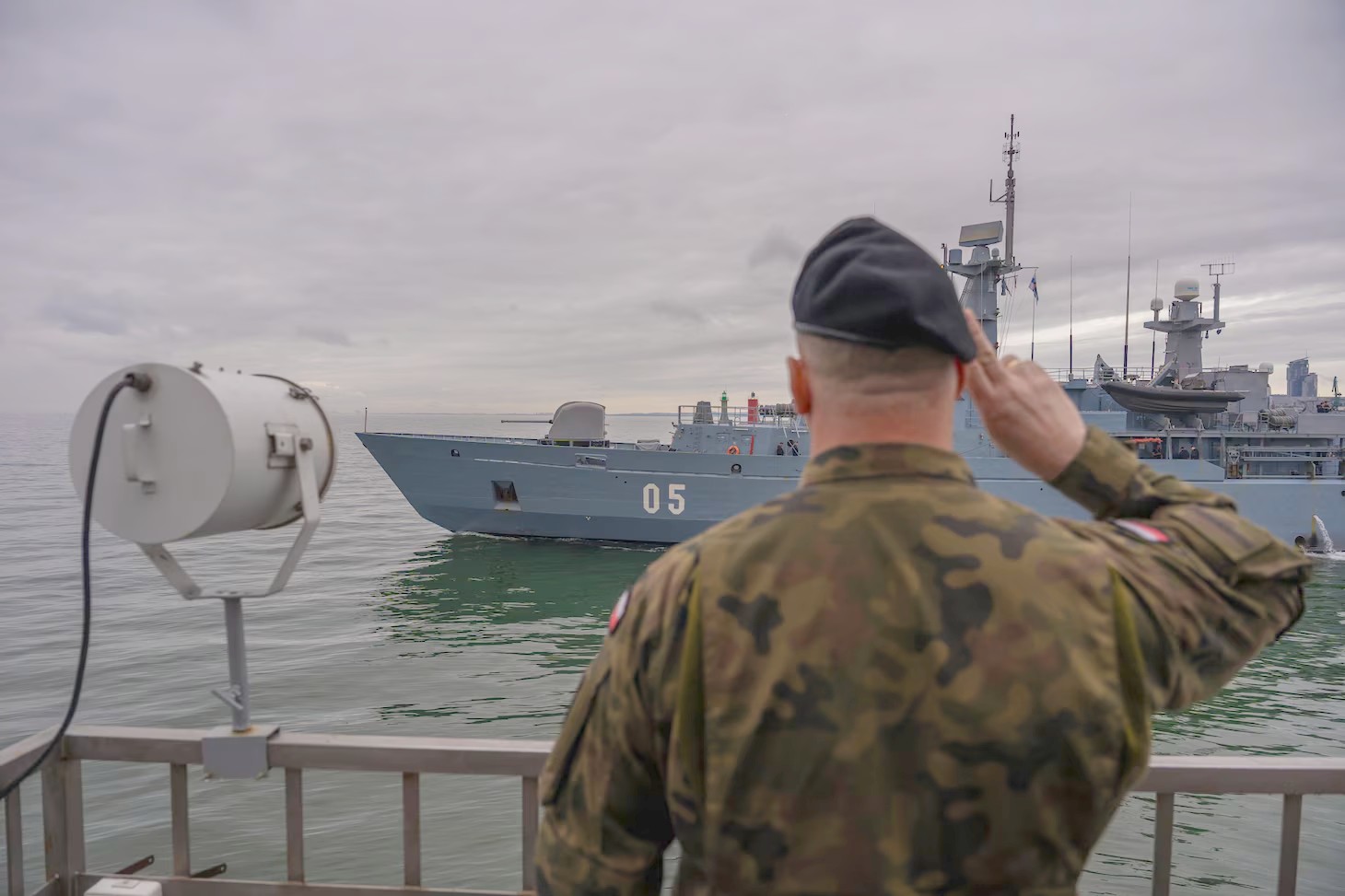
Twenty NATO warships have sailed from the Polish port of Gdynia to kick off BALTOPS 2026, the fifty-fifth running of the alliance’s annual maritime exercise in the Baltic Sea, drawing in around 6,000 personnel from fifteen nations and openly framed by allied commanders as a deterrent message to Russia, the US Sixth Fleet has said.
The exercise is being led by the US Sixth Fleet, headquartered in Naples, but for the first time since 1972 the day-to-day command and control of the drill is being run from Allied Joint Force Command Brunssum, one of NATO’s three operational-level headquarters, in what the alliance has presented as a way of giving participants more realistic training under a NATO command structure rather than a national one.
The deputy commander at JFC Brunssum, Lieutenant General John Mead, set out three jobs for the exercise, saying first among them was to “deter Russian threats in the Baltic Sea region”, alongside building real readiness and interoperability among the ships, aircraft and units involved and tightening the alliance’s own internal cohesion, and he argued that deterrence was something that had to be demonstrated rather than merely talked about.
The vice commander of the US Sixth Fleet, Rear Admiral Jason Naidyhorski, framed the exercise as preventative rather than reactive, saying that through BALTOPS the allies were “actively working to prevent” a crisis by showing unified strength, and pointing to the drill as another example of the European allies stepping up to shoulder the lion’s share of Europe’s conventional deterrence and defence.
The Inspector of the Polish Navy, Rear Admiral Jarosław Ziemiański, told a pre-sail conference at Gdynia on Tuesday that hosting the fleet was an honour, calling the exercise “an expression of our solidarity, determination and readiness” to meet alliance commitments, with the assembled forces drawing on the navies and supporting elements of Denmark, Estonia, Finland, France, Germany, Latvia, Lithuania, Norway, Poland, Portugal, Romania, Sweden, Turkey, the United Kingdom and the United States, together with NATO’s Standing NATO Mine Countermeasures Group 1 and Commander Task Force Baltic.


Hi folks hope all is well.
Just been reading about all of the UKs attack submarines alongside at the same time. I do despair at this level of incompetence not just the current government, but also the previous government. Both are to blame for the state of our armed forces. No blame on the actual personnel, they will always step up and do a fantastic job with what is available, and a magnificently perform amy deployment.
The quicker this lot goes, the better. Even the public can see the situation must change with defence at the top of the agenda apparently by recent polling.
Cheers, George
Exactly what have senior navy leaders been doing for years. They share the blame alongside politicians I suggest.
I’ve gained $17,240 only within four weeks by comfortably working part-time from home. Immediately when I had lost my last business, I was very troubled and thankfully I’ve located this project now in this way I’m in a position to receive thousand USD directly from home. Each individual certainly can do this easy work & make more greenbacks online by visiting
following website—.,.,.,.,.—>>> JobatHome1.Com
I’ve gained $17,240 only within four weeks by comfortably working part-time from home. Immediately when I had lost my last business, I was very troubled and thankfully I’ve located this project now in this way I’m in a position to receive thousand USD directly from home. Each individual certainly can do this easy work & make more greenbacks online by visiting
following website—.,.,.,.,.,.,.,.,.,.,.,.,.—>>> PayAtHome1.Com
Jonty, My experience is from the army but I expect there are strong parallels with the RN and RAF. You are, like me, concerned at the very poor availability of the RNs attack submarines and all other vessels. Senior officers have surprisingly little influence as to how many platforms are procured, who is to manufacture them and so what their build quality and what their reliability might be like, which contractors will conduct refits, the service life of platforms, the manpower count of the Service (what some call PIDs) which influences crewing ability, how much money is available for maintenance etc.
The blame for the really big flaws lies with politicians in the MoD and Treasury.
Out of pure Ignorance… What sort of Salute Is that ?
Looks just like a Cubs two finger one from my Youth. 🤔
Polish
Lol. Well spotted.
“Dib dib dib ” … 😁
Lots of news sites are reporting FCAS is officially over, Germany has pulled out.
This could be good news for FCAS/TEMPEST, if only ALL parties and gov’ts involve get their acts to together. It’s a golden opportunity for all three governments and suppliers. But… it means someone will have to actually DO something!
GCAP/TEMPEST…!
Both parties Can be Very Difficult.!…
Fact that Both Countries leaders invested a lot of time With No Success will Disappoint All Involved…!
How Germany if there’s Agreement fit into TEMPEST program Remains to be Seen…. Ah! The A400M !
While they’re on exercise in the Baltic Sea, I hope they get a glimpse of the charred remains of the Russian warship Boikry at Kronstadt or the see the smoke cloud hovering above the hole in the ground that used to be the 15th Naval Arsenal at St. Petersburg. Cheers Ukraine for helping keep the Baltic and Europe safe.
Defining 6k troops as huge is a bit of a stretch, considering Russia was doing exercises involving over 100k along the Ukraine border in the years before the invasion.
NATO well Europe really needs to step up and do similar big exercises. Doubt it could achieve 100k but could easily do 30-40k if it involved UK, France, Germany, Italy and Poland, plus others. Send a message to Russia that we don’t take their aggressions into NATO air space lightly.
Yep..Just as much for Media Consumption these days as Anything Else..!. Like PoW with 4 Helicopters in the High North…!
Understand Green Flags on the Way there..!!!!!!