

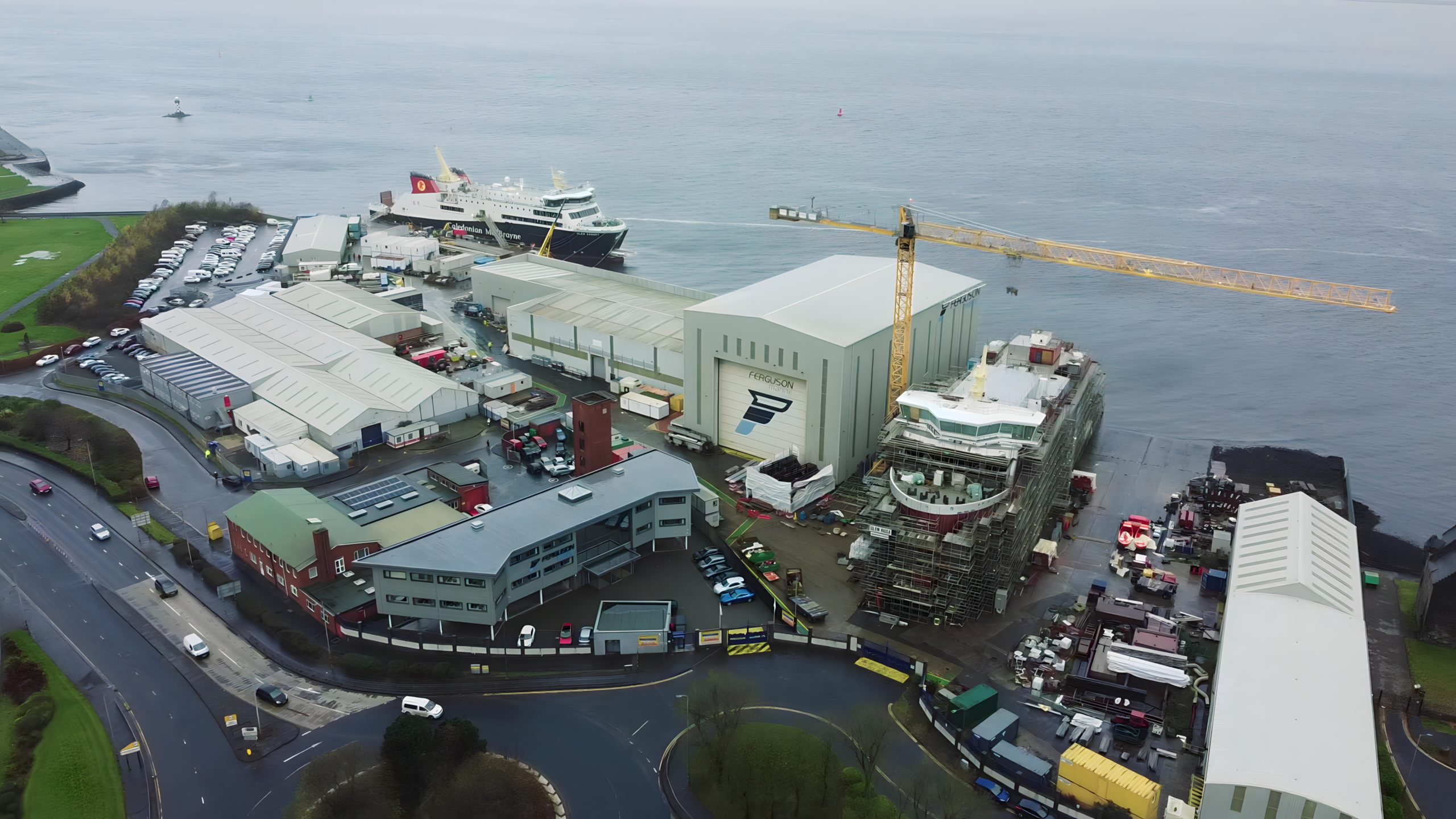
Ferguson Marine has set out what it says is a more disciplined path to delivering MV Glen Rosa, while arguing that investment, management reform and future vessel work could help restore commercial shipbuilding capacity on the Clyde.
Appearing before Holyrood’s Net Zero, Energy and Transport Committee, the leadership of the Port Glasgow yard pointed to technical progress on Glen Rosa, lessons learned from MV Glen Sannox and a wider effort to modernise the business after years of delays and overruns.
Duncan Anderson, the yard’s recently appointed chair, used his opening statement to argue that Ferguson Marine still has significant long-term potential despite the troubled history of the two ferries.
“With an effective modernisation programme and improved build processes, it could be a leader in the industry,” he said.
Anderson acknowledged that past failings had been serious, telling MSPs that “the past management of vessel construction has involved mistakes” and that governance and sequencing of work had been poor. But he said the current leadership was focused on changing how the yard operates and giving the workforce a clearer structure.
“With the appointment of a new senior management team, I have seen considerable changes in the yard and much improvement,” he told the committee.
He also pointed to immediate progress on Glen Rosa, saying: “We are powering up the switchboards as we speak, and we are close to full engine commissioning as per the recent schedule.” He added: “We look forward to delivery in the fourth quarter of this year as we move into our modernisation programme.”
Chief executive Graeme Thomson said the yard had introduced stronger programme controls since he took over, including more rigorous planning, formal risk management and a dedicated programme office.
“We have now implemented a much more robust planning process,” he said, adding that it had exposed issues that had not previously been visible at sufficient depth.
Thomson told MSPs that “we have established a programme management office, which did not exist previously,” and said Ferguson Marine had also brought planning capability in-house, adopted the Primavera planning tool and put new cost and schedule controls in place.
He described the changes as a shift back toward basic industrial discipline after years in which that had broken down. “The fundamental thing that we will do differently… is to start with good practice from day 1,” he said.
That case was reinforced during questioning from SNP MSP Kevin Stewart, when Thomson accepted directly that project management had been a weakness in the past. Asked if that was fair, he replied: “Yes.”
The session also covered technical issues affecting Glen Sannox, including hull cracking linked to cavitation from the propellers. Thomson said the yard now understood both the cause and the engineering remedy.
“The crack that was identified was a 20mm crack that manifested itself through vibration through the hull, which was caused by cavitation when the ship went astern,” he said.
He said steel strengthening had already been fitted to mitigate vibration, while redesign work on the propellers had now been tested.
“Between the steel that we have installed and the updated propellers, we will have a solution whereby this will not happen again,” he said.
Thomson also told MSPs that lessons from Glen Sannox were already being applied to Glen Rosa, including the same mitigation work ahead of the arrival of updated propellers.
Alongside the ferry work itself, Ferguson Marine made clear the importance of yard investment. Finance chief David Dishon said a £14.2 million capital package backed by the Scottish Government would help modernise facilities and improve productivity.
“One of the items is a semi-automated 13m panel line,” he said. “It will allow us to be more productive… there will be a 50 per cent productivity increase in that regard.”
That investment is intended to support construction of future vessels and improve competitiveness as Ferguson Marine seeks to move beyond the Glen Sannox and Glen Rosa saga. Thomson said the yard believed there was a viable long-term market if the current reset is carried through.
“As the National Shipbuilding Office reported in 2022, between the UK Government and the devolved Governments, there is a requirement for 150 vessels in the next 30 years,” he said.
He added: “We should be attractive and competitive in the UK within the five years and able to secure work on a competitive basis.”





They need to build a ship that doesnt break down in a puff of wind. I give you Gen Sannox, overdue by years, over budget by alot, and broken, again…….