

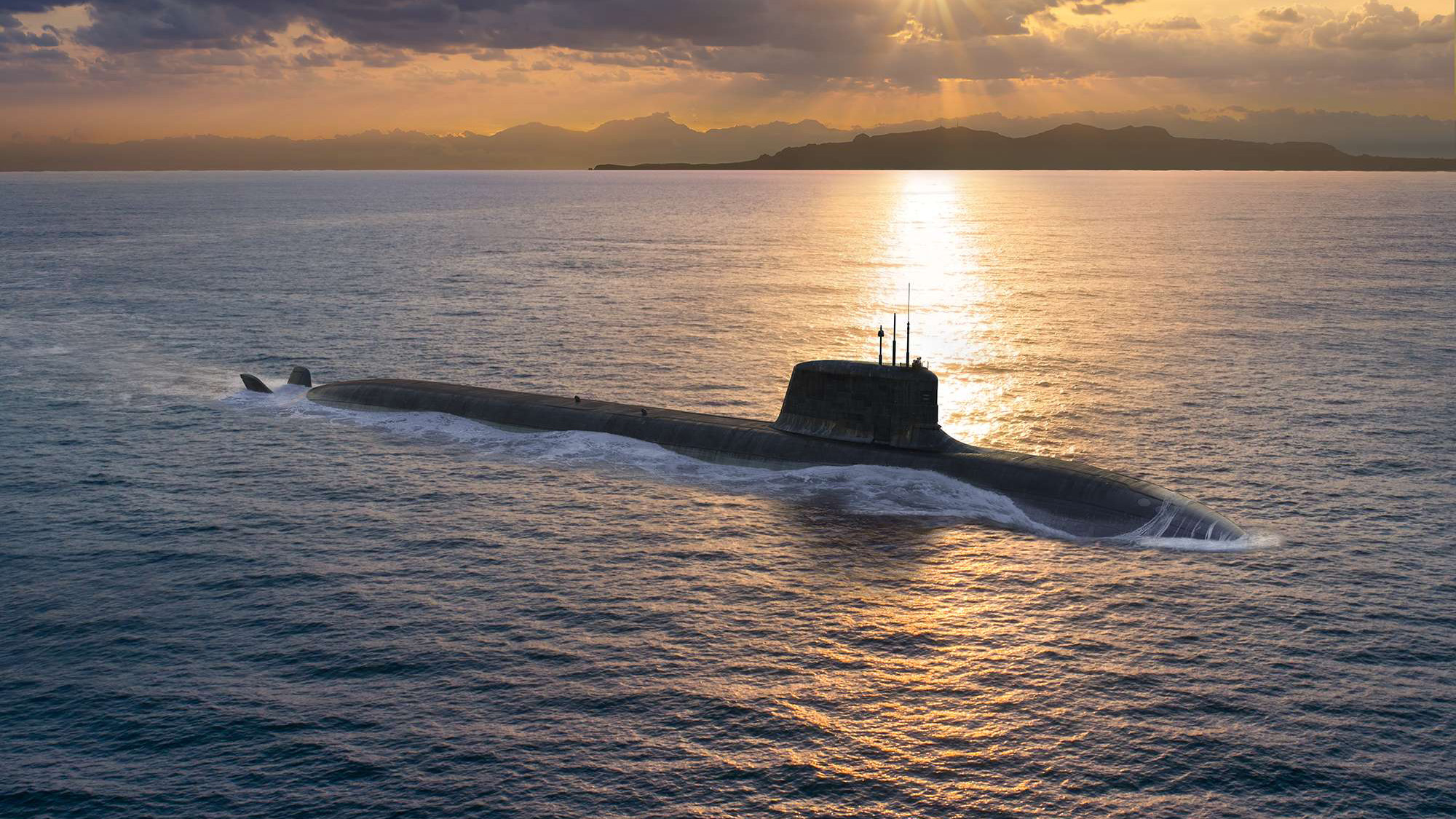
The UK nuclear enterprise is expected to absorb between 20 and 25 percent of the Ministry of Defence budget in the coming years, as spending rises across a growing portfolio of submarine, warhead, infrastructure and fuel programmes.
Giving evidence to the Public Accounts Committee, Permanent Secretary Jeremy Pocklington said defence nuclear spending totalled about £10.9 billion in 2024-25, equivalent to 18% of the department’s budget, and is expected to rise to around 20% in the current financial year.
He told MPs that the share would continue to grow, saying the Defence Nuclear Enterprise was on course to account for “between about 20% and 25% of the MOD’s overall budget.” That growth, he said, reflects both inflation and a broader expansion in the nuclear portfolio.
Pocklington said the increase was not being driven primarily by the core Dreadnought submarine build, which he said remains within the range previously set out to Parliament. “For Dreadnought, we are still within the range that the Department stated to Parliament,” he said, referring to the longstanding £31 billion programme cost plus £10 billion contingency.
Instead, he pointed to other pressures within the wider enterprise, including “scope changes related to AUKUS” and the re-establishment of a defence nuclear fuel capability, which he said had not featured in earlier forecasts in the same way.
He described the Defence Nuclear Enterprise as a large and increasingly complex portfolio, covering not only Dreadnought and Astute, but also warhead work, infrastructure at Barrow, naval bases at Clyde and Devonport, and fuel production. “There are nine programmes with a whole-life cost of over £10 billion in the Defence Nuclear Enterprise,” he said.
Pressed repeatedly for a 10-year forecast, a more specific Dreadnought in-service date, and an update on how much of the £10 billion contingency has been drawn down, Pocklington declined to provide further detail, saying much of that would have to wait for the delayed Defence Investment Plan.
On timing, he said there had been no change to the government’s position that the first Dreadnought boat would enter service in the “early 2030s,” but did not narrow that window further.
Committee chair Sir Geoffrey Clifton-Brown argued that the exact date mattered, given the pressure on the existing deterrent fleet and the implications for long submarine patrols and support arrangements if replacement boats arrive later in the decade.





‘General Inflation’ cant really contribute to a significant change in budget share. General inflation will affect most capex efforts. Issue is rising costs.
Also not sure as to why AUKUS should be driving long term increases in proportion of defence budget. Surely the benefits longer term of an aukus style collaboration should be cost mitigation relative to what it otherwise would have been…or why do it?
Issue is SSN AUKUS has become as large and powerful as Virginia block V but with even more capable technology.
Likely to be a case of invest to save, they need to sort out design and infrastructure early, but will save later on (and bring in alot of tax revenue)
Partly because we have been running everything on a shoestring, renewing nothing and everything is sized to build and support our diminishing fleet.
Hence just about everything has to be rebuilt, modernised and expanded to ensure capacity matches the enlarged overall numbers to be built.
It doesn’t help that we also stopped producing HEU, allowed the AWRE to get into a state which just isn’t fit for purpose and need to produce a new generation of Warheads.
And on top of that we spent very little on the support infrastructure to maintain, refuel and refit the boats we have never mind an enlarged overall customer base.
The interesting bit in the article is it’s the 1st time I’ve seen fuel production mentioned in the public domain since 2024 when they announced that we would need to start production again. That’s going to be interesting because if it’s at Capenhurst the UK has to get the agreement of their 2 partners in URENCO and ensure the IAEA are happy it doesn’t breach NPT.
Should they be putting a cap on all this to not exceed the 20-25% or reduce SSNR numbers to 10 and or add in a small SSKN fleet to bulk out sub numbers? Excuse my naivety on this but with such a large purchase of sub numbers you’d think there would be some savings to be had somewhere?
There hasn’t been a large purchase of sub numbers. All we know is the plan is for 4 Dreadnought class SSBN’s with an order for up to 12 SSNR. lets be honest there is 0 chance we’ll get 12 and even if we did there is simply no way we could crew them even with enhanced automation and a recruitment push. From what i have seen and heard the size and complexity of SSNR has increased massively driving the price up. They will be an exquisite capability but that comes at a massive cost.
The issue with SSK’s is the RN and UK industry has lost all the expertise of working with conventional boats and would require a massive investment in terms of skills and doctrine. That’s not to say SSK’s wouldn’t be a welcome addition especially if they were purchased off the shelf from say Sweden or Germany but again there would be manning issues.
Why would there be crew issues? They won’t be built and in service for many years yet but they are already fixing the recruitment and retention issues. The people that will crew these vessels probably aren’t even teenagers yet
It’s not the overall numbers that really impact the OA cost, it’s the underlying massive cost of having to rebuild just about everything in order to build and support an enlarged number. Everything in the DNE had been starved of money for 4 decades and was knackered and just not up to the job or didn’t exist anymore.
To list a few. SFM, Barrow, Capenhurst, RR here in Derby, AWRE at Burghfield / Aldermaston, Devonport, Faslane and Rosyth.
An argument for a move to a larger Astute fleet, and to equip the RAF with nuclear tipped stand off weapons. So lets call it “sub strategic deterrence”. Any nuke is a powerful weapon. And its use will only be after an attack unless doctrine changes. We are an Atlantic power, along with northern European nations. The threat is a Russian lunatic.
All the pretence of being big league? Chest puffing, and reliance on the discredited US who have been outed as unreliable and so in contempt of Nato they should be kicked out of Europe and the UK.
Still, flag shaggers dream of empire and Lord Nelson, time they got real.
Are you suggesting the RAF be the only part of our nuclear deterrent? The issue with that is they could be taken out in a first strike so we would have no response available. Having the nuclear missiles aboard a nuclear sub in an unknown location guarantees we’d be able to respond to a nuclear attack with our own nuclear weapons
That is why I mentioned Astute.
Famously capable of carrying nuclear weapons…
Tomahawk can be nuclear tipped. Do keep up.
Given the limited supply of tube launched tomahawks that are no longer produced, along with the need to use an American missile anyway, I’m not sure what you think this gets over the SSBNs?
I have never ever in my lifetime heard any brit ‘dream of empire’ lol…that term is just an outdated trope used to belittle or shut up someone who is on the centre right of politics and wants increased defence spending..i
Nice to see UKDJ back after a whole day, for me at least, with 502 errors at host.
Seems, as usual, conventional forces are screwed, 25 %
How much of the French budget goes to their nuclear?
13%, circa 6 billions euros but that was before Macron announced new warheads. It looks hard to compare as much of this is classified (not sure nuclear capable rafales are covered by this piece of budget).
Thank you.
Yet you maintain your own version of our AWE, and produce your own warheads, and have the tactical nukes.
Impressive?
And their own ballistic missiles and ASMPA-R for standoff air strike capability.
Yes, so what’s going on?
I assume they’re not having to refurbish so much of their nuclear infrastructure, after decades of can kicking, unlike us.
And that their own SSN are included.
Or, are we actually corrupt and billions vanish into….where?
How is it possible?
You’re welcome. As you say, steady regular investment vs need for a rapid catch up is probably why there is a difference. Now, let’s not glorify French nuclear budget too much: it’s probably the only well managed budget in France (thanks to 20th century traumas).
Don’t forget the Industry need of having 20% on top of a contract worth millions because Cost+Plus contracts favoured in the British state.
Won’t this partly be as Jim suggests due to the greater focus by the Navy on the SSN fleet, which also fall under defence nuclear? 12 top-flight SSNs won’t come cheap, and that might already be what they are budgeting to.
It’s not the number of submarines, it’s the prep to be able to produce and maintain even the first one. Costs right now will be the same if we have three, six or twelve.
It’s expensive but this covers three major weapons programs (Astrea, SSNA, Dreadnaught) and these are easily our most important capabilities.
The number one capability we bring to ENATO is our ballistic missile submarines. The number one thing we can bring in the pacific is SSN A. The nuclear program had much the same spike back in the 80’s when trident cost £14 billion which was an insane amount of money back then. The main difference is the treasury funded it separately.
Given the current state of the world and the deterioration in relations with the USA we should be investing more not less in the nuclear enterprise. Copying France and moving up to 500 warheads. Adding a 5th Dreadnaught. Development of a UK tactical nuclear weapon cruise missile and our own IRBM program to give us two completely independent legs of a nuclear triad.
ENATO has a massive Army and Airforce. It needs us to do the nuclear, space and blue water naval.
I’m actually quite casual about this because of where I see the geostrategic winds of Europe going.
I have for a while now said NATO was a walking corpse since Trump got term two.. now we know Denmark actually gave orders and prepared to resist an invasion and the aftermath of the US Iran war.. I would say it’s not now a walking corpse.. its in the resus room, in arrest, on cycle 2, just waiting for the someone to ask the team if they agree to call it.
When that happens there will be many strategic re alignments and we know they will be focus around the US on one side and the EU on the other.. the only definitive future I can see from that is Russia will still hate the UK..
So if we remove NATO what deters Russia from doing harm to the UK..
1) our submarine based nuclear deterrent
2) our SSNs and there ability to carve into the Russian bastion and fire cruise missiles at Russia
3) our carrier battle group and its ability to take sea control from Russia in the high north
4) the RAFs ability to project air power at Russia
5) our future ability to fire strategic range missiles and drones at Russia ( 2000-3000km range ) directly from UK sovereign territory
6) how strong an credible is any alliance we are in..
So quite a lot of what Russia will consider around deterrence of attacking the UK comes from nuclear..
Personally I think a nuclear attack on the UK is a real danger because authoritarian regimes do not constantly put ideas into their media for no purpose.. they put them their to both normalise and check for completely adverse reactions from their population.. so we should be taking the fact Russia state media is always talking about nuking the UK very seriously..
Personally I would like to see our nuclear deterrent increased so it does not drop we really should maintain 100 warheads on each boat and we should have 5 boats so we can ensure we have 2 out in time of tension… we also need to counter the Russian nuclear concept of escalation for the purpose of de escalation.. where Russia will use a small number of nuclear weapons to intimidate.. banking on the fact we would not waste our second strike on anything less than a full MAD exchange.. so we need a sub strategic deterrent to specifically deter an escalate to de escalate strike.. essentially we need the ability to go eye for an eye tooth for a tooth in a nuclear exchange to deter that and not just mutual suicide…
If you think NATO is dead, why assume that the US would continue the current agreement on Trident? In which case the costs go up even more as the SLBMs have to be created.
That’s the risk.. and I think is a real risk..
The percentage of overall defence spending is not the most useful measure. Rather it is the proportion of the equipment budget- acquisition and support- taken by DNE. Now running at over 40% and likely to increase because of AUKUS, it becomes obvious why funds for other new equipment are so tight. The last 10 year plan in late 2023, lurched back into deficit partly because the RN included costs for unapproved programmes, but principally because of the re-profiling and increase of defence nuclear costs.
Any increase in the overall defence budget is likely to be swallowed up by the rising costs of submarines whose increased size and complexity isn’t really necessary for the UK. If we want increased numbers, then the platform needs to be less, not more complex than Astute.
Was nuclear previously not paid directly from government? And was this not something Cameron/Osbourne changed to make it be paid from the MoD budget? Thus knackering the MoD budget.
Before the defence budget did not pay for this, now it does it just can never keep up. Iits simply eating up too much leaving little to buy or modernise any thing, That is the thing over the past years more and more added to the buget but its not gone up to cover it, its paper work con to make look like we are meeting NATO spending targets when we are pending less in real terms.
If you add in the cost over runs for Tempest the remaining share gets smaller and smaller. Both projects are tier 1 but we are spending a fortune on defending Australia and the Pacific which reinforces global stability but we are still ultimately reliant on the US for our nuclear deterrent.
This is why the past 17 years has been a disaster for the RN by letting piss port political thinking wreck what was the best SM force in the world and we have cut it financial throat by not keeping the infrastructure sound and built programme moving forward at pace!!